> anyone who used the whole integrated Apple software suite and never looked elsewhere has been missing out on some seriously nice features this whole time
Ditto for anyone not using the Apple ecosystem. Better tested drivers installed by default, no OS license hassles, no issues created by malfunctioning (or maliciously functioning) antivirus, top download sites weren't infested with malware (no hunt for the real DL link), journaled FS in the consumer tier for instant fsck since 2002 (vs 2012), no-additional-cost professional-grade IDE since 2003 (vs 2015), one-click backup since 2007, decent integrated movie editing, some truly awesome platform-specific-at-first apps (subethaedit, quicksilver, textmate, coda), solid one-button-away desktop search years before it landed and stabilized in Windows, window navigation with expose (they've arguably been leapfrogged since then with window snapping), unix command line with a decent terminal emulator, emacs movement supported in every text field by default, built-in menu bar search, the list goes on.
I now have both feet in the Windows ecosystem but the transition was rough. If you have used Windows all your life, you have taught yourself to live with a lot of BS. Since you have made the investment it's now a sunk cost and no longer factors into your OS decision. Fair enough, but realize that wasn't the case for everyone. Also realize that you necessarily didn't miss what you never knew you could have.
I use the past tense because MS has caught up on most of these fronts, except for perhaps stable drivers and license hassles, where they are hobbled by their business model rather than technical shortcoming.
FWIW, there are more options than just Apple and Microsoft. I was on RedHat from 1998-1999, Mandrake in 2000, back to WinXP in 2001-2002, Mandrake again from 2003-2004, XP again in 2005 but with Ubuntu running under VMWare, switched to mostly web-based apps from 2005-2007, but ended up going back to OS X Leopard (but again, with mostly webapps) in 2009. I had a System76 laptop running Ubuntu from 2013-2015, and of course all my workstations have been Linux (usually Ubuntu) since 2005.
I still have a soft spot for KDE circa 2003. It was as pretty or prettier than OS X, and also featured "No malware", but even moreso. Amarok is still probably my favorite music player ever, much better than iTunes. People in this thread say that Safari was one of the best browsers available when it came out in 2003 - well, it got that way by forking KHTML. Stability kinda sucked, but it was very usable.
Twice a year (after finals each semester) I would make a ritual of spending a day or two trying to install and use linux because I believed in what they were trying to do (also, package manager!). Every single time, without fail, within those first couple days I hit some sort of show-stopping bug. Sometimes the installer wouldn't work and I'd spend that time cycling through different disk tools / CDR drives / images. Sometimes the installer would run but repeatedly lock up at a certain step. Some times it would corrupt the partition map and never boot into the new install. Some times the installed OS would freeze on boot. Some times it would boot but I could only use external keyboard and mice. Some times linux came up but wifi, sound, or sleep were broken. Or the screen was locked at full or zero brightness. Or the UI was dirt slow because the graphics drivers were crap. Or... the list goes on. I'd find threads in forums filled with dozens of people with the same issue, trying increasingly desperate measures to work around them, almost never with any sort of success or even conclusion.
I never managed to get a non-VM linux install fully functioning. Once I graduated the end-of-semester ritual faded into the past and I stopped trying. I've recently had good experiences with bootable USB images, maybe I should give it another chance one of these days.
> KDE circa 2003. It was as pretty or prettier than OS X
My usual counterpoint is, I've been installing Linux on a wide variety of hardware, desktops, random laptops, etc., for a long time with virtually no problems, but I'm a little particular about the distro I use...
Since Mageia broke off from Mandriva in 2011, I've used them exclusively (and I used Mandriva before that, since 2009).
I'm not sure how they do it, or what the magic is, but they have been absolutely flawless for me. The last several laptops I've bought, I've dropped a Mageia CD and everything just works. No futzing with command lines ever.
I've forgotten nearly all of my old arcane linux knowledge. I wouldn't know how, for example, to fix pulse if I had to, but you know, I've literally never had to!
If you are even a little curious about Linux anymore, I'd suggest downloading the Mageia KDE livedvd and giving it a go.
I have the same experience but with Bodhi Linux (starts as Ubuntu but with an E17 DE fork now called Moksha).
Old Thinkpad uses the legacy non-PAE version, no set-up or install problems, newer hardware uses the current release, VM in VB for server work at work, again no problems.
The Enlightenment/Moksha DE has a lot of the features OS X is praised for, like alt+esc to open a Spotlight type app, plus a lot of other features which are useful; click anywhere on the desktop for start menu, visual scaling of the entire desktop which is handy when using a laptop with a high-res screen, eepDater - a GUI updater etc.
To anyone looking for a stable OS X-like experience from Linux, without it feeling like a 2nd-rate OS X clone, give Bodhi Linux a try. Geoff Hoogeland has excelled himself with Moksha and Bodhi. As you can probably tell, it has turned me Linux-vigilante. My only regret is not being able to help the project more than I am able.
I bought an Intel NUC two years ago, and it refused to boot Linux without a firmware update, which was not easy to apply. After installation, its IR port didn't work, and its HDMI output had tearing, which I was able to fix by editing xorg.conf. Based on my experience, Linux still needs a lot of fiddling before it works properly.
I didn't try Mageia. Alt distros are intimidating since most technical advice is for mainstream distros, and it's unclear whether it applies.
Mageia is the best spin (it used to be redhat v5-based), but is not as stress-tested as others, and has (slightly) less support than you'd find for Fedora/Red Hat/SuSE.
Just run Redhat or Ubuntu. You are looking for a "just works" experience, so stick with the binary sandbox those distros give you. You can even pay them money in order to get the better support experience you definitely need.
If anyone tells you to switch to something different, know it will require you to hand-tweak scary text files. if that sounds fun, dive in. Otherwise, run away screaming. You want a stable (read: long-term support) release of software.
I've had the same thought in my head for a long time now but haven't been able to put it the way you did; completely agree. There was also a time when OSX supported things like .psd previews, built-in *.iso mounting, and unzipping capabilities right out of the box when Win XP didn't.
This is part of what initially got me to become a big Mac fan, but as time goes on it seems that there are fewer of these unique advantages as modern Windows becomes more competitive. This also makes me all the more disappointed to see Apple's apparent lack of OSX advancement and shortfalls in reliability/usability.
The interesting thing for me is that I never would have thought that Windows would ever be competitive with Mac again for my attention, but the feel of sloppiness in Apple software is slowly moving me back in the other direction. Once Windows has things you mentioned like better platform-first apps, emacs bindings, and a better shell, I think I might fully commit to that switch.
I recently got 2 boxes running Windows 10 after exclusively using Macs for a decade or so. One is an Alienware Alpha and has been a pleasure to use. Everything kind of "just worked" out of the box and didn't come with the typical bloatware one gets with a mass-consumer grade computer. Daily usability of the box was great as well.
With this positive experience in hand, I decided to build my own rig and many of the annoying memories of why I switched to Macs in the first place came back. Windows 7 on the Skylake box was a pain due to driver support. Windows 10 installed without much hassle, but there was a minor engineering effort tweaking the bios fan settings to be silent, installing low-noise fan adapters, collecting and installing drivers for the new chipset. Obviously, this comes with the territory of building a computer, but it was a small reminder of things dealt with.
Gotta say though, Ninite does make the initial installation of software a breeze.
Okay, so Windows sucks (big surprise). What about GNU/Linux? I've been using it for more than 5 years full-time and I've never had any show-stopping problems or problems that couldn't be solved with a 5-minute Google search.
Oh man... for the last 2 years I've been running Linux servers, I have tried and tried and tried to run Linux on my desktop, but... I have just never had a good experience.
For instance, when I tried Xubuntu, my GPU was running at a constant 90 degrees Celsius for no real reason. Found out it was because it was also rendering another 5 screens in the background. Deleted them, after 3-4 days they would come back. My screen was 1920x1080, but it liked to change my resolution to 1024x768 every 5 or so boots.
Tonnes of small problems, like the "settings" program emptied itself. Then the Windows key would stop bringing up the menu thing. And icons liked to disappear from my desktop.
Then when I tried Debian, I could install it fine, but couldn't boot. Pretty sure this was also to do with the GPU.
Then when I tried Linux Mint, it worked okay for a day, then apparently I didn't have permission to change wireless networks, and I had to plug in a PS2 keyboard to decrypt the volume on boot (though this was easy enough to fix, just had to find the right Logitech USB Keyboard module to put into the initramfs). Again, many small issues that escape me right now.
The only distro that has worked well, with no bugs (that I didn't introduce), was Arch, but Arch is a real mission. Only thing is my wifi speed is slower than it is on Windows/OS X (~600kB/s down from ~1000kB/s, not a huge deal). Arch is great as a project IMO, but if I have to write an email or do banking or something, I really don't want to have to mess around with config files.
I love Linux so much, but that's why I'm currently an OS X user.
thats lot of edges cases. Ubuntu has been main desktop OS for last 5 years. No issues till now. I even play Steam games.
But my MacBook Pro has been regressing. It used to be that evey install of Ubuntu i would need to tweak it. Now i do that on every install on Mac OSX. Ubuntu even runs faster on the laptop then El Captiano. If not for the touch pad issues Ubuntu would have been my default laptop OS.
That's exactly why I used the awkward phrase "no additional cost" rather than "free." Even if I hadn't chosen my words carefully, "delusion" would be a strong word for attacking something that I didn't explicitly claim.
Why compare it to windows ? Compare it to Ubuntu or Chrome OS. You have Aptana, textmate, emacs, and web based IDEs. Ubuntu's "one button search" works better, it's called /usr/bin/locate.
If you're buying hardware devices that linux can't support well then you're doing it wrong. Support open standards and eschew manfacturers that don't support open source.
Sorry, locate is not even comparable to what Spotlight does. Do a search for mdfind(1) to get an idea of what is does. Recoll is the only thing I found on Linux being actively developed that comes close, but it's definitely not as polished or flexible. I'm primarily running Arch these days, but there are some things that Linux just has no good equivalent for.
But the opportunity cost is never having a true enterprise class file-system. If you look at Linux, OpenSolaris (and it's derivatives), BSD and yes even modern Windows in terms of core technology and performance their file-systems are generations ahead of OSX. What shocks me is that given the BSD lineage of OSX that is hasn't switched to ZFS yet given how Apple prides itself on being the "best of the best" of computing world.
But you want your mdfind and Spotlight so you have to be okay with giving up ZFS or another enterprise-class Linux/UNIX file-system!
While that may be a valid point on some glasses-bridge-pushing technical level (certainly Linus has strong opinions on HFS), but so what? In practice, this hasn't been an issue (I spent about 15 years running OSX desktop workstations and laptops, and and also managed a fleet up to 50 OSX client machines in very shady power situations w/o problems) - sure ZFS is technically sweet but doesn't make sense on a laptop (OpenSolaris, BSD on the go? please) and has historically been a PITA on Linux (CDDL).
What other enterprise-class file system are you talking about? btrfs is still immature, anytime I've strayed from ext, I regret it. And NTFS? I've had lots of more problems w/ that than anything else (admittedly, probably due to poor interactions between Windows and ntfs-3g on Linux).
In any case, since OSX isn't a data-center OS, I don't see what "enterprise-class" storage has to do with it anyway.
But at what cost ? What about the mdworker slowdown effect which can quite arbitrarily bring your workflow to a standstill ? On your hardware does mdworker increase the probability of experiencing a "beachball of doom" depending on what else you have running ?
I think I only had a noticeable mdworker problem (stuck process) once in my nine years of using Macs. Maybe I'm lucky to have had SSDs for a long time, but mdworker is something I rarely notice (in contrast to storedownloadd and others).
I think I use Spotlight almost a couple of dozen times each day to find documents, applications, and sometimes e-mails. So the productivity gains outnumber the marginal cost enormously.
Also, there is a healthy ecosystem around Spotlight. E.g., I use Alfred, which allows you to define use/custom workflows.
Yeah, I've had occasional mdworker issues, which was much more of an issue on battery-life than anything else. I had a bunch of launchctl shortcuts to disable a number of things when in battery mode (especially since Yosemite seemed like a big regression). What finally got me to switch, however, was mostly the out of control explosion network usage. I made a list of the network services that would run unbidden on my system: https://randomfoo.hackpad.com/OS-X-vs-Linux-JlyTLOwSWOG
(Ironically, by far the worst offender was Google's ksfetch - it had a psychic ability to know when I was on an airplane, and start its unkill9able update process (again, launchctl)).
Of course, there are costs for running Linux on the desktop as well. My original Ubuntu setup had many problems (its kernels were not Skylake friendly last year) and eventually apt got into a crazy situation with some ppa's (never a problem on my servers, since I run LTS exclusively). I ended up switching to Arch, and got it working how I liked, but not without a literal month of yak-shaving. I documented it here: https://paper.dropbox.com/doc/Arch-Linux-Install-Uf1RAzNYBU3 I've been poking around with Linux since the mid-90s, but even I can't help but shake my head at some of these things.
A lot of what you're saying is true, but arguing that MFS and later HFS is better than NTFS is just plain wrong. NTFS was a part of Windows XP (i.e. since 2001), and it was, and still is, vastly superiour to HFS.


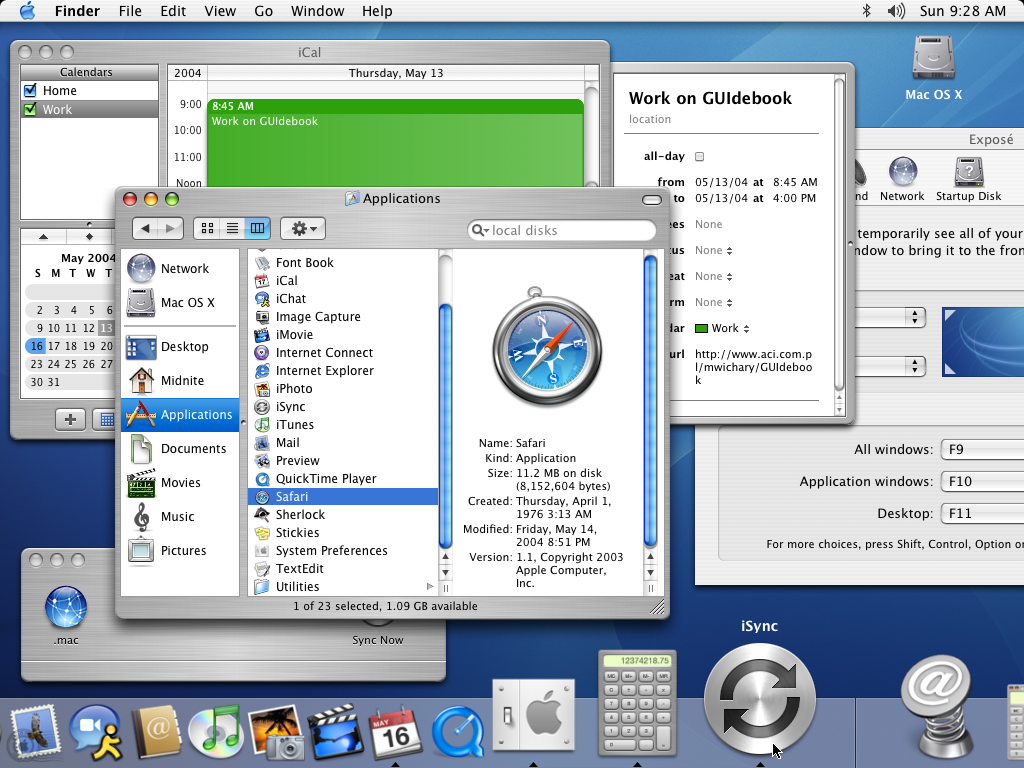
Ditto for anyone not using the Apple ecosystem. Better tested drivers installed by default, no OS license hassles, no issues created by malfunctioning (or maliciously functioning) antivirus, top download sites weren't infested with malware (no hunt for the real DL link), journaled FS in the consumer tier for instant fsck since 2002 (vs 2012), no-additional-cost professional-grade IDE since 2003 (vs 2015), one-click backup since 2007, decent integrated movie editing, some truly awesome platform-specific-at-first apps (subethaedit, quicksilver, textmate, coda), solid one-button-away desktop search years before it landed and stabilized in Windows, window navigation with expose (they've arguably been leapfrogged since then with window snapping), unix command line with a decent terminal emulator, emacs movement supported in every text field by default, built-in menu bar search, the list goes on.
I now have both feet in the Windows ecosystem but the transition was rough. If you have used Windows all your life, you have taught yourself to live with a lot of BS. Since you have made the investment it's now a sunk cost and no longer factors into your OS decision. Fair enough, but realize that wasn't the case for everyone. Also realize that you necessarily didn't miss what you never knew you could have.
I use the past tense because MS has caught up on most of these fronts, except for perhaps stable drivers and license hassles, where they are hobbled by their business model rather than technical shortcoming.