This is why I detest touchscreens for most car functions. Specifically AC, with old fashioned knobs I have full control over AC without taking my eyes off the road, but nowadays everyone wants to put it on their infotainment system, hidden beneath 4 other buttons.
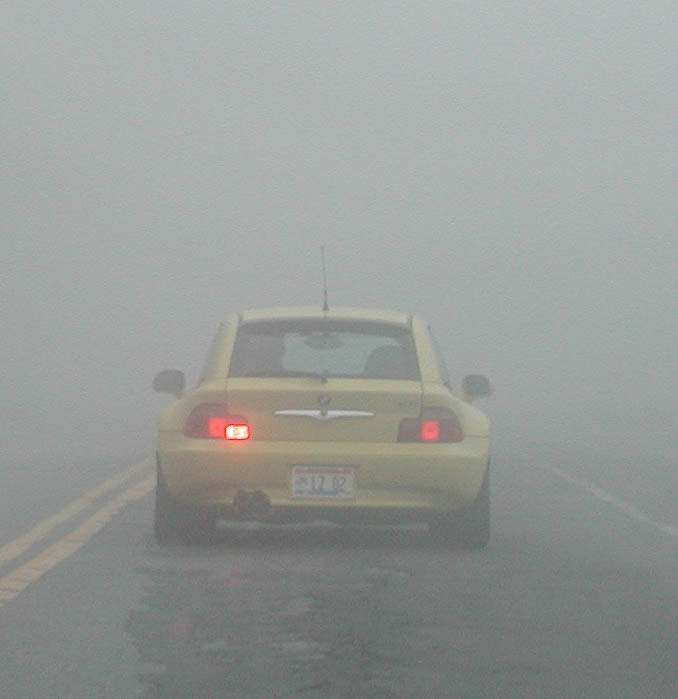
Yesterday I was driving back from Scotland to England, doing 70ish, when we ran into a really heavy thunderstorm. Went from good visibility to almost zero in seconds, and the only thing I could properly see was the crash barrier alongside the lane. I found myself desperately trying to see where the road was, simultaneously trying not to get rear-ended as I slowed up, switch on the rear fog lamps and hazards, max wipers, and select max demist because suddenly the windscreen had fogged up. Was one of those thankfully-rare maximum mental workload moments. Thank god for manual controls and muscle memory. Pretty such I wouldn't have had enough spare attention and/or brainpower left over for operating a touchscreen.
Honest question: Why don't modern cars yet monitor humidity in and outside the car and make the correct decisions to keep your windows clear? Why are we focusing on self-driving cars while our cars are too dumb to do this much on their own?
It isn't caused by any specific humidity levels. While it is depositing water droplets on to the glass surface, that same water is normally suspended harmlessly in the air (it is effectively de-humidifying the air onto the cold windows).
It is caused by the glass's surface temperature being much lower than the air temperature inside the car. Humans are warm. The air we breath is warm. We're heating up the interior of the vehicle. When that warm air contacts the cold surface of the glass, the water droplets migrate from the air onto the surface.
In order to detect it you'd need to know the glass's surface temperature ideally in the middle (away from the car's body) and also know the interior temperature. The interior temp they already have. But figuring out the glass's temp is non-trivial. Infrared camera is the only thing I can imagine working (since a sensor wouldn't be transparent or wouldn't be replaced when the glass is) but that would likely give inaccurate readings due to the outside temperature.
Yes, but could we maybe get a decent approximation of the windshield temperature from interior temperature, exterior temperature, and speed? Combined with interior/exterior humidity (maybe these gauges might be the expensive/finicky part of this project?), we could calculate a probability of window fogging.
It doesn't have to be perfect -- we can have it just turn on the defrost whenever the probability of window fogging is >10% or something.
Could glue/epoxy a sensor right behind the centre mirror I’d think. It’s far enough from the defroster vents that it wouldn’t heat up quickly from the hot air.
You could do one of two things. First, a heated windshield like I believe some Landrovers have. It’s about $5000 to replace, last I heard, but it works. Second, a double pane windshield like house windows or some motorcycle helmet face shields. These work 100% of the time, but would definitely be more expensive as well.
Best car I had for window defrosting/demisting was a Ford Mondeo which had a fine-mesh heating element embedded. Super fast clearing. More expensive than regular glass but not $5000 by a long shot.
I had a Honda Accord with a cracked radiator.... It defrosted right quick, but idling it after it warmed up was very ungood. After the radiator was replaced defrost went back to normal.
You can get it for most Fords. It's one of my favorite features, and any car maker that caters to the more northern people should have that option.
When it's sort of cold, but not "ice on the car" cold, it works great as defogging. Way faster than waiting for the car to heat up. When there is ice on the car, you turn on the heaters and within a minute or two you can simply use your wipers to clear the window of ice.
It's not super accurate, but most cars these days also have outside temperature. Add a humidity sensor inside and outside, and we have temperature and humidity inside and outside the car, which should give us enough information for a basic microcontroller to approximate the temperature differential across the glass and whether or not fog (or frost) is likely.
I think knowing the temperatures and such amounts to predicting the foggy state. Detecting it could look much different. Visual observation is obvious. With purpose built glass, perhaps one could look at electrical properties on the inside of the windshield. Maybe changes in the reflectivity of the glass could be used. Maybe some refractive index shenanigans?
Or simply look for reflectivity at an angle, like the recent HN story about the guy who implemented a touchscreen on his Macbook by adding a small mirror to the camera above the screen.
> In order to detect it you'd need to know the glass's surface temperature ideally in the middle (away from the car's body) and also know the interior temperature
Or, perhaps more simply, have an optical sensor that detects and reacts to the fogging itself sooner than a human would.
Wouldn't it be easier to point a camera at the windshield and detect a change in opacity? I would think that's a far easier problem to solve than, say, facial recognition.
Not really. Many windshields already have elements embedded in them like the ultra-thin wire used for the AM radio antenna. Sensing temperature via the resistance of a wire like that is about as trivial as it gets.
Because when the sensor goes screwy I don't want my car to start flipping shit like the defroster on when it's not needed? Because manual controls make such automation totally unnecessary? Because even if the automated system were designed to be "fail safe", the state that's 'safe' is actually context dependent, therefore manual controls will be necessary anyway?
The problem is the current solution doesn't work. Because trying to perfect those settings manually while driving in near zero visibility is scary and dangerous. And nobody even knows the correct settings to use! There are YouTube videos testing whether cold or warm air is the fastest way to defrost and/or defog your window, because nobody knows or remembers.
I honestly don't remember and my solution is "try both for a little bit while maintaining control of the car".
I just leave the defrost on when it's raining or cold regardless of whether my windshield is fogging. No need for an automated system and my windshield never fogs up.
it's really not that complicated, you just have to understand why condensation is happening in the first place. it's always because the glass is colder than the moist air it is touching. there are two strategies to deal with this: either blow air with very low relative humidity over the glass, or fix the temperature differential itself. if you're using the "blow dry air" strategy, you always want to turn on AC and at least some heat, as this will create low relative humidity.
now in the winter you can sometimes do better than this by fixing the temperature differential itself. you can either lower the windows or cool the entire interior by blowing air with no heat. in reality, most people don't actually want to drive around in the winter with windows down or no heat, so the best tolerable option is usually to do as above: turn on AC and heat.
in the summer you can also get fogging on the outside of the windows. just use your wipers for this.
Both work, one is just faster than the other. The post you replied to seems to imply that cold air is better in the winter, but that is absolutely not my experience.
When I get in the car in the morning, the air is already cold. No amount of more cold air from the vents will clear that. What's making it fog up, is the moisture I'm exhaling. More cold air is not going to fix that unless I drive with all windows down. So the only reasonable option since AC don't work at low temperature, is waiting for the car to heat up.
tl;dr of my post: turn on AC and blast hot air at the windshield. if that doesn't work in the winter, open your windows. if it doesn't work in the summer, it's because the fog is on the outside of the windshield; use your wipers.
In my car there is a front window defrost button that turns on the a/c (to dehumidify) but also the heat. Dry warm air does the best to remove condensation.
Perfect the settings? I've never driven a modern car that can't do it perfectly well when you hit the demister button. You're well overthinking things.
Manual works just fine. I just drove clear across the Trans-Canadian Highway, east to west, in a car with manual controls and it all worked great. Your eyes stay on the road because sober people can reach out and grab objects, like knobs or buttons, without looking. If the matter of defrosting confuses you then maybe you should sit down in your car for five minutes and learn how the multi-ton machine works before attempting to operate it; you owe that much to the rest of society. Don't ruin a car just because you are too lazy to work a damn knob.
(Warm dry air evaporates water that's condensing on cold surfaces. That's very far from rocket science.)
One: I think we can discuss this without condescension for anyone who doesn't agree with you.
Two: You are making a false choice: Automatic settings need not replace manual ones. Essentially what we are talking about is a spot on the dial that says "auto" which you are free to not use, much like headlight controls on higher end cars.
In practice the introduction of high-tech options reduces the availability of the manual options as manufacturers seek to reduce costs. Touch screen AC controls don't supplement manual controls, they replace them. This leaves people without irrational infatuations with tech high and dry, hence why I'm annoyed at anybody who advocates for it. If you've been in the market for a new car recently you'd see what I mean. Considering the state of the automotive industry right now, I think my comment was gentle. The suggestion that defrosting windows should be a matter delegated to a computer because it's confusing made me roll my eyes so hard, I was nearly blinded.
But cars already have this. My 2014 Ford Edge has front/rear defrost/defog buttons and they work just fine. As "liability" said, the answer is warm, dry air which happily works for both the defrost and the defog requests.
Well, they worked fine, but my A/C just went out, so getting dehumidified air is a problem these days.
Sure, but the marketing department had to fill a few blanks in the "bad weather options pack" (optional but casually installed on all cars in production that will be available in the next six-eight months) for a mere US$ 3,000:
1) self-learning wipers (using AI to set automatically an appropriate wiping speed, including economode, that only wipes the right side of the windscreen when you make a free turn on right at a traffic light)
2) intelligent defrost (computing the correct defrost temperature through analysis of real-time satellite heat maps)
3) heated and ventilated mats (that can dry your wet shoes and lower half of trousers independently from heating/confitioning settings)
I hope you make an artistic statement and patent some of these awesome ideas. 1) for conversation starter purposes, and 2) so that we can make sure auto manufacturers never actually do this, or at least you get fabulously rich in the process...
I'd rather have the AC system dehumidify outside air, then reheat it before blowing it on the inside of the windshield. Most car HVAC systems make AC and heat mutually exclusive.
Dry hot air to heat the windshield above the dew point avoids the "damned if you do, damned if you don't" choice of cold dry air to keep the inside from fogging up versus hot humid air to keep the outside from fogging up.
It's not a matter of temperature sensing on the windshield, but humidity sensing in the cabin air.
Automatics are great when they work. I do have automatic wipers, which usually work pretty well. Fortunately they didn't remove the manual controls though because I had a boat on the roof yesterday, and the rain sensor behind the rear-view mirror didn't really see as much rain as I did.
There is a max-demist button, which for me is the perfect automatic function - it says what I want, and lets the car get on with selecting max fan/heat/AC/flow to the demist vents. And I can find it with muscle memory when I need it.
This is the Airbus v Boeing problem. There are two schools of thought, one being that you the operator can control all the settings including the ones necessary to avoid the fogging. There are others that do so automatically. So many times people would be aggravated that my a/c would turn on with the heat in my Audi. What they didn’t realize was how that prevented fogging of the windows which inevitably would happen a few min later. I noticed my current car also does this but it turns itself on after the heat has kicked in.
Thats why a good notification system comes in different levels. Like red and big for important messages, blue and small for information like "heating windshield".
Some cars have do two batteries, one for start/stop and one for everything else. (For example, some Mercedes have these, Suzuki "mild hybrid" cars, etc.)
I know about the Mercedes but did not know about the Suzuki. My main point though is that this is not a feature in your bog standard Honda Civic or Toyota Corolla or Ford Fusion. I think it should be, it's a huge safety and convenience feature. That it is not in your average car implies it's probably too expensive for the utility it offers the average person.
Personally I solved the problem by buying a lithium ion car starter for both of our cars. Works great, but I really would prefer the cars just had some redundancy built in.
You just have to be picky when you choose cars; my twenty year old Land Cruiser came with twin batteries factory fitted - though rather than one for starting and one for all the thingamajigs, they went with two beefy ones in parallel - 2*105Ah makes sure it starts every time.
I have been contemplating using the second one as an auxiliary battery after installing a fridge in the boot, though. Basically a matter of fitting a voltage monitor and a hefty relay.
Two beefy ones in parallel don't really solve the problem. If you leave your 1-Amp (probably a gross underapproximation) headlights on over the course of ~200 hours, you'll deplete the battery.
-It doesn't solve the problem (which is why I am considering splitting them now that I have added a ~1A consumer to the mix), but it does postpone the problem for long enough to (in most cases) ensure that you will realise your mistake before it causes you not to be able to start your car.
Leaving the headlights on (~10A) as you leave the car in the evening will still let you start it in the morning, for example.
It's an add-on you can choose for cars, if you want to. A lot of service vehicles in Australia have 2 batteries for this reason. 1 for the vehicle, the second for chargers (USB, DC, etc), routers, fridges, cameras, etc.
on the other hand, AC is one of the only electronic features that causes a meaningful hit to fuel economy (and available power, if you have a weak engine). I very much prefer to decide for myself when it turns on.
Some cars do that automatically - in which case there are tons of complaints about the car turning on the climate control automatically. This is something where you just can't win...
they do but people resort to hyperbole all the time to justify their hatred of touch screen interfaces or just interfaces they do not like.
there are bad touch screen systems and there are good ones. just as there are badly laid out physical controls and good ones.
even muscle memory works with touch screens, to say otherwise is just a lie. however the biggest oversight people tend to ignore is, how little they actually interact with controls of their car other than the turn signals and such. Most modern cars have full climate controls which does include humidity and such, many have automatic lights and wipers, and some go as far as doing the driving.
nineteen to twenty four buttons on steering wheel is just fine and intuitive to some just like the same number on a center console yet these same people will complain about the simplicity of a properly design touch UI and fewer physical buttons as being too complex.
Or fewer. The only time I ever see them on is when it's a clear night and I'm getting blinded by the person in front of me. That said, they are pretty useful for more than fog... They're good for flashing at people behind you who don't have their headlights on.
...a rear fog light is an additional parking light on the rear driver side of your car to help other cars identify the width of your car in foggy or other incline to weather situations. They are not brighter than any other light that would regularly be present on that car. If it is brighter and blinding as you say, rest assured the car has been illegally modified and is subject to constant harassment by police in all other jurisdictions!
In the all cars I've owned, rear fog light is brighter than regular rear lights. Not sure if they are brighter than braking lights, but brighter than "position" lights for sure.
I've owned three cars with rear fog lights and all of them came from the factory with the rear fog light(s) being brighter than the rear parking lights. That makes sense too -- because if rear parking lights were bright enough for fog then you wouldn't need rear fog lights.
In cases like this I love the radar cruise control in modern cars it very accurately shows what's ahead even when you can't see anything. Agree with your conclusion some of the latest luxury cars have touch screens and the UX is awful.
Eyesight on my Subaru would fail as well. Manual basically says “if you can’t see, that thing can’t see as well”. It uses two cameras after all as well.
In the UK taking a train is often (but not always) more expensive than driving and can take longer too. Depending on the route there might not be a viable service. The service in bad weather isn’t very reliable either.
But for some routes it’s really easy and convenient. It just depends on where you are and where you’re going.
I didn't take the train because I was transporting my son's sailing boat back from a competition. Also the train line was flooded yesterday, so that wouldn't have been an option. But normally that's not a problem, and I agree, if I'm just transporting myself, I do like the train.
You know, when you take your drivers test in the US, you have to demonstrate your ability to know where all those functions are before you even pull away to start your test.
The real question, as I found yesterday, is can you switch on high-speed wipers, rear fog lights, hazard lights, and max-demist, in a few seconds, while you're devoting 99% of your brainpower to not crashing into an unseen vehicle slowing in front, not veering out of the lane that you can't really see, and glancing repeatedly in the mirror in case you're about to be rear-ended.
The question is not whether you can operate the controls under normal circumstances. It's whether you can do it when task-saturated with more important tasks. Under such circumstances, I simply wouldn't have had any attention left for glancing at a touchscreen, but I did know and could hit all the manual controls rapidly without looking.
The answer is you focus on dealing with what's in front of you, so turn on wipers and demist. If all the drivers do that, then no one needs to worry about what's happening behind them. After you take care of being able to see and control the car, then you worry about rear fogs and hazards.
And if it's really, really bad, pull over. Don't be like those idiots who decide to stop in the middle of a highway with 75mph traffic around them, under an overpass to protect themselves from a hailstorm.
This is like the arguments that C programmers just need to be more careful about errors. We know that people make mistakes, get distracted, and get older. Real engineering is about designing systems which work well in actual conditions, not some unrealistic ideal case assuming perfect conditions.
It’s also simply wrong: in California, I had to show use of turn signals – not anything else – and no other place I’ve driven since has ever made me pass a test again. Assuming that everyone reads the manual and practices with every new vehicle is unrealistic, so you’re looking at potentially half-century lags between what’s tested and what people are driving.
About as well as the rest of the country, with the possible exception of Maryland, where they’re used to decoy people by indicating the turn required by the lane you’re in as opposed to the turn three lanes over you’re actually going to make.
I actually wonder whether google maps / Waze integration would be a worthwhile improvement: self-driving cars are a good ways off but simply signaling the direction which the driver was just told to turn would be nice, and a majority of drivers seem to be using mapping apps these days.
It is by far the worst state (or province) I've lived in for lack of turn signal usage. I want to get a bumper sticker that says, "Your Turn Signal is Broken".
This depends on the state/region. There's no universal standard in the US, and some states definitely don't require the operation of all of these controls before the test.
And just like when they learn to use the shifter, they need to learn what that thing on the other side of the steering wheel does too before driving off whether it's tested or not.
I commend you on your attention to detail under every circumstance, but not everyone masters the windshield defogger (to the point where they don’t have to look at it) the moment they sit down in a rental car.
This was not my experience in New York. You don’t have to demonstrate anything other than knowledge of where the turn signal, ignition, brake and gas pedal are.
I had a top model Mazda 3 2014 before (manual Astina) as the #2 and everything about it was just first class usability wise.
The rotary navigation knob let me do everything on the screen, and all the buttons for everything else were in intuitive places. Also a great radar cruise control, simple yet highly functional HUD, and things like rear cross alert which is amazing when backing out of 45 degree parking spots next to some big trucks.
As much as I'd love a Tesla as my next car I'm not sure if their UI is where I want to go.
Old Panamera and new Panamera. Disgusting and disorienting touch controls. I honestly can’t tell why would anyone prefer touch controls. I also can’t honestly tell how is Tesla’s screen street legal.
I have knobs on the climate control on my car, but I still need to look at the screen. The problem is the knobs have no stops so I still need to look down to figure out what they're set to after they update the electronic display. On my old vehicle I knew the whole way to the left was fan blowing on feet, whole way to the right was defroster, and the 2 or 3 clicks in between were different settings of those extremes. Now I have no idea where it ends up when I spin the dial.
I'm not sure why dials have stopped clicking. Maybe it had some direct mechanical function at one point, but even if that's no longer necessary, the haptic feedback of the click seems just as important.
In fact, even on touchscreens there will often be some sort of audiovisual "click" effect, whether that's an icon lighting up, expanding, or making an audible click noise.
That’s the thing it doesn’t stop. It’s just a rotary dial with the lightest detents I’ve ever felt. You just spin it and it’s a circular buffer through every setting.
Agreed. I consider them dangerous, a threat to public safety, they should be banned by the NTSB, and some cars that use them should be under recall to retrofit them with mechanical controls.
Many states are now passing hands free laws that criminalize the use of phones or any other devices that use your hands while driving. The states provide exceptions for car touch screen use, but they shouldn't. They should criminalize the use of all touch screens when driving, not just some.
For the life of me I can't understand why touch screens built in to a car are considered "different" than phones. Cities and states are finally waking up and making it a crime to use your phone while driving, how in the world are car touch screens any different?
I suspect it's more because using your phone is almost definitely not controlling the car, while using a touchscreen that is part of the car's controls is still technically considered "operating the vehicle" and thus not a distraction, regardless of how difficult it is to actually operate.
I had this discussion with my teenage child this week and neither of us are sure. Our state requires handsfree phone use but has the car touchscreen exception. Would operating Android Auto or CarPlay be illegal or does it fall under the allowed exceptions?
Absolutely agree. Controls with tactile feedback are literally lifesavers when you're trying to pay attention to the road. Touchscreens are cool, but all the basic controls should be presented as neat panels of knobs and buttons that don't require so much as a glance to operate.
You're not the only one who detests touchscreens in cars. Mazda agrees with you[0]. I think touch screens are primarily useful for complex interfaces and interfaces that change every time. But driving a car needs to be as easy and reliable as possible, because you need those eyes and brainpower on the road, not trying to figure out an interface.
There’s a part of me that misses T9 texting on my cell phones. There was a time that I was very good at T9, and because it was deterministic (with auto complete off) you could text without looking and it’d text exactly what you meant. Definitely can’t do that now, and voice controls aren’t as good.
I'm going to repeat a comment I made a couple times before as I think it's relevant:
In one of the talks at Google I/O a few years ago a VP from Audi (or Volvo?) spoke in a thick and lofty German accent about how "ve haf completely oferhauled ze driver exzperienze". He played a sexy video clip showcasing their new Android infotainment system (something like https://youtu.be/h_7_fKJ0PNs), and the first thing I noticed is how they'd taken away my traditional temperature knobs and replaced them with digital touchscreen ones. They looked just like physical ones, and were in the exact same place you would expect (https://9to5google.com/2017/05/15/android-cars-audi/). So, I've gained absolutely nothing, and now I have to take my eyes off the road and look down at the stupid console just to change the temperature.
TLDR: Tacticle feedback is a Good Thing(tm) and designers should cultivate - not fight - muscle memory.
The emergency brake. I really need that to be a mechanical lever and not an electrical one. If something is going wrong on the road I need a backup brake that takes me under a second to activate while in a state of panic with my eyes glued to the road and it had better be functional.
That’s the worst thing you could do. You block your wheels and you totally loose control over the vehicle. ABS enabled bakes do stop you quicker while maintaining control over the vehicle.
This is often repeated but not the complete picture.
Modern, knob based, vehicle climate control systems actually bury a lot of functionality. For example Toyota's "automatic" AC you can either pick between fully automatic or a subset of manual controls. That's because they ran out of space/complexity headroom for more controls.
Touch screen climate control integrates better with voice (which you should be using while driving), offers better fine-grain control, more information (like CURRENT interior temp rather than just outside/target temp), and can offer new functionality (like profiles/pre-sets, additional automatic modes, memory climate, linked seat heat & cool/positional vents, etc).
I dislike several touch screen based climate control systems I've used. But that's because they're BAD. Car manufacturers are bad at making touch screen systems. But let's not throw the baby out with the bathwater. There's a lot of good reasons to go that direction, car manufacturers just need to work on UX a lot.
I feel like you're making some very false choices between smarts/voice compatibility and physical controls. Physical buttons and dials for users to interact with that still can be changed by the system are wholly possible. For instance, a rocker switch that sits in the middle can be used to issue on and off commands, while being separate from say, a status light that lets you know whether the device is on or off.
Which is to say, I think you're significantly limiting what you believe is possible with physical UX.
Voice controls suck and are exclusionary as fuck. Maybe they work for the subset of the population who natively speak a very standard dialect of American or British and have no speech impediments; for those people it's just an annoyance to have to pause the podcast or music.
For the rest of the population of this planet, voice controls are horrible; either the user doesn't speak the supported languages at all, or speaking the supported language doesn't come naturally and switching to it requires mental effort, or it's an infuriating experience to try to make the bloody machine correctly interpret what you're saying.
That's even ignoring the complete fucking shit show that is software trying to understand natural language and infer meaning, without just turning it into a tedious form of a command line interface.
> For the rest of the population of this planet, voice controls are horrible
Please count me out. I'm a non-native English speaker, with a strong accent, and I'd absolutely prefer voice control over having to:
1) Remove my right hand from the steering wheel, reaching forward where the controls are. There is a good reason all important controls (besides pedals) are on the steering column.
2) Either a) moving my eyes away from the road for a moment, looking for the knob; or b) trying to find the exact controls by touch and memory.
> an infuriating experience to try to make the bloody machine correctly interpret what you're saying
Machines are limited - and despite marketers wanting us to believe otherwise, I don't expect them to display comprehension natural human languages better than my cat does. Like I query search engines with keywords and special syntax, and not proper sentences, I expect to communicate with the machine in a special, non-natural language.
Restricted speech recognition with strict grammar and limited vocabulary works quite OK those days. It's the general-purpose voice recognition and "smart" assistants are things that suck hard.
Heck, maybe I'm a total weirdo, but I'd rather learn a special conlang than reach for AC controls by touch.
> Physical buttons and dials for users to interact with that still can be changed by the system are wholly possible.
Sure, but irrational. One of the largest benefits of physical controls is physical feedback, like being about to feel if you've reached the max cold/hot ceilings or the state of the switches.
To make them voice compatible you have to remove that physical association (e.g. infinite spinners, or blind switches), which means now you need to take your eyes off the road to use them, which was major perk of physical controls.
Physical controls that have no physical state are the worst of both worlds. You've lost the physical and electronic control's advantages while adding the disadvantages to both.
At least you can find it without taking your eyes off the road. This works fine for fan power, where you know when to stop based on what you feel, but not so much for temperature, where you can’t immediately tell what’s right.
One of my friends has a motorized knob he uses for volume control- shr wrote a script that relays the current volume to the Arduino that controls the whole thing.
It's awesome- I love that thing so much and have parts on the way to build my own.
I think the issue is more bad integration than it is a bad idea.
A VFD or 7-segment display next to a pair of buttons for up and down works quite well for temperature control, and lets you integrate it nicely with digital controls.
The issue here is not that it's impossible to integrate the analog physical and the digital aether- it's the implementation that's oft lacking.
>Touch screen climate control integrates better with voice
That's a false dichotomy. Tactile controls doesn't mean you can have electronic logic behind them, that you can talk to in alternative ways (e.g. through voice).
Also, I wouldn't say the whole BS added to modern "climate control" (i.e. bloated AC) systems is much of an improvement...