Out of interest, why do you prefer a salt grinder? I've never understood why these exist. Pepper grinders, absolutely - the aromatics are released on grinding. By not so with salt. Curious if I'm missing something.
I've asked my mother the exact same question a couple of weeks ago. She said, that as salt is hygroscopic "table salt" comes with anti-cacking agents. Salt which comes as larger crystals doesn't need them.
I guess it'd depend on what the agent was, but either way, it means some amount of the salt you're pouring over your food isn't salt. Eliminate the non-salt from your salt and you never have to worry about what might be wrong with it or how much non-salt you're paying for. That's the reason I've switched to shredding my own parmesan cheese instead of just shaking it out of a can since the cans in some cases contain ~10% cellulose.
Table salt is just sea salt (the stuff mined from underground just comes from an ocean that dried up a few million years ago) and is full of other compounds beyond NaCl.
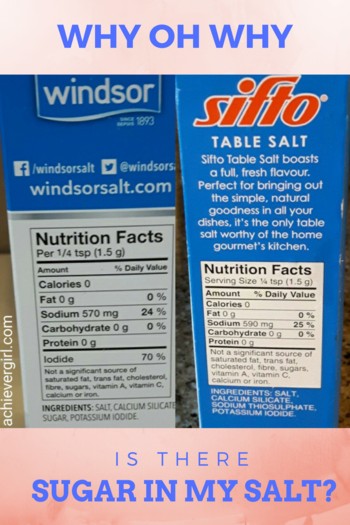
EDIT: I looked it up. It's supposed to stabilize the iodide. The reason they use corn sugar is that it's cheap. Thankfully there are brands that don't include additives in their salt. I'll have to keep an eye out for them. I already get plenty of iodide in my diet.
With ferrocyanide in particular ([Fe(CN)6]4−), the reason cyanide (CN-) is such bad news is also the reason it's safe complexed to iron: Iron-Cyanide coordination is very strongly favored by thermodynamics and kinetics, so it likes to stick to iron, sticks very quickly, and un-sticks itself very slowly. When cyanide is not already coordinated to iron, it coordinates to the iron in hemoglobin (+ COX enzymes in mitochondria, and other less immediately important enzymes) and makes them not work, basically forever. But when CN- is already stuck coordinated to free iron, it doesn't really fall off enough to stick itself to enzymes in any meaningful amount. It would be more of a problem if CN- accumulated, but it's metabolized and excreted quickly enough to not be a big deal. The LD50 values basically reflect this.
No, it doesn't, because sodium ferrocyanide is poorly absorbed in the first place and not bioaccumulative in humans. I suppose you also don't each spinach or almonds either?
"spinach" nope and of almonds not too many either.
But my point is, sodium ferrocyanide intake is not beneficial, (unlike ordinary sodium). Even if it might do no harm, why should I risk even little harm?
And with adding up, well there is a whole libary of other toxic or potentially toxic additives in the normal food you can buy.
I prefer to minimize the potential bad intake, that's all.
As well as in any processed food I am buying, yes I am aware of that. But when I have the choice, I prefer the non toxic salt
(and it is still mindblowing to me, how it became normal to add cyanide to salt in the first place).
Yup, there are cheap salts with their own toxins and even expensive Himalaya salt can probably contain bad stuff.
But at least here in germany, there are (non government) organisations that test food for their poisons and you can buy their test results, also for salt, in the shape of a magazine.
And even they can be wrong, sure, but I can still avoid poison where possible, so if I see no reason to voluntarily add cyanide on top of all the other shit for no good reason, I simply won't.
That’s not enough to justify the grinder. Buy a box of Diamond Crystal Kosher salt. It has the perfect texture for keeping in a salter on the counter so it’s easy to grab a pinch.
I use salt flour for popcorn; it's essentially salt that is milled as fine as flour. There was a study (which I can't find now) which found that our perception of saltiness is based less on amount and more on surface area coverage.
It's sometimes just called "popcorn salt" and it's exactly as you describe. (And it can also be made at home from regular table salt with a food processor or mortar & pestle.)
I take a trip to the bulk-barn often enough to get “Butter Salt” it’s powdered and yellow. I suspect it’s what goes into the packages for the movie theatre.
I've never seen on-the-spot ground salt smaller than the stuff you can buy already grounded. Except if you buy flakes, but then why do so if you want finer salt?
It's just culinary cargo cult. You grind pepper and other such things because the flavor survives well in the peppercorn but degrades relatively rapidly in air, so waiting until the last minute to grind it results in better flavor. Oxidized pepper is easy to notice the difference in flavor profile and much lower complexity. Especially the pepper shakers that have been sitting at the restaurant table probably yea verily these many years, mostly unused.
Therefore, grinding things at the last minute makes them taste better, goes the simplification.
Therefore, grinding salt must make it taste better.
But salt is not like the aromatic flavors in a peppercorn. Salt is geologically stable. NaCl itself does not need a last minute grind to retain its salty flavors. NaCl is not a chemically complex flavor.
I qualified that as NaCl specifically because it is faintly possible some of the fancy salts could have their fancy flavors come out better if they are ground, but I'm yet to even notice a difference when any of these are used in food in any manner so I can't judge. Those flavors must be awfully darned stable as it is if they're still hanging around in a 99+% NaCl environment. I'd want to see a specific chemical that can survive that but will suddenly wilt if exposed to oxygen. (We're sure not talking about traditional benzene-ring aromatics at that point!) If there is a difference it is hovering at the very bottom of human detectability.
Salt grinders are annoying. They're hard to use because you're trying to grind a rock, a soft rock sure but still a rock. It's wasted effort, and it occurs to me to wonder if they even do anything to speak of; now I want to find one and compare the before and after of the chunk size; I find myself suspicious that many of them are just theatrics and the salt basically passes through unscathed because "cheap plastic" and "grinding a rock" are not compatible with each other. Even if it does do some real grinding it's still a waste though because it was never necessary, you could just have bought it at the right grain size.
The reason you'd use a salt grinder is when you specifically want an inconsistent spread of grain sizes in one single application. Like salt flakes on ganache or caramel, or there's a beloved french butter with large crystals mixed into it.
Usually you'd just use two sizes of salt. I don't own a salt grinder, can't remember ever seeing one in a professional kitchen, don't recommend people buy them. But it does produce a particular effect that you could prefer for some applications.
And in fact I suspect popcorn might be one of the places where it would shine. An even background of salt dust with bursts of intense saltiness from larger grains sounds good here. I'm not going to buy a salt grinder to test it but it's not an absurd idea.
I think you’re misunderstanding the use. It’s a different goal from grinding spices. It’s functional. And I’ve never seen powdered salt selling anywhere in Canada. (Except for expensive artisan stuff). So, the best way to achieve it is with a grinder+rock salt. I’ve been using a simple Amazon grinder and it’s easy to use.
Powdered salt tastes different not because of a differing chemical composition, but because of its different physical nature + your tongue.
>It’s a different goal from grinding spices. It’s functional.
Or... it's an after the fact rationalization for the cargo cult!
At best this might be your goal, for whatever reason. 99% of the people who cargo cult a salt grinder don't have that reason - and regular sold salt would be 100% OK for their purposes.
Okay c'mon now, are you even trying to understand/empathize with their argument at all?
Right off the bat any real consideration will make you aware that large particles will distribute very differently from small particles of the same volume.
Additionally that large particles will be substantively different from small particles in how they interact with the toungue. Eg large particles will "burn" more due to their extreme concentration and will be effectively "hot spots" of seasoning.
From just that it would be apparent that there would be truth to the claim of substantial difference in experience when using the two forms.
In my neck of the woods, unground salt is much, much cheaper than ground. Ground salt can basically be only found coming in a plastic dispenser. It could be argued that throwing all these plastic containers away isn't great for the environment.
I only realize that I've never thought of comparing, but I've got the habit of using unground salt when cooking. My grandmother used to do this for some reason, so I picked it up.
Unground salt is also useful for cleaning things, like cooking pans.
It's therefore easier to only buy salt in one big pack that lasts forever.
In london at Canary Wharf there is a 'German' pub that serves pretzels without salt on them! I tried explaining that they are all crinimals but they were just really confused!
For pop corn you need fine grained salt. A grinder lets you control that. It is only about the grain sizes. Nothing about freshness with salt.
With pepper it is about freshly releases aromatics.
I’ve never found a salt grinder able to sustain the salt corrosion in the long run. Sooner or later, salt is aggregating and turning even the more resistant parts into rust.
I was recently planning to get back to a regular pestle/mortar setup after yet another costly failure.
Did you manage to find a way to work this around?
What timescale are you talking about? I have a William Sonoma salt grinder, as well as one that my friend made for me. They're both about 5 years old. As far as I know there's no significant deterioration on either one. The grinding surfaces are ceramic.
A coffee grinder will quickly make a lot of really fine salt. I do that when I need to heat treat 3D printed parts to improve their material strength. You pack the part into fine salt, bake it at the original extrusion temperature, then slowly let it cool down. The plastic liquefies, and the packed salt holds its shape.
If you want a really fine grind in a hurry you can use one and get ok results. You have to let it rest every 30s or so to cool down or it heats the grounds too much. I liked to shake it while grinding too. It isn't quite Turkish grind and there are a few large pieces that won't get full extraction, but if you want really fast extraction (or fast intentional over extraction) it works.
And salt is a lot harder than a coffee bean. Blade is probably a really weak/soft metal. Might be harder than salt on the Mohs scale, but that just buys you time.
Blade also gets kicked around more going around the salt instead of grinding through, more bending = shorter lifespan.
You do need 100%, otherwise you'll end up with a void at the top once the plastic melts. You could experiment with intentionally designing in a "sprue" of extra material to melt and control where the void is, but I haven't tried it yet.
I've successfully used this method on a sun gear for a planetary gear box designed for a low speed, high torque application. Due to mechanical constraints, the gear only had about 1.2mm of wall thickness at a 5mm radius, and it was prone to shearing off. Remelting it in salt solved the shearing, without having to redesign anything else.
The shapes of the crystals affects the taste. If the salt is going to be dissolved, such as in pasta water, then grain-shape doesn't matter. Use the cheapest salt. But if the salt is going onto the surface of a food, such as in popcorn or a steak, then fresh-ground salt gives a more salty flavor per gram used. The salt grains that come already ground have a smooth texture like the smooth pebbles in a creek. Fresh-grinding gives the crystals a jagged, irregular shape. This enhances the effect when they hit your taste buds.
My conjecture: salt grinders create more irregular shapes than provided by commercially made table salt. Irregular shapes mean more surface area, which means faster absorption into the body, which means tastier food.
I'm a big fan of tomatoes, and one of my favorite dishes is sliced tomatoes, salted, and eaten with cheese.
For some reason, normal salt just sticks on the top of the tomato despite it being wet and I can "taste" the salt not just saltiness. However, with crunched salt crystals, they basically dissolve and disappear into the moisture of the tomato. This just tastes better too.
Don't ask me why or how it all happens, it's just what I've found using my taste buds.
Probably the anti-caking agents in the normal salt absorb some of the wetness and have it stay clumped up instead of diffusing through the tomato liquid
This comment reminded me that for the past few years I’ve been using a hand crank coffee grinder for my pepper and i don’t think I’ll ever go back. It’s perfect.
> Some salts mined in Pakistan are not suitable for food or industrial use without purification due to impurities... Although a study of pink salts commercially available in Australia showed Himalayan salt to contain higher levels of a range of elements, including calcium, iron, magnesium, manganese, potassium, aluminum, barium, silicon, and sulfur, and reduced levels of sodium, compared to table salt, the authors concluded that "exceedingly high intake" (a level in excess of the recommended daily salt intake by almost 600%) would be required for the differences to be clinically significant, levels at which any potential nutritional benefit would be outweighed by the risks of elevated sodium consumption such an intake would entail.
Well, iodine is required for life so you better get some elsewhere, like from a supplement. It's not present in sufficient amounts in water or plants these days...
Lack of iodine in the diet was an issue 100 years ago, but not so much now.
According to the National Institutes of Health’s Office of Dietary Supplements, tests have shown that the population in the United States is “iodine sufficient.” Most Americans who eat a varied diet get enough iodine even if they don’t use iodized salt. They are at little risk of iodine deficiency*
It links Americans being iodine sufficient to getting varied diet but that’s not a conclusion made by the source from what I can see.
The article also says bread is a good source of iodine when the source says it’s a very poor source of iodine.
So I think the article is making stuff up, linking a source but hoping no one will actually read it, and probably written by someone trying to get iodine supplements removed.
Normally I’d expect to see this kind of writing from some blog but not the NYT.
It’s worth it for anyone to read the article. Plenty of circumstances that could lead to deficiency.
I think the “varied diet” usually means Americans get enough through non-home use iodized salt (like processed/restaurant foods). As the article says, seafood (plant or not) and dairy are good iodine sources, if you consume them.
Not an expert on this, but after buying both types of salt from the same manufacturer and comparing them, the pre-ground one has a different texture and is less pleasant to eat; almost like it was mixed with dust.
I also don't use salt grinders, preferring coarse salt like Kosher or coarse sea salt on most dishes. However, to play Devil's advocate, a grinder is adjustable between fine and coarse.
It didn't sound plausible tbh since they add anti-caking agents and sugar seems like a pro-caking agent. I even googled salt additives (to keep the search neutral) and it didn't turn up sugar anywhere.
Yeah, no. I have no idea what that person is referencing. I've had all the available salts around me and I've literally never seen sugar in salt. That would be insane. They do use an anti caking agent sometimes though, but that's more like sand