One of my favorite philosophy books is A Secular Age by Charles Taylor. It has a lot of interesting ideas, but a key one is that the “subtraction thesis” of secularity is wrong. By this, he means the narrative that secular society today simply “subtracted” religious beliefs and behaviors of yesteryear. Instead, these things have just morphed into different forms, with astrology being a prime example. It can be understood as a reaction to the disenchantment brought on by the Enlightenment and scientific worldview.
I don't want to support this idea because it goes against my worldview as an atheist from a very conservative society. I grew up on Hitchens and Dawkins.
But the YouGov poll [1] that the WaPo article is based seems to support this idea: 30% of Agnostics answered yes to the following question: "Do you believe in astrology, or that the position of the stars and planets influence people’s lives?"
Dawkins [1] and Hitchens’ works on religion are pop-science/culture books, not serious academic studies. Virtually no scholars in philosophy, religious studies, etc. agree with the narratives they present.
Instead, I would read Taylor, Robert Bellah’s Religion in Human Evolution, and maybe Nietzsche’s Genealogy of Morality.
(As an atheist who found The God Delusion to be one of the most important books I've ever read, as it gave me a solid framework of arguing in what I already considered to be true)
It's okay to read more digestible books, and not serious academic studies. In fact it's more than okay -- in order to understand an academic study you likely need to do a lot of reading on the topic before hand. A pop sci/culture book is very self contained. I can assure you that very few people in the world can read The Genealogy of Morals and understand much of it without having read a significant amount of philosophy before.
Personally, I read Thus Spoke Zarathustra before reading The God Delusion. I can't remember much of the Nietzsche book, but The God Delusion's arguments are forever etched into my brain. It doesn't matter if I didn't get the Russell's teapot argument from a primary source, it matters that I got it.
It’s not so much about accessibility, just quality of argument. As I said, basically no one that has read and thought significantly about religion thinks that Dawkins’ works are anything other than simple-minded polemics.
It’s the equivalent of watching a 5-hour YouTube video about programming and thinking you understand computer science, except that books by Dawkins et al are not even very good, impartial introductions to the topic. All I can say is: if the topic of religion is interesting to you, these are not good books to start with.
I also really don’t think Genealogy of Morality is all that complicated.
Edit: I just remembered this excellent book by Julian Young, Nietzsche’s Philosophy of Religion. I really recommend that if you’re looking for a more nuanced but modern take of what Nietzsche thought about religion.
I don't think the Bible is as popular as you make it out to be.
Its really the songs / performances that carry the Christian belief; few people actually read the bible but they can all re-iterate to you that Christ was born in a manager because there was no room in the inn (not in the Bible).
Nietzsche's Genealogy of Morality might not be complicated to read. And while all this stuff about good and evil is valuable context to understand religion, all the other slave morality babble feels pretty close to a YoutTube rant video.
The challenge with books like The God Delusion is that it's barely one step above strawman arguments.
It attacks claims made by some simple lay people, based on their half-baked understanding of their own faiths (which they never really dug into). However, people well versed in the religion don't actually make any such claims.
The arguments being debunked are ones that religious scholars themselves would have disagreed with. Such misrepresentations don't guide anyone
Very few real world practitioners of these religions would recognize “religious scholars” or “academic experts” as being authoritative arbiters of their religious beliefs.
And atheists don't generally recognise Richard Dawkins as the arbiter of their beliefs either.
If someone were to attack the arguments for atheism in good faith I would hope they would fight its strongest arguments and not just tackle a hack like Dawkins. I'd like to extend the arguments for God the same courtesy.
My experience with religion in the public sphere is that ~all of the religious arguments that are actually advanced in that sphere have nothing to do with ones made by religious scholars.
Attacking a strawman is perfectly appropriate in this case, because the strawman is what actually drives policy.
I've always been curious about serious scholarship of religion.
I've wondered whether it is possible to be both, say, a Christian and an atheist simultaneously (e.g., not believing that Christ existed physically, but at the same time believing that following the tenets in the religion is the right thing to do for the greater good, or perhaps interpreting the Bible completely metaphorically).
I imagine that scholars can have serious disagreements over the meaning of the Bible or even its provenance without necessarily leaving the religion.
The vast majority of historians, including atheist ones, think that someone answering to that general description _did_ exist, though they obviously don't think he was the son of God.
> not believing that Christ existed physically, but at the same time believing that following the tenets in the religion is the right thing to do for the greater good
Substitute 'God' for 'Christ', and yeah, that's common. Many people are also purely _culturally_ religious; they don't believe in a god (or at least not the one their religion mandates), and do not accept many of the teachings or beliefs of their religion, but do _identify_ as being a member of a religion. In Ireland, say, 70% of people identified as Catholic on the most recent census (in the 90s this was closer to 90%; younger people _are_ less likely to engage in this practice and the child abuse scandals also caused many older people to break away), but in polling the majority of Irish Catholics do not believe in, well, Catholic stuff (a personal god, hell, transubstantiation, the virgin birth, etc), or accept the Church's moral worldview (see outcomes of referendums on abortion, equal marriage etc).
I'm an atheist but wouldn't mind seeing a religion based on Jesus' teachings flourish. I think most people are dumb and need something/someone to encourage them to act rationally and civilly. Not me, of course; I try my best and don't need further encouragement. Current Christianity isn't sufficient; one can easily see how un-Jesus-like many Christians are.
> Christian and an atheist simultaneously (e.g., not believing that Christ existed physically, but at the same time believing that following the tenets in the religion is the right thing to do for the greater good, or perhaps interpreting the Bible completely metaphorically).
To be clear, Hart's own religious views seem pretty eclectic, and he is much less dogmatically Christian than blurbs and marketing of his books suggest.
As a Muslim, I've seen Dawkins make very basic and laughably incorrect claims about Islam. It clearly shows he has extremely shallow knowledge about what he claims to criticize. Niel DeGrasse Tyson is also guilty of the same.
Ok, I just suffered through the 13 minutes of nonsens from this "expert".
One problem is that he doesn't understand what he is arguing against. Dawkins doesn't argue that, because people tend to have similar beliefs as those around them, he has disproved those beliefs. He just uses it to illustrate the close minded way some people take the supremacy of their particular religion for granted. The question "What if you are wrong?" comes with a lot of assumptions.
It's also laughable for an expert (for a number of reasons) to claim that C.S. Lewis has disproved atheism.
And the counter argument that Dawkins himself he is an atheist because he was born in the UK in the 20th century just proves Dawkins point. I think Dawkins himself would agree that the likelihood of him being atheist would have been far lower if he would have been born in Pakistan or in 17th century England.
This was just a short clip that has English captions. He refuted Dawkins' book in a longer series on his main channel, but I don't think it has English captions. He is an expert, no need to be dismissive.
Does it matter all that much that they get some nuances to Islam, or other religions, incorrect when the central tenant is that there is no God / spiritual being? Like arguing over the cake decorations instead of tackling the central issue of the sponge being made of chocolate or turds.
It's not just nuances, it's entire straw man fallacies. They don't understand basic Islamic tenants and claims, let alone advanced topics like Kalam, and then they attempt to argue against it, making a mockery out of themselves.
Details do matter, because they lump all religions together and attempt to argue against them as a whole, not realizing that there exist core differences among them, even if there is potentially large overlap between say Islam, Judaism, and Christianity. Disregarding these facts is doing an injustice to themselves and to their audience, and spreads ignorance and malice.
While I agree that it's bad to spread misinformation that may be harmful, I'll again appeal to you that it doesn't matter a great deal to the audience of this particular book. If the argument is that the fundamental underpinning of all these religions is untrue, unreasonable, or directionally opposite to modern science then the details are not important.
To put it another way, if you read the book and you are religious then it probably matters to you in a way that other's just don't give a damn about. For example, I remember at uni some Christians in my class debating the holy spirit / God / Jesus and the distinction or lack thereof. But if you're not Christian then it doesn't matter, that detail has no bearing on you at all. In the same way that if you are Christian then a book discussing whether Jesus was a mythical figure and retelling of an older story or a real person, that detail is just outside your belief system, it doesn't have any bearing on you and there's no point engaging with that detail.
> If the argument is that the fundamental underpinning of all these religions is untrue, unreasonable, or directionally opposite to modern science then the details are not important.
And that argument is fundamentally flawed, and is the point I'm trying to make. While it may apply to other religions, it does not apply to Islam. This is where Dawkins and his ilk show their ignorance and fall flat, and falsifies their entire approach. What appears to them as (or them falsely assuming to be) underpinnings, isn't, if I can put it in another way.
I don't see the parallel to the example you gave. Once you're inside a religion, then you can discuss its details and nuances like the examples you gave. That's a completely orthogonal discussion however. Dawkins and the neo-atheist movement are arguing core basics like the existence of God, then using some fallacies that some religions commit to discredit every religion. See the problem there?
Sorry you've kind of lost me. Islam has a god and heaven as a fundamental part doesn't it? The argument is not that there's no Christian God, it's that there are no gods of any kind and the preposition of humanity to make up mythological religions for various reasons. All religions fall into this argument.
Just because Islam has God and Paradise as a fundamental aspect does not mean that you can conflate its presentation of God with the rest of the religions, which is my point. His argument is extremely brittle and laughable.
We know that truth extends beyond what can be empirically proven. Meaning that just because something cannot be proven empirically, does not mean that it is not true. Furthermore, truth is not limited to what can only be empirically proven. This is what the neo-atheists/scientism followers seem to always fall for, and something that even philisophers know not to be true. I believe Godel's incompleteness theorem has something to say about the matter as well. And Dr. Ameri is an expert, you can read up about his credentials. Unlike say Dawkins who was referred to as a journalist by an academic in his field.
But I guess most people are not really interested in religous studies. The useful thing to understand is that thought rooted in religon can be discarded out of hand.
Maybe I'm reading it too literally, but I think the question is just badly formulated. Of course the position of the stars and planets influence people's lives, that's called the seasons.
I think the same when they ask people if they think dinosaurs co-existed with humans, of course the answer is yes, as birds are dinosaurs.
I can easily argue the opposite of your assertions, simply by picking different definitions.
The "stars and planets" do not influence peoples' lives through the seasons, only the Earth and its relative position to the Sun do, and when someone talks about the "stars and planets" in the context of astrology, they mean other stars and planets besides the Earth and Sun.
Dinosaurs do not co-exist with humans, and never have: "birds" are the distant descendants of some of the "dinosaurs", but are not part of the same group. (I'm pretty sure any dictionary definition of "dinosaur" does not include modern-day "birds".)
"So a reptile is any animal descended from the original group called reptiles. Both birds and mammals share ancestors sometimes referred to as reptile-like animals (Reptiliomorpha), but it's not very common for people to talk about mammals as reptiles."
Mammals are from Synapsids[0] and dinosaurs (and modern reptiles) are from Sauropsida[1] — with the commonality being that amphibians split off first [2]. We can draw disjoint clades, which we cannot do for birds and dinosaurs. Beyond that, you’re just talking about tetrapods in general [3]. Reptiliomorpha has multiple names, precisely due to this — eg, pan-amniota.
Your logic is flawed, it is true that birds are dinosaurs, and it is also true that some dinosaurs are birds (literally birds). But it is not true that birds existed 200 millions years ago. The oldest known bird fossils are around 160 million years old.
Why? If birds are dinosaurs then some dinosaurs are birds. So the ancestors of those dinosaurs are also birds and we can go further and further until the first living thing which was also a bird. So its descendants were also birds. So every living thing is a bird.
If humans are vertebrates, then some vertebrates are human. It is wholly possible (and indeed true) that a specific subset of vertebrates (those that existed 200 million years ago) and another subset (humans) are disjoint.
This is silly. Astronomy and physics perfectly explain the tides. Just because there's another belief system that also claims to explain the influence of celestial bodies on the earth, doesn't mean I need to believe in it to explain the tides.
Astrology is a subset of astronomy, since astronomy is the study of things in space. But the part of astronomy that deals with how things in space affect life on earth is astrology. It's literally the definition. You can't just attribute a bunch of random bad things to astrology and then change the definition to make it fit your preconceptions. Literally just type "astrology definition" into Google.
I don't think the poll supports the idea of spiritual morphing. The 30% of agnostics is not much different from the population average of 27% and less than catholics at 31%, while atheists believe in astrology less (10%) than any of the other groups.
If abandoning religious beliefs of yesteryear really just morphed them into others like astrology, those new beliefs should be much more common among people who've abandoned the old.
I think a better explanation of the data is that some people have strong opinions on spirituality, ranging from dismissing it all to holding up some particular scripture as the single source of truth, which then informs their stance on astrology, while others just go with whatever, so they're distributed across denominations at roughly the base rate and believe in astrology at roughly the base rate.
Agnostic isn't a consistent belief position though: if you claim you don't know if a higher power exists, the question is which one and how is the impact of this different to being an atheist.
So that bucket collecting random other beliefs isn't too surprising.
Nope, any scientist should be agnostic ;). Since the existence of a god can not be proven nor disproven.
Do I have an elephant in my living room? Chances are incredibly low, but can you prove it?
_Good quality_ internet polls these days are fairly comparable in accuracy to high quality traditional polling. This isn't the CEO of Yougov posting a twitter poll; there's a process.
But other than Taylor, I recommend Robert Bellah's Religion in Human Evolution, William James' The Varieties of Religious Experience, and most books by Nietzsche, but specifically Beyond Good and Evil and The Genealogy of Morality. You might want to pick up an anthology of papers / topics, like Philosophy of Religion: An Anthology by Pojman. Max Weber and Durkheim are also considered to be foundational thinkers in religious sociology. If you get through all that and are looking for something a bit more obscure but super interesting, I would also check out "process philosophy" or "process theology", which addresses a lot of the traditional issues with religious arguments.
This is why I think that it is perhaps beneficial to not completely remove religion, but replace it with something that is more aligned to the 21st century. Let's be honest, humans are very flawed and prone to succumb to religious thinking; regardless of how smart/dumb you are. Superstitious thinking can arise from simple day to day observation.
So it is much better to fill in the void with something dull like "do good, because mother Gaia watches over you" than to let some random beliefs to fill it. I personally belief that the self-introspection, consciousness-obsessed cultures like Hindu and Buddhism actually have one. Consciousness is the one thing in this world that is actually mysterious. So let's start mysticism from there.
What's the point if this mysticism doesn't make "better" people than any random superstition or religion? I fear it's more dangerous than most basic superstitions.
I mean, these "self-introspection, consciousness-obsessed cultures like Hindu and Buddhism" are a source of hatred and violence. The Hindu majority is India is on this brutal trend. And in Burma-Birmania-Myanmar, the Buddhist population was almost unanimous in supporting the discrimination against muslims and the ethnic cleansing of Rohingya. People feel they belong to a religion and that those who do not are unenlightened strangers. The phenomena is well known and studied: religion leads to intolerance.
Astrology is stupid, but at least it does not create that feeling of community, so it won't spread intolerance and xenophobia.
> I mean, these "self-introspection, consciousness-obsessed cultures like Hindu and Buddhism" are a source of hatred and violence. The Hindu majority is India is on this brutal trend. And in Burma-Birmania-Myanmar, the Buddhist population was almost unanimous in supporting the discrimination against muslims and the ethnic cleansing of Rohingya. People feel they belong to a religion and that those who do not are unenlightened strangers. The phenomena is well known and studied: religion leads to intolerance.
That is why it is important to fill these void with fluff. But that fluff requires some mythos otherwise it wouldn't hold the fluff together.
There's a subset of these 2 religions that doesn't require you to believe in anything aside from the fact that "consciousness exist".
However, this concept is quite hard for common folk to grasp.
This is why I think that it is important to create a layer on top of this that the masses can feed unto.
The problem with using astrology as the basis for religion is that it doesn't correspond to reality at all. Simple statistical analysis would yield weird results that doesn't match with reality. How do you reconcile being bad at something X despite being born at month Y that supposedly makes you better at X. Or why does X today when my horoscope is Y?
The problem with this is that you as a non practitioner think you can look in and decide which parts of the religion are fluff and which are true. You really can’t, and that’s one of the biggest failures of secular Buddhism. Without significant training on the path there is no way for you to tell what is bs and what is the true deep stuff. I don’t really get this pattern of random westerners coming into Buddhism and thinking they immediately know exactly which things the Buddha made up and which he didn’t
> Without significant training on the path there is no way for you to tell what is bs and what is the true deep stuff. I don’t really get this pattern of random westerners coming into Buddhism and thinking they immediately know exactly which things the Buddha made up and which he didn’t
Why not? I just read it like any other book. When the Bhagavad Ghita says that there's nothing before and after my existence, that is true as far as I am concerned. I don't read the whole thing like a gospel nor do I think Buddha was correct on everything. He was just another person trying to make sense of things like the rest of us. When the Dhammphada says that I shouldn't dwell on emotions and that I am not my emotions; I can easily get the intuition by using the simulation hypothesis which is something that the people of old didn't have the luxury of.
Because the book literally says that you don’t have the training or insight to decide what is true or false in it. An explicitly laid out aspect of Buddhism is that you can’t tell yet. Sure you can ignore that part if you want to feel like you know what’s right, but the Buddha already saw people do this to much failure and gave teachings to try and prevent it
Well, it is! It’s a training. It’s like someone coming in to lifting weights and saying “squats are useless and no one should do them”. Without training you might not know that’s wrong. Buddhism is just like this
I’d be surprised if it’s not co-opted to do so. We saw what happened with vaccines: global tribes with half-baked ideas all swirling around crazy leaders. Only way it’s not going to be co-opted is if it can’t be due to some fundamental reason.
I agree, but is it important for the "religion" to be effectively neutered.
>If you really believed in God and Heaven you'd become a monk or nun, logically you'd spend your finite life maximising your chance of infinite reward
I think the story is not as simple as that. The problem is that people actually _do_ believe in Heaven/Hell and they _wish_ that they have the devotion to match their faith. That is to say that people wish they can become a nun or a monk. Which is why when people do become nun/monk/suicide bombers, they don't condemn them but wish they are brave enough to do it themselves (why not every religious person is suicidal) or even admit to wanting to do it (why it doesn't show up as much in polls).
You had to patch the religion to avoid the suicide bug, telling people that it was bad.
You only want really old religions that have been around long enough they're not doing anything mad, but most people aren't going around doing mad things if they have a comfortable life, they just need someone to tell them they're on the right path, people crave leaders
I’m far from being antivax but if you look at the thousands / millions of deaths caused by religious wars and / or strict societal control in history and up to today I’m not sure I agree with your statement that antivax people are way more dangerous than organized religion.
and with organised religion you get the crusades and the inquisition.
Current day catholicism is pretty nice, because we've had a good 300+ years of post-englightenment/rationalism in society to balance out the violent intolerance religion zealots can dish out.
agree that religious/spiritual groups can be good for social ties.
To be fair, playing badmington every tuesday night is also good for social ties, and less likely to make you feel justified in violently disembowelling someone for heresy. Or flying planes into tall building in the name of God.
You know, given the choice between ISIS and antivaxxers, I think I'll take the anitvaxxers.
> You know, given the choice between ISIS and antivaxxers, I think I'll take the anitvaxxers.
Say Christian nationalism rose to it's post-reconstruction prominence. Where would you put it?
> agree that religious/spiritual groups can be good for social ties.
Further: Religious humanitarian projects aren't insignificant and it's not like they're competing with non-religious aid. If aiding religions disappeared, nothing would fill the vacuum - because the vacuum is far from filled now.
> Say Christian nationalism rose to it's post-reconstruction prominence. Where would you put it?
I had to look up what this meant, so if I'm mis-interpreting it, please correct me.
But from what I understand it's just ISIS but swap the Quran for the Bible? Not a huge fan of that idea. Really any fundamentalist religion ramming it's morality down my throat grinds my gears. Still prefer the anti-vaxxers. At least they're not going to tell me how to live my life. They're more like drunk drivers - I have to deal with their stupidity endangering my life, but with religious freaks I have to deal with their stupidity endangering my life (because the Pope declared that vaccines weren't kosher, or that the new cancer treatment is heresy, or stem cell research displeases the Prophet, and you can't argue with that because it's religion, it is by definition arbitrary, disagree and the Pope sends you off to get burned at the stake for heresy), and them controlling every minute detail of my life (prayer mandated, dress code mandated, etc).
> If aiding religions disappeared, nothing would fill the vacuum - because the vacuum is far from filled now.
that's a strong claim and and I don't think your reasoning adequately supports it.
Still, I suppose it's possible that if all religious groups disappeared tomorrow secular sources of aid would not move to compensate. shrug
Nevethless, I don't think "there isn't enough aid now, ergo if religions disappear there will be even less" is a logically sound argument, perhaps there are some intermediate steps to your reasoning that I'm missing, if so please explain them :)
>> If aiding religions disappeared, nothing would fill the vacuum - because the vacuum is far from filled now.
>that's a strong claim and and I don't think your reasoning adequately supports it.
This puzzles me. My claim is self-evident. The vacuum of human need exists; only a tiny portion is filled.
Anyone who wants to supplant a religious outreach effort can form up now and achieve the good they seek. In other words, if you want to compete and put religions out of the service game, please do.
> But from what I understand it's just ISIS but swap the Quran for the Bible? Not a huge fan of that idea.
Christian nationalism grew and pervaded America in the decades during and after reconstruction. The Klan was probably the most visible facet of that and but it was everywhere, organized and not.
I do a fair amount of genealogy and in my perception, there are many parallels between now and the early 20th century.
> Without Organised Religion you get antivax people
Antivax people have been around since 1798 when the first vaccine was invented (arguably even _before_ that; some of the same arguments were made about variolation).
A lot of anti vaxxers seem to advertise themselves as Christian. I think the actual problem (when it comes to anti vaxx, incels, and similar cults) is the internet unfortunately.
I wish religion would dissuade antivaxism. I'm active in a faith and every antivaxer I know is some stripe of Christian. They're a small minority, thank Glob.
Like it or not, the replacement is politics. Atheists have edged out Jews as the most politically active group in the US, even when controlling for education. Because they donate money to politicians at incredible rates, expect more messaging aimed at this group.
that's pretty messed up take from parent's suggestion... and I don't agree a zilch, politics cater to other aspects of our (often irrational) needs compared to what religions aim for
>
Yet more Americans know their zodiac sign than their blood type,
I mean, most people get a reminder of their birthday once per year, but blood type? You have to test for that and most people just don't see that sort of thing come up. The average person neither gets blood transfusions obviously (and it's not like medical professionals take what you state about your blood type for granted, so remembering doesn't help) nor have a good reason to donate.
If anything, it's good that Americans aren't doing Japanese blood-type personality beliefs. I hope they never do.
True. It's not until I was writing my blood type on my chest every morning that I memorized it. Every girl with jade jewelry was reminding me of my zodiac sign long before then.
Of the atheist STEM postgrad degree people I know that love to talk about astrology/tarot, they usually retreat to this type to defence: it's a useful tool for introspection. Sure.
But then if I ask them to admit that believing in it is unscientific, the response is something along the lines of "well it could be true". They know there's no evidence for it, but they're probably afraid of offending close friends that actually believe.
Many human experiences are better understood by means that are not scientific. Life is full of aesthetic, moral, spiritual, and even unanswerable questions. Science is incredible and beautiful and profound - but it's not everything.
I can't remember what TV show I heard this on, but I like it; "the true sweetness of wine is... but one flavor."
I guess it wouldn't matter, a lot of the human experience is dogmatic. It's not necessarily wrong to experience life through minor misunderstandings, especially ones that make life more bearable. I am a little jealous of people who believe they go to heaven for one example. The experience of their entire life may be enriched by that, whereas I gain nothing by not believing in it.
I don't mean to be factitious, but I'm gunnuh answer your question with a question.
How do you know someone loves you?
Because everyone I've ever met has been convinced certain people love them or don't, it's tremendously meaningful to their lives, and none of them used science to do it.
If I were claiming that something which was knowable as a fact, wasn't, then sure.
If I'm claiming that like, tarot helped me develop a spiritual relationship with the world (this isn't the case for me personally), then no, that isn't propaganda.
I sure you can see a substantive difference in these claims.
White noise can occasionally make images seem sharper[1] or enhance perception of pure tones.[2] (Tinfoil hat on) Astrology and tarot might be doing the same thing for introspection. Confirmation bias will at least make you more sure about something, and… indeed people do these stuff to feel more sure about themselves.
Exactly. It's just a tool to visualize your own intuition. I have my own set of cards. I lay them, and see what I see. And of course, it's just me making up a story, but it has significance to me, and helps me in understanding myself better.
It's not hard to understand, yet, people find it "weird".
I guess it ties in with the still-prevalent thought that mental wellbeing is something you don't really talk about. It's shameful to some people to say you're depressed, or seeing a psychologist.
Tarot AND psychologists have helped me tremendously in my depression. Tarot in particular has helped me far more than any psychologist could, just because it makes me understand where I am, what I'm stuck thinking about, and how to move forward.
I have Tarot cards exactly for this reason. It's also just a fun party game.
But of all the esoteric things, astrology seems the most boring to me, because it's static and determined just once when you're born. It feels like there's just no interaction involved.
In a similar vein I like to observe myself and my thoughts when it comes to tarot cards.
I know they are not real, but by focusing on my own cognitive biases and wishes I can extract more information about my subconscious mind and potentially solve my problems.
This is the entire point of divination tools -- to bring something of yourself into it so that the interaction between the reading and your reactions to it help to inform your perspective. I read I Ching but it's the same kind of thing. Astrology makes no sense to me because there is no interaction as I describe, just directives. There's no reason to believe they don't equally apply to everyone[1].
At this point I assume all articles saying “young people are doing X” to be total bollocks. Like the articles we’ve seen here about paper maps making a comeback for young people (a small handful of people were using them as art) or the “young people trading their smartphones for dumb phones” which had a tiny sample size and sounded like bullshit.
Nowadays you find 1-2 tweets (or similar), call it a trend, and move on to then next shovel-blog article.
In principle I would agree, but trust me, they're onto something. I know such women around 30 who are passionate with this shit. Hell, a new word in Polish was coined for them, "zodiakara".
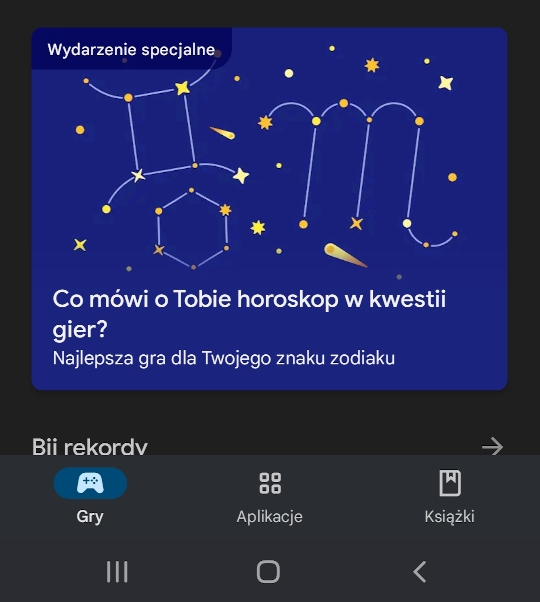
That is indeed total bollocks as you say but there's something going on regarding astrology in this half-year. Some two months ago after finishing configuring my first Android phone I'm seeing this weird banner at the bottom of Play Store [1] saying "What does your horoscope says about your gaming preferences? The best game for your zodiac sign". Then, there's this well-known Polish newspaper service gazeta.pl, which in its RSS channels publishes daily horoscope for about 3 or 4 months now. And about 4 days ago I'm seeing an ad on tv (mum jumps between live tv and netflix) regarding again, astrology and best around horoscope predictions in some magazine I never heard about.
The question is, does there is indeed some high interest in this stuff that happen naturally. Or some manager in this half-year spotted a spike of interest and decided this is the new big thing for younger generations and now we're seeing the outcome: people being aggressively flood with astrology stuff all around. Or this is some well-thought campaign to condition younger people to drive further away from whatever values they barely hold on into this fringe territory of predicting one's future from star and planets positions.
They said 70 million Americans check their horoscope
I’d like to see that broken down by age group, but if 20% of your population is doing something, that’s not the same as saying "I saw two people tweet about it" or whatever.
Is checking your horoscope considered believing in astrology? I ask because I check mine, but mostly for morning reminders and put my head on straight.
Today mine starts with "The universe may deliver an ego bruise or two today, dear Virgo, as brooding Pluto squares off with the Nodes of Fate" and while I don't believe they're predicting a specific event it's nice to have that in the back of my mind today.
Coincidentally, I have an email I'm expecting to be in my work inbox this morning that could be a bit of an ego bruiser. I've been dreading it all weekend and I was thinking about how to approach it last night and decided I was not going react and reply to the email today. After reading my horoscope this morning I had the idea that skipping the email today and not even reading it might be a good thing to do. It's not going to be urgent or require a reply so why not ignore it today if I think it's going to ruin my day? It damn near ruined my weekend and I don't even know if it's in my inbox.
For me, my horoscope is no different from reading a random motivational quote every morning.
> Is checking your horoscope considered believing in astrology?
I don't think this is something that I can answer, but at the very least it says that you're neutral enough toward it to allow it to speak into your life.
That's why I think of it as more of reading a motivational quote that will inspire me to do something that day. I try not to take it too seriously, but my conflict with astrology is that I don't want to believe it, but I can't shake the fact that the moon affects the tides on Earth from my brain.
That makes me question if the moon can affect humans. The whole personality prediction and things like that I'm not a believer at all, but the moon affecting our mood? I can buy it.
We are made up of a lot of water, especially our brains, and I'm not confident enough to say it's impossible the moon can affect us. Mars and Venus are a lot more kooky, because even though we don't know how gravity works we're pretty certain it doesn't have a strong effect for small masses over long distances.
I will admit I'm more willing to say astrology is a "maybe, who knows" compared to the existence of God. For me the existence of God is a firm no and I'm pretty confident in that.
As a non-believer I wouldn't go as far as to say there's evidence for God, but I definitely agree with the spirit of your comment. Evidence against astrology is abundant, trivially easy to replicate, and the alleged narrative behind how astrology works is obviously incompatible with our knowledge of the Universe to the point that an educated middle schooler could explain why. None of that could be said about God.
If I read it, then I usually read all 12 of them and try to decide how many of them fit better than my own one. Not sure that counts as believing, more being easily amused.
We could only be so lucky if “a dozen people” was the bar that “journalists” held themselves to. I’ve seen articles written on a single post/comment from Reddit, it’s absurd.
That said, I’m absolutely going to start rewriting titles in my head like that, good idea.
In general I would agree, but I would like to add I have had two conversations in the last month or so with strangers who were both women in their late 20s to early 30s that involved their asking of my zodiac sign, and a quick rundown of what that meant
I get given the crystals as gifts sometimes. the healing element is obviously complete nonsense, but they're aesthetically pleasing.
they're also a potentially massively profitable business venture if you have easy access to a lot of credulous people, which certainly facilitates their spread
>I suspect it's a social virus
you say this as if this is different to any other idea or meme or brand
perfectly reasonable people eat at McDonalds and buy crisps and support a football team. if you sit down and think about them, they all fly in the face of reason too
I've found political agendas to be much more of an aggressive nature, liberals, conservatives, vegans, they tend to push a lot more than your religious folk. In fact I've found most religious folk to have a sense of reservation and wisdom that understands not everyone will see the same way.
My guru (I'm Indian) was an astrologer. Every time Mars goes retrograde I tell people "astrology is nonsense, but this Mars retrograde thing gets me every time..." and surely enough, every time...
I was raised on Karl Popper and Thomas Kuhn. There can't be anything to it. It has to be nonsense.
December 06 2024 is the next Mars retrograde. See if things don't go completely to hell right around then.
The day humanity understands the power of symbol is the day we turn reality into anything we desire, for the representation of information is everything. That is what I think of as true magic. Narrative control is the most important state actor military agenda, no wonder if it frames how reality is interpreted and rendered.
Belief in astrology looks a lot like the personifying animals or anthropomorphizing of inert items. Maybe the toaster hates you, or maybe it's just faulty and confirmation bias is strong.
Belief in astrology puts words to the chaos and randomness of life. There's something very human about how we try to add life and agency to everything: mother earth, ghosts, forests, grumpy co-workers, broken toasters, and the actions of those around us that don't make sense. We try to breathe life and meaning into everything. That's why I don't get too keyed up about it. I think plenty of people "believe" in astrology about as much as they believe the toaster hates them, which is probably quite a bit.
We have to remember, as STEM people we have to see the world exactly as it is, without any superstition or mystery. But the average person has the ability to live in a world filled with mystery and magic that is backed by a lifetime of confirmation bias.
More like I'm faced with realities when other people see magic. When the WiFi signal is spotty, the reality of the situation forces me to understand at least the basics of how it works and how the signal is getting blocked. When my database is acting slow, I can't just say "well the moon is half so..." I have to instrument and figure out what's happening and fix it. That at least pulls away a lot of the mystery.
When you're responsible for something you have to understand it better (or at least get good at making justifications). All people do this, they just typically aren't responsible for keeping an object or program working.
I don't see why you would have a superior mental model about subjects you are not intimately familiar with the details of.
I don't recall making the claim of having a superior mental model. I make the claim that STEM workers cannot rely solely on mystical thinking, we have to apply the scientific method to perform our jobs. This gives us a tool at our disposal to pull back the mysteries in other areas of our lives. Flaky toasters, keyboard keys that stop working, the way light effects our bedtime routines. We don't need to rely on confirmation bias, we can apply the scientific method. Of course anyone can, but we're often forced to do it for hours a day, so we get a lot of practice disregarding our natural instincts in favor of observation and record keeping.
Hmm, well you effectively said you "see the world as it is" and that would typically be understood to be a claim that you have a superior mental model, I think.
Quote: Nahua philosophers saw humans as creatures yearning for rootedness — i.e. for a deep, firm, and lasting anchoring for their lives — and who restlessly search for it. Obtaining well-rootedness enables one to become an “upright man” (tlacamelahuac, trans. by Lopez Austin 1988:I,p.189) and to live a balanced, pure, and genuinely human life. Without roots, one finds neither balance, purity, nor humanness. Obtaining well-rootedness is difficult, and in their search many humans give their hearts to what appears to be well-rooted and authenthic but is not. Since this cannot provide grounding and stability, humans eventually become dissatisfied with it and abandon it, only to begin their search anew, often times repeating the process over and over again. Their hearts eventually become scattered, unbalanced, and lost (Lopez Austin 1988:II, Appendix 5). As Nezahualcoyotl put it, “If you give your heart to each and everything, you lead it nowhere: you destroy your heart” (Cantares mexicanos fol.2, v., trans. by Leon-Portilla 1963:5). Such humans become vagabonds, wandering about aimlessly from one illusion to the next. They become beastly, unstable, unbalanced, impure, perverse, dull-witted, intemperate, and vicious. They fail to realize their humanness and merely appear to be human. They become deceivers, rogues, and dissimulators. They “act on things with [their] humanity dead” (Lopez Austin 1988:I,p.189). They are “lump[s] of flesh with two eyes” (Sahagun 1953-82:X,pp.3,11) and “defective human weight[s]” (Sahagun 1953-82:X,p.11, trans. by Lopez Austin 1988:II,p.271).
> It’s the date that determines parts of her personality, her passions, her romantic interests and, to some degree, her life decisions.
One day it came to be from a female colleague during a fun meeting. The vibe was too good to be disturbed, so I just skipped all birthday hoops and told her my star sign is Orion, then I asked her to search online if she wanted to know the attributes.
My fellow nerds, remember, we have a whole 88 IAU designated constellations, and they only got...like 12?? We can win this war and teach em some real astronomy.
> My fellow nerds, remember, we have a whole 88 IAU designated constellations, and they only got...like 12?? We can win this war and teach em some real astronomy.
What matters in astrology is the constellations that the sun passes through. You can learn some basic astronomy by figuring out the movement of planets in the solar system as seen from Earth, as the ancient astrologers (up to Kepler) did in order to predict their locations in the future, which they (erroneously) believed would allow them to predict auspicious days for their patrons.
> My fellow nerds, remember, we have a whole 88 IAU designated constellations, and they only got...like 12?? We can win this war and teach em some real astronomy.
If you're going to criticize astrology on astronomical grounds, you should at least learn enough of the astronomical basis of astrology to understand how to criticize it.
In this case, there's 12 astrological signs because the ecliptic passes through 12 constellations. (Actually, there's an interesting discussion about Ophiuchus, but this is where it's helpful to know that the constellations aren't well-fixed in divided space, IAU's process of doing so notwithstanding, and for astrological purposes, the ecliptic is instead divided into 12 equal-sized regions, each one labeled with a constellation)
Mental health therapy carries significant social stigma and is not affordable to many people who need or want it. Having regular conversations with an astrologer is a cheaper, more accessible, and more socially acceptable alternative, even if it isn't as effective (or at all effective). The same principle applies to most forms of "alternative medicine"; people cope with what they have.
I agree in general.
I think that if for some reason you do not want to see a therapist some kind of "alternative" (like Family Constellations or Jodorowsky's Tarots/Psychomagic may offer some solace.
The main problem is that (in my limited experience) they also conveniently offer solace but not much impulse to actually try to change things.
I don’t know if this is true, but I wonder if these alternatives offer very top down perspectives on an individual’s life and circumstances, rather than one of personal responsibility and agency. One is kind it like “here’s how things are, and here are the deterministic, universal reasons as to why that is”, while the other might be more like “here’s how things are, and here are the ways you could choose to reason about it and navigate to a better place from here”.
I actually don’t know; I’m totally speculating, but curious. I used to know someone who went for tarot readings as a means of coping with losing her husband and I find it very sad yet fascinating. She didn’t seem to get much from it in a constructive sense, but she did get someone focused on her and her experience for an hour or so. That means a lot, too.
I like to think of Astrology (the way ancient India / subcontinent attempted it) as the largest and most ambitious big data analytics project.
Whether they provided real results or just an illusion of it is up for debate. But some "actionable insights" were surely delivered :)
Keeping records of many independent variables (time and place of birth, positions of "planets" at the time of birth, and their movement againts constellations through ones lifetime) and then trying to correlate them with observed outcomes / results. (Personality traits and accomplishments).
Developing some latent representation of those input combinations. Giving them esoteric names that don't mean anything in real physical world. And then using those categories to make predectionas.
Might as well compare it to a neural network being trained to predict.
Is this line of comparison already attempted and well trodden? I am just curious -- maybe I am not the only one who thought of it this way? Even though I myself use this comparison semi jokingly.
The only independent variable is the date and time of birth. The position of planets and their movements are highly correlated to this variable and won't provide any additional information.
And yes, there has been plenty of research on the impact of the birth month, and the time of birth within given day, on a person's development through life.
> The only independent variable is the date and time of birth.
Minor nuance. Just sharing this for awareness, not endorsing its validity:
When indian astrologers plot a "star chart" / "kundli" / "raasi chakram" of a person -- it is quite literally a snapshot or plot of all major "planets" against the constellations.
And this snapshot depends rather precisely on the PLACE of birth as well. (not just the time)
The latitude and longitude of the place of birth are starting input variables. There are almanacs and pretty detailed tables of star positions by date and hour, published for use by practitioners, that are used to lookup. The sunrise, sunset times for that place obviously differ by lat/long. And similarly since the "positions" of planets are measured not in absolute terms but against the backdrop of constellations -- so the place of birth also determines for example whether Mars is in Constellation A or whether Jupiter is on the cusp of Constellation B & C.
For example you can skim through this book's pages -- that show lat/long and timezone info for places worldwide:
These tables go quite deep into accounting for drift of lunar year versus solar year, apparent retrograde motion of planets, precession of axes and correcting for them, etc.
The attempt to gather so much data and attempt to do a correlation analysis / modelling on that is fairly ambitious and worthy of acknowledgement IMO.
Similarly, there is evidence and research which demonstrates the evidence that someone's name has pre-determined effects on that persons life; especially in the case of their career or what they are known for. Most surprisingly, even on the account that the individual didn't realize it until being told what their name meant!
I feel like this is much more likely a correlation than a causation. if your name is some middle to upper class fare like Alfie or Penelope, then I can mystically predict you an financially comfortable life from here on in. however, if your name is Deniqua or or Tyler, well my crystal balls have bad news for you
You'd think it's a correlation rather than causation but the research looking into it finds it to be probabilistically much more than a correlation, especially concerning the fact that individuals have been shown to be unaware of the nature of their name and their career path. It's an interesting study.
It has a lot more to do with the surname or what acts as the surname, as various cultures have it in different places.
the reason this is happening is science and rational thinking has really let them down in their lifetime, especially during the pandemic. they (and people in general) dont know what is real anymore, what to believe any more when everyone seems to be making up things as they go along, especially the so-called experts. why not review everything they have access to but told by the experts not to pay attention? ie they want to do their own research now.
Think about it as odds. Unless you have the time to become an expert yourself, following the majority is more likely to be correct than following fringe opinions. Sue, sometimes the fringe opinion turns out to be the correct one, but which fringe opinion?
I think basic stats and critical thinking skills, even just looking at the scientists current and former funding is enough to spot the BS. Though given the state of the world I guess that's asking too much.
The article gives only anecdata as evidence that this is happening, mostly from astrologers themselves. I would question that it is happening at all. At least I found nothing objectively convincing for the thesis that "young people are flocking to astrology".
> the reason this is happening is science and rational thinking has really let them down in their lifetime, especially during the pandemic.
No it hasn't. Science and rational thinking are part of the reason that many are still alive. Without vaccines the number of dead would be far, far higher than it ended up being (and people are still dying of COVID right now, but fortunately in lower numbers and it looks like we can safely say the pandemic is behind us and chances of it flaring up again are low).
>Without vaccines the number of dead would be far, far higher than it ended up being
based on what? 'projections' from sources that commissioned the cures and the mandates? what to believe? who to believe? let's cue in data ambiguity and conflict of interest as among the reasons why this is happening.
most of the young people were not affected by the virus but had to lose key years of their life to save old people. they do feel let down.
I suggest you look at the world wide statistics from before the vaccine roll-out and afterwards. There is nothing to 'believe', that data is about as non-ambiguous as it comes and you should be very, very grateful that those people spent their lives learning the skills required to save our collective asses, especially in light of the way their contributions are being minimized.
And if you don't understand that then that's fine with me but that still doesn't mean that science has 'let you down'. You benefit from science every day of your life, even if you don't want to credit it.
actually british govt stopped publishing COVID infection/fatality data based on vaccination status because of risk of misintepretation :) ie a lot of folks that were vaccinated were getting [re-]infected and so on. i could dig the sources for you but i suppose we dont care anymore.
the fact is people feel physically, spiritually and scientifically abused by the handlers of the pandemic. and they cant talk about it cos they still get downvoted or truncated out of discourse. so they are taking a different route to calm themselves down.
Fun fact: Because people have been using the same astrological charts for a few thousand years, every single "sign" is off by at least one nowadays due to stellar drift.
But convincing a believer is like trying to explain to a die-hard flat-earther that the world is roughly spherical.
Actually astrologers are well aware of this, it's why they sometimes refer to this being the "Age of Aquarius" because the sun is in Aquarius rather than Pisces at the equinox (there aren't strict boundaries so there's some disagreement).
And the effect is called the precession of the equinox. It's not stellar drift.
Increased interest in astrology has been noted before in societies with declining traditional religious belief and greater feelings of uncertainty. Whereas a Christian would leave his concerns about things out of his control with God, and a stoic might simply accept his powerlessness, the anxious remainder look for other ways of trying to cope. Astrology has a track record of filling this void with its fatalism, and like all occult practices, it does so by luring people with irrational promises of foreknowledge, control, and power.
“People like games that offer low-stakes predictions about their personality” has both more explanatory power and is much more parsimonious than the explanation you’ve presented.
Unless we’re prepared to consider consuming Cosmopolitan an “occult practice” as well, of course.
The replacing traditional religion bit makes sense, since they’re both approximately the same. The increasing uncertainty is unfounded, though I suppose even modern traditional religions took hold when their parent empires were falling.
Second part seems dubious. Seems likely that a large portion of people are simply spiritual and go with whatever is socially popular in their circle regardless of circumstance.
My girlfriend is in the middle of her PhD program and is very intelligent but she's really into this stuff. She makes comments about it in public and I cringe. But the worst part is that half my female friends and all my gay friends love astrology. It's very weird.
I worked in various "alternative" industries in my youth.
One day I was having an informal diner with people that, in another context, could have been business partners.
One guy was making a killing with an astrology service by phone. He started with those text message based games, that were popular in the 2000'. Remember? "Send 'love' to this number to know if he loves you".
And eventually created a full phone call based business with about 200 freelancer astrologists and mediums. He just redirected, and took a cut. He made banks.
What he told me that night was that 99% of his customer base were women.
"You have to see astrology as porn for women", he said. "Porn public is mostly male, astrology mostly female. Both know it's not real, and most won't spend more than a few minutes on it. But many pay for it even if they would never say they do".
Can attest to this, all folks that I know are into this are women. Even seasoned doctors. And the response? 'Yeah I know its not rational but you know....'.
Some form of quick reward system gets invoked in the brain with this apparently. Well still better than looking for tobacco kicks or chocolate instead.
I always wonder what the morals and ethics of these kind of business owners is.
You're selling a service you know is bullshit and liken to porn. Personally I would not be proud to say I run that business. I would rather that these businesses didn't exist, and so I don't want to contribute to perpetuating them.
Of course there's the "fulfilling the market need" type of answer, but that's basically saying you will do anything for money regardless of morals and ethics.
Not 100% sure if the GP and I share the same friend, but I know someone that fits the description exactly. Morals and ethics are all relative. There are people who have absolutely no qualms about running a porn business and there are people who couldn't care less about you or someone else spending your hard earned money on nonsensical information.
They would see it as just as valid a business as an author that sells fiction books. Depending on their background this may be understandable, or not. I know a gay guy in Toronto that runs a porn empire, he doesn't care one bit about other people's opinion on it. Given infinite time he would spend it all on watching porn so for him it's a natural to want to be on the supply side, he understands his audience perfectly and the way his business is set up (co-op) gives everybody in it their own share of the take.
What I think you'll find is that morality and what is ethical can differ greatly from one person to the next and that it is possible that someone disagrees strongly with you on what is ethical or moral and that all you will end up doing is to argue the case based on your own experience and your own (cultural) background without ever arriving at some idea about what 'absolute' morality or ethics would look like.
You can see this very clearly in debates around abortion, war and other controversial subjects. People on both sides of those arguments fervently believe that they (and only they) are in the right and that everybody else is delusional, amoral and un-ethical.
>> "You have to see astrology as porn for women", he said.
If that is the case, what is the pleasure they get out of it? Porn triggers the pleasure centers that sex triggers... but astrology, what does that trigger? Sense of security that you "know" your future after reading your horoscope? Or what? Did the guy have any theory about that?
> Sense of security that you "know" your future after reading your horoscope?
No, it's comfort in knowing that some(thing|one) else is controlling your destiny. It's not about knowing your future. It's about knowing that there exists a path you're being ushered along.
It's worth noting that women experience sexuality differently. You can see it clearly in romance novels. Women don't read smut for the sex scenes, they read it for the sexual tension and character development. Male sexuality is image-based, female sexuality is language-based.
To say an astrology hotline is strictly equivalent to an orgasm is silly, but for women the circuitry is very nuanced so I wouldn't be surprised if the same neurons were firing.
> half my female friends and all my gay friends love astrology
That's about exactly my experience. Half my female friends (and about as many on dating platforms), and about three in four of my gay friends. Not a single straight guy ever talks to me about star signs.
In the 1970s many straight guys were “into” (natal) astrology, as evidenced by the classic pickup line “Hey babe, what’s your sign?” Any less scientific than “Hey babe, what’s your Meyers-Briggs type?”?
Astrology got me out of an intro to stats final. You could write a paper using stats in lieu of the final, if your grades were high enough. I got a list of DOB and declared majors for each UGs from the University, hypothesized the most likely sun sign for each major, and tested whether the number of students with the characteristic Sun sign was significantly higher. Pre-VisiCalc, IBM360 era. Huge ream of 17”x12” pin-fed green and white computer paper, sharpened pencil.
Twelve hypotheses, three significant at the .05 level. There may have been a wee bit of what the kids today call p-hacking but it would have passed the social science standards at the time.
The most significant result was 7 out of 12 International Studies majors were in the Sun sign of Libra (roughly p=1/12), and the expected correlation between diplomacy and Libra was commonly cited by their literature. That was unexpectedly strong. People have gotten funded on less.
If all your sample came from the same country (and to a lesser extent, hemisphere), what you're really measuring with "star sign" is "age upon entry into the school system".
That's good. Another physically plausible correlation would be effects of weather upon early development. Babies born in the springtime being likely to get more sensory stimulation during months of prime brain growth: sunshine, outdoor hours crawling around among the bugs and such.
I was having a conversation with a friend at work about a conspiracy theory loving colleague.
I asked if it's possible to be good at your job while believing in far out stuff.
My friend said "seems like it". But I have a feeling the mental baggage that comes from wacky beliefs is going to affect other aspects of life and work in a negative way. But that's just my opinion.
Everyone is mostly wrong about most things most of the time. Don't assume you're a paragon of rationality and correctness just because the toleration in your daily life is bigger then the margin by which you're holding mistaken beliefs.
We just need to be right enough long enough within a limited scope. That's what makes civilization successful. Specialization.
> is very intelligent but she's really into this stuff.
I was working on an astrology widget for a portal site, and read every advice in it every sign for months at lengths.
None of the advice were ever highly impacting, nor seemed to have a chance to bring problematic results. At best it felt like a nice way to get some variety into someone's life ("wear something green today to improve your luck")
In that light, I feel caring about astrology could be just another hobby, it's pretty innocuous.
The whole point of public astrology is to make statements that are general and harmless. Genericity means people patternmatch the advice to their daily experience often enough to feel the advice was indeed meant to them.
”Your week starts you being stressed, but come Friday things will look out better. Weekend will energize you. Remember to care for yourself. Coming months will offer you a happy surprise.”
Personal astrology then has similar aspects as tarot and geneal counseling. As any roleplaying game enthusiast knows, mapping life to fixed ruleset is great fun. What makes this pathological is if people actually believe this stuff. But in the non-pathological case I suppose it works similarly as therapy for non-clinical stuff - people helped to identify their issues and are coached to work through them. People are really blind to aspects of their own life (speaking from experience) and need things pointed out to them in a safe setting.
Personally I feel it’s infuriating bs, but recognize it’s mostly harmless and may actually help some people work out some issues.
The problem is they often make statements that A should be careful around B and avoid serious decisions this week. They can literally model the behavior of a significant amount of population for a week. It may sound funny until you realize that B is you and A is HR who loves that shit.
You're right in that this could be problematic to emit such an advice, but I am optimistic in that the writers tend to avoid such a direct framing. It will be more around "pay special attention to the serious decisions comming this week".
> You get some weird news early on that leaves you feeling kind of funky for most of the day, but it's not all bad! You know deep down that things are right where they're supposed to be.
You won't get anything that leads to direct action from these tidbits of non-comited vagueness.
The funny thing is that most of these "advice" or "insights" can be swapped around, it don't matter which sign you put next to them. Mostly the texts are so vague and generic that people can fit at least parts of it to their current situation.
Two of my favourite and easily most intelligent friends are deeply into astrology and have been for decades. One is a PhD as well, the other an accomplished writer.
It’s always hard to put these things together, though it’s actually very stimulating to talk with them about it. It’s an entire world for them, loaded with meaning and salience. It doesn’t take away from how intelligent I think they are (they both possess capabilities I can’t fathom), but I don’t think it’ll ever properly make sense to me.
MBTI is an attempt at classification of people's personalities at a high level from a series of questions. That just seems fundamentally different than "I will predict your future based on what day you are born".
> MBTI is an attempt at classification of people's personalities at a high level from a series of questions.
Not one which works, however.
They both purport to tell you what sort of person you are, with an explanation for how they do this which might be vaguely convincing to some non-experts, but are, statistically, meaningless.
> At the time of the COVID-19 pandemic, MBTI testing became highly popular among young South Koreans who were using it in an attempt to find compatible dating partners
Astrology is also not, as it turns out, the only woo used in dating.
Yeah, this is a "very intelligent woman in a PhD program" who has a hobby that she shares with her friends, that's no reason to suspect she and her friends can't discuss "important things."
My understanding as an outsider is that astrology, tarot, etc function as a shared vocabulary and mythology to communicate about mental health and life's troubles. I think for most people the occult elements are largely aesthetic.
Throughout history people have used occult aesthetics to create a heightened experience. Sometimes that can help you commit to the process and get more out of it. (And other times con artists use it to get you to let your guard down, c'est la vie.)
Personally it's not for me, but when I got to know people who were into it, and did some readings to humor them, it made sense to me.
Also people can have interests that aren't that serious or have no impact on their lives. Sometimes I've met people that it seems as if some of their interests are basically long-trolls of their friends and family. So if the SO likes astrology, who cares?
Yes, but the hackers don't tend to think literal demons will invade earth unless the ~crystal chakras are aligned~ doom is ported to everything more complex than an opamp
Porting Doom to something weird is a hobby. No one actually believes the game is anything other than a silly game. It's not much different from building model ships in bottles: a very interesting and impressive technical exercise, but ultimately a task of zero practicality.
This is also an interesting/insightful comment.
But again, Tarot (and especially Astrology: you cannot really change when you were born) do not encourage self analysis and especially any attempt to change your own mental models/way to do things.
Hugo Pratt, author of https://en.wikipedia.org/wiki/Corto_Maltese - hinted at this in one of stories about the character.
Allegedly Corto met some sort of Gypsy palm reader when he was just a teen. The Gypsy checked his palm and told him his life line was short, so he would die very young.
His reaction: he took out a knife and cut his own palm to make the line longer.
The latter part is usually missing when you use Tarot, Astrology etc.
To be more precise, I generalize the tendency that people have in trying to "externalize" their problems. And "traditional therapy" can have the same effect: "whatever, the root of all your problems is your parents".
What I am trying to say is that most people will not dig further and most importantly will not even try to put some honest work in trying to understand things in order to try to repair these.
And assuming I am right, Astrology is not really helping much, because if you are "stubborn because you are a Taurus or whatever" what are you supposed to do?
What kind of corrective practices will Astrology suggest?
Please enlighten me (I am not sarcastic): in all my dealings with people who were interested in Astrology (interested beyond the most superficial interest) everybody was trying to "understand", a minority was trying to "predict".
But nobody had any Astrology-based best practice to "heal" or "repair".
Learning to accept that some things are beyond human control is a mental health victory in itself.
To the kind of person who wants to find a proximate cause for everything, "I didn't get the job because Jupiter is in Scorpio" is much less toxic than "I didn't get the job because the hiring committee is racist".
Maybe you didn't get the job because you weren't a good fit for the job, or maybe you didn't get the job because the hiring committee simply found someone else just as good and flipped a coin. Sometimes there's a good reason for something, sometimes it's just happenstance. Trying to make up nonsensical reasons for things is pointless.
I wouldn't jump to conclusions about people based on their blind spots. The guy who invented calculus believed a whole lot of nonsense. Doesn't make him dumb or invalidate his accomplishments. Being in a PhD program is most definitely sign of some sort of above average intelligence. Irrational beliefs are not proof of lacking intelligence. People who are so ready to dispense judgement should go talk to specialists about things they hold to be true on fields they don't really know a lot about. Would be humbling.
There are epigenetic markers which can identify the season or perhaps even month you were born. If you might think there is a link between personality and birth order and that perhaps metaphor is useful in storytelling or group dynamics … then one could loosely link these concepts together and consider it more than something like a party trick.
Indians often do this with marriages, by checking the astrological compatibility. All of it honestly seemed like bs to me, if anything it’s job security for so-called soothsayers and astrologers, who have been grifting generations of families
Thanks for the link, always curious to hear other experiences from India. Stateside we don’t get much perspective outside of what NRIs do and the mainstream media which leads to a bubble of sorts.
Indians? This is sort of like saying "many Americans pray to Jesus". Hindus are the ones that believe in astrology-- the majority religion among dozens.
If there are such markers, the flaw in astrology is not taking into account the hemisphere. Someone born in July would be born in summer in the northern hemisphere but winter in the south, so they can't possibly have been exposed to the same environmental factors growing up.
I believe that "modern" astrology takes in account the location of birth (latitude and longitude).
Of course if you go back to more traditional texts (European or Middle Eastern) they did not really have any concept of this, but on the other hand they were making charts and predictions for people of their own area so it was not a big deal. For them.
When put like this it really sounds like astrology is just trying to be a tool to predict and explain someone's behavior based on external factors that have a non complex origin.
A more accurate and scientific version would be to be to examine someone's upbringing and life events while using methods from modern psychology.
Note that both methods are kind of cold and one way. You are determined to examine someone else, while the needs of the person you are examining are not important here.
The sane or pragmatic way is just to accept that a person is complex and instead let your internal model of their personality evolve through conversation and shared experiences.
This is definitely another problem with Astrology as a "cure".
Tarot is a bit different, at least in the way it is used by Jodorowsky and other who were influenced by him.
You turn up a card and start answering questions from the "Tarot Reader". It is more like "what do you see in there? who does this figure remind you of?"
I was not being as specific as latitude/longitude, exact time of the day, or “planetary alignments” … only the season or birth month (or perhaps week if you want to get loco). Much of the natural world runs on such a schedule (even considering lunar phases). This would be more scientific than the concept of Groundhog Day, but less “scientific” than a farmer’s almanac.
But they're exposed to the alignment of the celestial spheres in relation to the Earth the same way. Imagine if the celestial spheres have a particular electromagnetic relationship with the Earth, this dynamic nature is a type of 'song' if you will. That song becomes imprinted. That's one way I've come to understand these views. Then you actually have some semi-modern approaches to the music of the celestial spheres and the orbital resonances being similar to musical intervals.
Birkeland currents flow following magnetic field lines.
The Earth's magnetosphere is shaped by solar winds, rounded on the sunside extending 6-10 x Earth radius with a longer tail opposite the sun that extends up to 1,000 x Earth radius.
The Earth's radius is very small compared to the 1 AU Earth distance from Sun and smaller again compared to the distances between planets.
So, rather than "filling the entire universe" the currents you've linked flow through a magnet field that rapidly dwindles with the inverse square of distance and neither the electric currents nor the magnetic field reach to another planet (nor vice versa).
Not only that, but the time of year you're born probably also impacts how you develop socially since you might end up being a bit younger or older than your peers at school.
I've always had the suspicion this was partly the case.
If you're born in August or September when the sun is out for a long time and everyone's jovially enjoying social events during the first few months of your life, of course you'll be more outgoing and positive and active!
What interests me about the article is the fallout between astronomy and astrology, akin to the fallout between medicine and magic.
Western scientific culture is so obsessed with the tangible that we minimize (and to some point ridicule) spirituality, although science and spirituality at some point were once one and the same.
Human beings need spiritual experiences, and "young" people flocking to astrology seems like a response to this evident lack of spirituality in Western culture.
This explanations have so many logical issues. It feels like hand waving.
- The false dichotomy between 'western' science and spiritual (eastern? ancient?) science. There is just one science that's defined by scientific methods. Almost every culture knew this method.
- The implication that at some point in the past, science also dealt with intangible things. Science is always based on evidence. Rest was always in the realm of mysticism.
- That spirituality is about the intangible. It has been shown that people can get spiritual experiences from many non-religious and tangible things like music, meditation, arts, nature and martial-arts.
- That 'western' science minimize and ridicule spirituality. Science practitioners ridicule illogical things like astrology. But spirituality and its importance has been the subject of several serious scientific studies. I haven't seen one study that simply dismisses spirituality.
- Though not directly said, there is implication that astrology is a spiritual experience. Sure! If you're deluding yourself. But having studied a bit of vedic astrology myself, I never found the practice to be spiritually touching at all. The only part that I found valuable was the ancient mathematics/astronomy that precedes the prediction stage. If astrology can be considered as spiritual, then flat-earth beliefs can also be.
I see a lot of parallels between astrology and sports fandom. Sports team affiliation is pretty arbitrary and often based on where someone was born (which is out of their control). There's tons of lore, stereotypes, compatibilities, and rivalries between various teams (which is largely artificial). Sports fans care deeply about things that ultimately have little impact on their lives (does is really matter who wins the super bowl?). And of course, sports are a common interest for people to discuss and bond over.
I'm not into astrology, but I'm not judgemental of it either. To me, asking if someone "believes" in astrology would be like someone asking me if I "believe" in the sports teams I follow -- it's not the right question to ask.
I get that you're saying that when a team wins or loses, you clearly didn't have anything to do with it. So associations with an organization that just wants your money are as arbitrary as divination. However, as a Vikings fan I've experienced multiple times the feeling that "this might be our year" only to see everything taken away, charlie brown style. So the feeling of shared hopelessness is something I have in common with local Minnesotans. Maybe that's the irony: that I think the true meaning of being a Vikings fan is to suffer, accept Ragnarok and NOT believe in them.
That's what was lurking on the other end of demolished Chesterton's fence. And now it's coming back slowly like a tide that no dam of enlightenment can hold it. That's why I'm more worried of people antropomorphizing the existing GPTs than the potential coming of AGI.
Totally agree, as time goes on I've started wondering if the accelerated tearing down of traditions and cultural walls from the last 100 and something years wasn't a totally good thing. Of course it lead to some great outcomes, but at the same time some holes were left open and what seems to fill them isn't up to par.
To phrase the above in a straightforward example: If astrology and other woo-woo replace religion over the next 100 years then they'll have the same growing pains that the early christian church did. Sure, now the way you live your life isn't dictated by your local priest which is great I suppose. But now you shouldn't marry the person you love because ultimately your star signs aren't compatible.
I for one welcome the arrival of our machine overlords once they develop opinions. /s
I just wanted to complicate the story by pointing out that secular materialism is not new!
All the ingredients are there in the philosophy put forward by Epicurus in 307 BC, which was widely known by the Romans and rediscovered by renaissance humanists in the 1500s (in De rerum natura).
(Epicurean tenets I have in mind are: The universe behaves according to physical laws; whether or not the Gods exist, they are not concerned with human affairs and do not intervene; there is no afterlife and yet no need to fear death.)
Astrology is pretty bad for the mind, structurally.
You end up constantly reinterpreting current events in a never ending backward-looking interpretation of signs and symbols. The only stable interpretation you can make is the one you have with you, when you walk away from astrology.
Clearly, from the asinine discussions in these comments, we can tell that a lot of people are into astrology now. This is getting really bad.
That said, arguing against it probably won't work, there's a whole framework of weasely excuses and rhetorical chaff people can deploy. It's much harder to argue against a religious belief that people can just pretend they don't really believe in when challenged.
My hope is that someone can come up with a pop-culturey alternative that provides the fuzzy feelings of astrology without rotting people's reasoning ability about the natural world.
And yeah i do believe in it. Not the basic ones with newspaper horoscope but the full analysis of the 12 planets and hous placement.
Why ? I've seen a few people including myself being able to tell to SEVERAL PEOPLE "no you're not born at that hour" and after verifyg, these people indeed were born 1 hour later of earlier.
Is it weird and not really that planets impact people ? Yes but I do believe there's enough room in science and especially in quantum mechanics to allow for that kind of non verifiable forces to take place. Another real question is "why not" ? Basic answer is that it allows us to not just be a simple animals, but influenced by 12 "archetypes" / "primordial forces"
How can I use it ? YOu don't NEED it in life. The best consequence of believing in astrology is a good philosophy of life, not actually getting rich or something like this.
What's next. The best would be to be able to prove it. And it's possible ! take a trained astrologer, ask him to find which chart correspond to who. ON a long enough sample the probability it works is good enough.
The article provides evidence that the market is growing but as far as specific support for "young people" I saw about two.
The first is the quote "The astrology field is booming — a trend that has been driven by younger generations, experts say, ..." and the second is from a YouGov poll.
In that poll 37% of 18-29 year olds believe, and 33% of 30-44 year olds believe, and then there is a large drop to 22% for 45-64 year olds and 16% for 65+ year olds [1] where 3472 people were surveyed [2].
The polling has a stated margin of error of 4% [3].
It seems more accurate to say the 18-44 year old range has a much higher likelihood of believing in astrology than those in an older age group.
That is something I noticed on dating apps when I still used them. Star signs seemed to be a big part of what a lot of people were looking for, despite the fact that it hasn't been accepted in any way for centuries. Normally I would just accept it as just a fad, but then people started saying they weren't interested in "x" sign or "y" sign because it is "incompatible."
To be fair, at least that makes it easy to filter out the crazies
It is so sad to see that despite being the most educated generation in history, there still seems to be a need for supernatural meaning in young people's lives.
From where I am, I can see religion and traditions destroying plenty of lives. Astrology often causes problems for many getting married. Not to mention the religious conflicts that take lives or rigid traditional views severely limits opportunities for many communities. Consumerism may be bad. But that doesn't justify the damages an unscientific world view can cause. Scientific temper also doesn't equate to consumerism.
Oh it's not only the astrology loons, you have the UFO crowd, conspiracy theories crowd, people who make their political cult leader a semi God, &c. it's also super easy to embrigade them in extremist causes by promising them to be part of a group
Instead of having one big cohesive group you get hundreds of sub groups with a lot of conflicts
I'm not advocating for going back to that, which wouldn't even be possible, just saying we lost something and what we replaced it with is lacking in a lot of aspects
Could you clarify what you consider as the thing we replaced the old tradition with? And what are its drawbacks?
I personally find it very liberating to not worry about someone else's concept of God or how the position of planets affect my future or how God judges everything I do. Religion and tradition has all the baggage that you associate with astrology loons and other conspiracy theorists.
Do you mean consumerism? If so, that isn't the result of replacing theocracy with scientific beliefs. Consumerism is the result of a highly imbalanced political belief. And it prioritizes momentary pleasures over long-term well being. It should have been possible to have a balanced and mostly self-sufficient life with a scientific world view. Unfortunately, we ended up prioritizing profits over happiness.
If it was the case the west wouldn't be 70% overweight/obese. They believe in so little they can't even take care of their own self. Depression is on the rise, the loneliness epidemic, &c. it all has the same origin, we changed our ways of life too fast/too much
There isn't much left besides consumerism, it's just that it's disguised under so many masks that you don't even perceive it anymore. The vast majority of hobbies are consumerist, even holidays (I don't have to remind you where "Holy" days came from do I?) became consumer oriented, vacation destinations are 90% about consumerism (I went to X, I've done X, it's all a checkbox in some todo list)
We consume our endless diarrhea of entertainment, we consume our vacation destinations, we consume our news sources, we consume our "content", we consume our sub par food, if you can even call that food anymore. People spend something like 4 to 6 hours per day in from of their mobile, doomscrolling twitter/instagram/reddit or playing games.
Anyways, we'd need a book to unravel that topic.
“At the beginning of human history, man lost some of the basic animal instincts in which an animal's behavior is embedded and by which it is secured. Such security, like paradise, is closed to man forever; man has to make choices. In addition to this, however, man has suffered another loss in his more recent development inasmuch as the traditions which buttressed his behavior are now rapidly diminishing. No instinct tells him what he has to do, and no tradition tells him what he ought to do; sometimes he does not even know what he wishes to do. Instead, he either wishes to do what other people do (conformism) or he does what other people tell him to do (totalitarianism).”
The truly sad thing is they have sky-high depression rates and all anyone cares is that they use too much social media and believe in astrology. The way the west regards love is supernatural anyways, so it's not surprisingly that they'd accept the idea of fate in this too.
In my youth, I spent some effort looking into astrology, before dismissing it as a way to explain personality types.
Any system for classifying personality types (Myers-Briggs?) can provoke reflection on one's own personality and those of one's acquaintances. It doesn't really matter if the system is complete hokum.
Astrology originated with astronomy and then parted ways, in the old days people relied on astrologers to predict when spring would arrive or winter will come, once astronomy separated from astrology, some people just continued to believe the astrologers even though we have astronomers today. Sigh.
People seek for meaning beyond the concrete; this has always been true.
Astrology doesn't work, but it's exactly as meaningful and grounded as beliefs that don't get half as much criticism. Every "AGI is here and it will change everything" comment, every "the dollar is about to be replaced by bitcoin" claim made on HN is the exact same thing - people stringing breadcrumbs together to find a higher meaning than is warranted.
These are all articles of faith that people find interesting and comforting; it's disingenuous to criticise one and not the others. Disliking astrology is one thing; disliking astrology alone but accepting all the other little faiths is another.
It's about emotion-based cognition. I think straight guys would do well to be more insightful about how deeply entangled emotions and cognition are. Don't get me wrong, astrology is most definitely bunk. Still people can get some reflection out of it that wouldn't be available trying to be very rational and clinical about everything all the time.
Rationalists will always dismiss anything that has a woo quotient ascribed to it. This is unfortunate because traditional astrology provides a remarkably sophisticated toolset to study this aspect of reality -- _but you have to know how to look at it_.
The system deals with archetypal reality. Archetypes have an unboundedness to them that live within a fixed topical frame. Astrology says: at such and such time, such an archetype is active; it is probable that this _type_ of event will occur, but it is impossible to say exactly what it will be. Using the more ancient toolset one can narrow down the type of event quite precisely.
An extremely simple example of this:
Astrologer says to client, "In two years your 5th house will be active and you will have a baby". Two years pass, and the client does not have a baby, but rather publishes a book they've been working on for a long time. As the 5th house covers children and other labors of love, this prediction is in fact accurate. The book is their baby, and it has been born. This mode is how one must look at all topics covering all of the 12 houses houses and signs, as augmented by all of the planets and their myriad significations. And crucially, this is how one must understand predictions made by skilled astrologers. It's a different gaze, but also one that is testable assuming the experiment is designed correctly.
Discussions about pop astrology (as seen in this article) will always fail to comprehend the true depth and potential of the craft.
Without fully grasping how archetypes work, it is impossible to begin. It's a prerequisite, and without that one will always miss just how remarkably accurate (in field-like terms) astrological prediction can be.
Honestly, astrology could have been something neat, like everyone born under a certain star sign could go to a club with activities and the like and overall just be a silly excuse for people to meet up and mingle.
Its the so called "professionals" that charge money and give advice leading often people astray that I find deeply immoral.
> According to [THE CRYSTAL BALL USED BY] Allied Market Research [the only source of data for our article], the global astrology industry was valued at $12.8 billion in 2021, up considerably from $2.2 billion in 2018. By 2031, it’s expected to rise to $22.8 billion.
we all go too school on the same calendar cycle. But to young children one year difference can be quite significant.
this magnitude of difference diminishes with age: 50 vs 51 years old? same thing... 3 vs 4 years old? may be the difference between pooping your pants and holding it in
but consider the social consequences of shitting your pants in a semi-public setting? and add these up over your whole k12 education across millions of people.
the idea is that some psychological traits will be formed by this. and the zodiac reveals when you where born.
in summary I'm saying that taking all these things together and averaging them out may reveal psychological traits formed by an homogenized (standardized) education experience.
I assume it is a sign of the times: young people facing a crisis of meaning, given global issues such as climate change. I guess it is quite welcome to accept a meaning that is given from the outside instead of having to define it yourself.
Clearly I am not young, but over the last say 5 years I have been visiting a specific astrologer and has been very useful - primarily for decision making, managing stress.
It is like therapy with dos/dont's and checks against any of your immediate worries. It basically helps you work out a near-term plan, typically 12-18 months, and helps to manage when things do not go your way.
In a abstract way, it fits to the fatalistic world view and that is why it works for people who use it, even if they do not fully accept. It really is therapy.
good point. for me, the difference is the sense of time
A easy example is say I am looking for a job, and have sent out 200 applications, 4 phone calls, 2 interviews and still unemployed.
Therapist will obviously help you out and prepare you mentally- the astrologer typically will "inform" you that tour next 7-9 months are hard for you personally and it will work out if you do continue doing it plus some x,y,z things
Has anyone considered that the modulation of light reflected by the planets could potentially have some kind of impact on people? I feel it's pretty arrogant to out right deny the potential of astrology. It's been practiced for thousands of years by multiple cultures and faiths for a reason. I agree you shouldn't base your whole life on metaphysics, but to think we absolutely know everything about the mysteries of the universe is pretty narrow thinking.
Thanks for this. I actually re-wrote the content but replaced the word 'astrology' with 'bullshit' and it actually makes a lot more sense in the translated context than the original. You can find the other version here:
Young people are also flocking to Taylor Swift. Doesn't mean much other than young people flock to fads. Well, everybody does but especially young people.
I suspect most people who are into astrology are doing it for enjoyment too. Not sure how somebody who enjoys looking at their weekly horoscope is being defrauded.
I'm sure some are, but I wouldn't know how to determine what proportion of the market is just entertainment versus people being misled by charlatans who promise good fortune after having to pay a literal fortune. This applies to all New Age gimmicks; not just astrology.
With the return of astrology, crystals and tarot, we 1970s prophets have only biorythms, mood rings and disco remaining. Our messiah will descend from a cigar shaped UFO, blinding us with the reflection of his lapels. He will speak one-sentence truths below a bushy porn-star mustache and laugh tracks will sing our adoration.
What about the coorelation of higher probability of narcissistic traits among people interested in astrology? There are few studies about this. Maybe modern society harbors values that invite such narrative to emerge and so we see increase in interests that reflect this?
I have written this little project above and as a consequence I had to learn how to compute certain astrological aspects. And oh boy, astrology isn't just not working because "it can't work". It is also terribly imprecise in its assumptions..
In theory you could calculate the astronomical part (position of certain bodies even if some are just fictional like Lilith, Iris etc.) and check for correlation with astrological predictions. But each astrological system makes so many soft assumptions that you can't decide which system is the true one.
For example you have division of a horoscope in 12 houses. But there are multiple systems of that division (Whole sign, Placidus, Regiomontanus, Krusinski/Pisa/Goelzer) each at odds with each other...
You might be familiar with concept of Age of Aquarius. Well estimates of when is this going to happen vary from 1844 to 3573 CE depending on astrologer...
Not surprising at all; considering the holes religión left in their heads. They've been trying to fill them in many many ways, just because they claim they're not like their parents doesn't mean we should believe them.
[...] According to Allied Market Research, the global astrology industry was valued at $12.8 billion in 2021, up considerably from $2.2 billion in 2018. By 2031, it’s expected to rise to $22.8 billion.
Same thing with tarot. These are real markets and will bloom proportionally with depression and lack of education. So when you see $22.8 billion market increase, you now know what you are actually looking at.
On the other hand, these are just 2 games, really. Think gaming industry has to produce a miriad of games to hit $300 billion. It's just they don't sell you hope, just some cheap entertainment to evade from a crappy life.
Show me 2 games worth $12 billion market share.
p.s. and co-star really took it to the next level. beautiful design, extremely well built weekly readings, and i think their backend is coded in haskell :-)
Ofcourse i'll buy some hope to get me through to the end of the week.
While I agree, there are so many other traditions that make much more sense than astrology. Meditation, quiet shrines with incense in groves, yoga, taichi etc. And they are not at odds with scientific temperament.
Once secularism changes peoples beliefs, no one is actually in control to decide what they choose to replace it with. They might choose yoga, they might choose astrology, or they might choose qanon. Nietzsche and other philosophers talked about these problems a lot, but most this society failed at the task of living up to what was needed(ie society as a whole guiding peoples and establishing healthy alternatives).
Here is the thing. People abandoned religion not because it is 'irrational' but because of arrogance. Look at the present day - people are far from secular. They believe in all sorts of new age bs, astrology, self improvement narratives, visualisation techniques and the law of attraction. How is this more schientific? It's not, the real difference is that modern day 'spirituality' has the self as god. there isn't a creator, no god judges us... this is too inconvenient for the self - rather god is the mere universe that is supposed to serve the self without exceptions. god became a mere nature force under the command of human ego. This is why people believe in astrology, tarrot, crystals, political ideologies and what not - they worship the self.
> According to Allied Market Research, the global astrology industry was valued at $12.8 billion in 2021, up considerably from $2.2 billion in 2018. By 2031, it’s expected to rise to $22.8 billion.
Purely subjective, but New Age-y stuff had a bit of a renaissance in the 90s, then fell off around 2000 - 2016ish, and now in recent years astrology in particular is back in a big way.
What's new is that a lot of the recent interest in astrology among millennials / gen z is semi-ironic, but really only semi.
Well... not anymore, yes.
But at the start of the Science (I mean Astronomy) the two things were basically indistinguishable and some reputed Astronomers (e.g. Mason & Dixon) still dabbled in Astrology on the side.
No, but if you were, say, in your 20s I could see how you might _believe_ it was; it had a bit of a dry spell. Astrology's been a perennial fad for, well, millennia, but in a modern context it shows up every couple of decades.
I wouldn't say its new, but in my entirely anecdotal experience I'm hearing more and more young people talk about astrology than when I was young a few decades ago.
Its not new, but I'd believe we're in some kind of resurgence.
Ah, the stars are right again in Lovecraftian Country.
I have always seen Lovecraftian myth as the reaction of the powerless individual to the inscrutable and impersonal social powers of modernity to which he is at the mercy.
In particular, such devouring monstrosities as fascism and communism.
The funny thing about astrology is of course the stars are quite down to earth as Adorno did put it in his essays on the irrational in culture:
"the constant appeal of the column to find fault with oneself rather than with given conditions" is evidence of "the implicit but ubiquitous rule that one has to adjust oneself continuously to commands of the stars at a given time."
"The idea that the stars, if only one reads them correctly, offer some advice mitigates the very same fear of the inexorability of social processes the stargazer himself creates."
Nothing new here, the stars were always right.
And astrology is ridiculous self-adjustment to anonymous powers in an incomprehensible world, where nobody is in control and whose true face one does not want to recognize.
Why is this supposed to be a thing to care about? I fail to recognize how someone's belief or disbelief in astrology significantly affects anything real. If believing in astrology helps them in being happier then why not?
What should be really scary is that people who believe in any kind of magic(celestial bodies governing your life, wizard man in the sky) will believe anything, because trusting something with zero proof is so familiar to them.
In my experience, having contradicting beliefs if pretty common and people are pretty good at mental gymnastics to create a justification that works for them. Or they just change their beliefs, many people change their faith.
> Especiall since many of those beliefs directly disavow each other.
There was no problem with that in the past. Like, “Jesus loves everyone, except if you’re gay”. Or “don’t kill, except when taking the wholy city from muslims”. I bet if we dig deeper we can find more examples.
I think the easy way to look at this is that a certain segment of society will always want to believe in something beyond the observable world
with the decline of organised religion amongst Western Europeans, astrology is one way they fill that void
if astrology doesn't float your boat, there's always witchcraft and tarot, or crystals and alternative medicine. or if you're less inclined towards new-age horse you can believe in QAnon and cryptids and Graham Hancock and ivermectin. basically there are always going to be people like this, and astrology - as of now anyway - is a harmless, if extremely stupid, outlet for it
perhaps in 60 years it'll be death camps for Scorpios and I'll have to eat my words, but that seems unlikely
>as of now anyway - is a harmless, if extremely stupid, outlet
As the article mentions people go as far as turning down relationships because of "mismatched star signs". That to me is not harmless at all, people make significant decisions based on superstition apparently exercising quite a lot of prejudice. Good friend of my family on my mother's side always was into herbal alternative medicine and people laughed it off. Few years ago she was diagnosed with breast cancer and was convinced she could treat it with some sort of rose tea. Well, she's dead now. These eccentric hobbies can be more detrimental than people give them credit for.
Financially that industry is apparently twice as large as the homeopathy market, so it's quite a big scam. I think we ought to be worried about this stuff even if there's no death camps.
> As the article mentions people go as far as turning down relationships because of "mismatched star signs". That to me is not harmless at all, people make significant decisions based on superstition apparently exercising quite a lot of prejudice.
If we take for granted that most guys are decent and yet many woman keep falling for the wrong guys, then perhaps a method that essentially produces a random result might be an improvement..
Also consider that while star sign might be the stated reason for incompatibility, the truth could have been an impression or gut feeling and so the astrological mismatch is simply a way to give a reason for their feelings, whether done consciously to save face, or subconsciously to have something decisive to latch onto.
> I think the easy way to look at this is that a certain segment of society will always want to believe in something beyond the observable world
Even if you believe that, this can also in principle be studied at least somewhat more rigorously by considering philosophy.
There's no "right" or "wrong" answer to "is there anything beyond the observable world?", but there's arguments that are principled and reasoned and others that aren't even internally consistent.
I'll agree though that majoring in metaphysics is unlikely to be something many people will be able to (or willing to) achieve.
I don't even think it's just metaphysics. People in general like to find patterns in the world even where none exist. The LessWrong community is somewhat infamous for abusing statistics. Political predictions sites like 538 have put out stuff that's not much better than astrology (specifically the granular primary predictions they did), but they make a lot of money feeding people who don't know better. A sense of order is comforting, even when it's nonsense.
Yea the 538 stuff (at least that audience) is a prime example of the McNamara fallacy[0]. It’s easy for people to find comfort in what can/is being measured and appoint it as objective truth, and consequently disregard anything that can’t be easily quantified.
Like u alluded to, people like to at least feel in control. And in the case of astrology it manifests in being able to have a simple explanation for things.
And now that I think about it, I’m sort of puzzled y more things don’t seem to get chalked up to random chance. It’s a simple enough explanation and seems ripe for abuse but strangely doesn’t seem to be. Maybe cuz by definition, its randomness isn’t that satisfying of a conclusion for people to draw
Because nothing really ever happens because of random chance. Everything has a reason, and to pretend it happened because of random chance is to say you don't care enough what the reason was to try to figure it out.
Quantum mechanics, at least, seems to indicate that certain things happen if not for "no reason" then at least not for any reason that we can discern in any sort of way.
But beyond that I think your comment misses the larger point: it's exceedingly rare for something to happen for "a reason", most things, even in a deterministic universe, happen due to the combination of multiple factors. Sometimes we can model the cause and effect in simple terms with some success, but in other situations (e.g. wheather forecasts) we deal with nonlinear and chaotic systems that we can't really predict very well.
Yes obviously everything happens for a “reason.” However I’m talking about the majority that internalizes that phrase as indicating there’s some predetermined sequence of events and stars aligning whatever.
Not the “since everything happens for a reason, let me inquire and dig deeper to figure out what was the cause” person. And my point was I’m surprised more people don’t attribute things to random chance cuz it’s an easy out. Again, not the people that actually care about finding things out, Im talking about the astrology type
Sure, cause and effect rules everything, but I suspect that most large systems are chaotic enough that any description we lay on them is just telling stories.
That's a shame, because basic Aristotelian philosophy used to be schoolboy stuff.
Interestingly, the only things we can actually know with certainty are purely abstract, like a^2 + b^2 = c^2. Is that within "the observable world?" Meanwhile it's entirely basic that our senses cannot be trusted. There's a fairly compelling argument to be made that sensory observation isn't a particularly good means of gaining knowledge. My own philosophical inclinations are pragmaticist though, so I believe abductive reasoning can, practically speaking, suffice for a useful if not entirely correct understanding of many phenomena.
"I think the easy way to look at this is that a certain segment of society will always want to believe in something beyond the observable world"
So nearly every scientist that is known for introducing a paradigm shift in history?
Most often these scientists or inventors do not have something in the observable world, they rely on their imagination and spark of intuition to craft their way towards a representation in the observable world.
I agree and I'd edit my comment to include this if I still could. who knows what more there is in the world beyond our senses. actual reality is not observable
It's not harmless if people begin with "Oh yes, my astrologer said this partner would be my perfect match" and a few years later they end up with "The jews are actually lizard people that control the world economy, we must stop them."
This seems... unlikely, though. There does seem to be some "crank magnetism" effect (people who believe in one form of nonsense tend to adopt others), but it's heavily tilted towards _conspiracy-based_ nonsense. So people who sincerely believe the earth is flat and there is a grand conspiracy to conceal that are probably good fodder for qanon and the anti-semitic stuff and what have you, but it's not clear that astrology people are.
I don’t understand why people would be flocking to bunk like astrology in a day and age when we have the evidence and tools to improve mental health using psychotherapy, seratonin reuptake inhibitors, and lithium.
Many believe that astrology is real and scientific - at least where there are professional astrologers. Astrologers often make predictions that are either too ambiguous or based on observations of the subject. This often leads to confirmation bias in the believers who start interpreting their life events based on these predictions. That leads them to believe that astrology may have solutions (yes - astrologer prescribe solutions too, where I'm from) to problems that actually require psychiatric treatment.
don't bother with an LLM, you could just do some basic procedural generation.
This morning will be [adjective], but so long you keeping [verb] and make sure your [noun] is [adjective], by this afternoon you'll feel very [adjective].
I have a pet theory that things like astrology, tarot, the I Ching, Myers Briggs, etc. are valuable (and therefore stick around) not because they have a supernatural or scientific ability to make correct predictions, but because they provide a useful framework for discussing topics. So for example, even if tarot doesn't give you supernatural insight, the discussion it generates with the card reader may allow you to recognize insights that you otherwise would have missed.
Or perhaps practices like this provide value by prompting people to make changes that they otherwise wouldn't have. For example, suppose someone who normally lacks confidence receives a prediction that they will soon find love, prompted by the prediction they decide to talk to someone they normally wouldn't and end up dating. The fortune telling didn't actually predict anything, but it did provide the motivation for someone to take advantage of an opportunity when it arose by chance.
You're assuming here that there has to be "real" value at the root. This isn't really true.
Astrology, Tarot, the I Ching, or any other kind of divination all serve the same purpose: To provide certainty where there is none. To measure the unknowable.
People fear the unknown and risk, divination lets them feel like they have some certainty about the future.
Myers Briggs, DISC, and all the other "personality tests" are the same thing, for contemporary times.
They provide no actual measurement of applicants, Myers-Briggs is especially easy to cheat and dubious in science.
The benefit is that managers feel like they're taking less risk when hiring, but that is mere delusion.
The issue with them is that it's not simply "looking at oneself".
If you were using divination for that purposes then it's no issue. Harmless superstition is fine.
But things like personality tests and other pseudoscience see regular use in hiring and promotion. And that's just ridiculous, damaging for both "honest" applicants and the company, as such processes favour dishonest people.
Do personality tests see regular use in hiring and promotion? What are some examples of that? My workplaces have offered those sorts of things as professional development, but not for direct promotion or hiring practices. I would be fascinated to see the outcome of a place that does use those things in that way.
Long ago the first place I worked developed a HyperCard stack for Myers-Briggs evaluations for a specific company. The company used it as tool to improve communications between existing employees. The purpose is to give everyone the same language. Fundamentally one is not in simply one category but can move through all the categories based on their current state and context.
Helping people have language to express this thoughts has value.
In my experience yes - At an earlier role, all employees were subjected to a DISC assessment at hire. This was at the headquarter office of a large real estate franchise. Results were kept in your file, and were a big component during reviews.
The biggest flavor-aid drinkers at the company used their assessment results as shorthand to either justify shitty behavior: "oh, person X is a 'High-D', of course that's why they co-opted the meeting, were abrasive, made everyone else feel small and insignificant". If you did not test with a high decisiveness level, it was absolutely brought up in promotion conversations. High-D, High-S etc. all became quick qualifiers to know where someone's career was headed.
Knowing strong dominance was likely an attribute valued by the company, I took the assessment with that in mind, resulting in a high dominance level (I'm probably middle of the road). That it was so easy to game made me loose all respect in their application of these assessments.
These are more like frameworks for imagining & interacting with the complexities of reality. Similar to an interactive Philosophy. Worldviews cannot be avoided & nobody holds a purely objective viewpoint...anyone who claims to hold an purely objective viewpoint is a liar or delusional.
Confusing the subjective for the objective is a widely studied phenomenon. It's called reification and people generally deny doing it. There's a strong ego defense mechanism that raises when it's pointed out that shuts down conversation.
The utterly bizarre things is how so many (I would say, the VAST majority) smart people are unable to overcome it when discussing certain subjects.
Like sure, I can certainly understand the initial incident, heuristics are a bitch...but what is so bizarre is that when people are in this state, there seems to be literally nothing that can draw them out of it. I have done many, many thousands of experiments in this area, it is uncanny.
> They provide no actual measurement of applicants, Myers-Briggs is especially easy to cheat.
Myers briggs aside, I take issue with this specific argument in any context, just because a dishonest party can cheat a test, doesn't mean the test itself is worthless. I can do a math test with a calculator without knowing how to even do math, (oh, put this symbol next to that symbol and hit the = key?) doesn't mean the test is worthless.
I was once skeptical of the usefulness of personality tests, but reading Principles by Ray Dalio convinced me they can be used to build well-oiled organizations.
The I Ching is very ambiguous and open to interpretation, as Philip K Dock shows in The Man in The High Castle, or you can try for yourself. Whatever else it's doing, it is not providing certainty.
That's the trick. It's about feelings of certainty, not actual measurable reproduceable predictions.
Most long-lived divination methods are very vague. Anything providing concrete predictions is easily proven wrong and discredited, only the vague survives.
But people rarely take ambiguous answers for what they are, and instead interpret them into something more certain.
And this lets divination exploit all kinds of biases. On top of the regular old confirmation bias, whenever the interpretation turns out wrong, people don't write off the divination method, but assume they merely "interpreted it wrong" (and often, the vagueness means they can retcon an interpretation that is true), and worse yet, assume that now they're better at interpreting so next time it's going to be a correct prediction.
Observe how little the personality tests actually say, they're just as ambiguous.
Nitpick: The five-factor scale (extroversion, agreeableness, openness, conscientiousness, and neuroticism) both reproduces and makes good life predictions.
MBTI and most other personality tests unfortunately seem to be astrology for the scientifically oriented.
I look at personality typologies in general as approximations. If you actually want to get to know a person, get to know them. But when you need to make a snap judgment about how someone might see the world and react to you, on very little information, it's handy to have a general archetype as guidelines. You can fill in all the details later.
It's not unlike Carmack's fast inverse square root, a Bloom filter, or how Google hasn't used PageRank since 2006 (instead substituting a cheaper-to-calculate approximation). Yes, they give wrong answers. But the answers are usually close enough that when you lack the computing power to get a better result, they'll do.
The biggest issue w/ MBTI and others like it is the desire to put you into a category as an outcome. This is really bad for reliability of the test - take it again and change just a few answers, you may be in a different category altogether! But it's often great for sparking team discussions on norms, behaviors, etc. But the sheen of science and validity can be misleading.
As I see it, even assuaging fear of the unknown seems like it could be a valuable benefit. Especially if freedom from fear helps someone to make better decisions based on the information that they have.
Meyers Briggs (MBTI) is based on Jungian archetypes. Those were explicitly designed by Jung as a framework for discussing emotions and the unconscious like you are saying, and were never intended to offer any new information on their own.
People misunderstand the MBTI because all it does is locate what you tell it about how you see yourself onto a coordinate system.
From a Jungian perspective, the result of the MBTI is not interesting directly- people already know how they see their own personality!
The point of these archetypes from Jung’s perspective is to figure out which types you don’t identify with- what would be the opposite of your MBTI type, or your “shadow.” This gives you some perspective on exploring the aspects of yourself you have rejected, allowing you to be a more well rounded (integrated) person. This is a painful and difficult process, and the very idea of it is usually upsetting to people when they first hear of it.
It is very simple and straightforward tool, but is mostly misunderstood and misused, which also leads people to expecting it to have some “magical powers” or dismissing it as “pseudoscience.” It was never intended to be “magic” or “science” but to be a system to help people explore themselves in ways they otherwise would not. It is intended to be a set of arbitrary axes- however they are aspects that Jung personally felt were important for people to explore, according to his own values and philosophy.
I do solo tarot card readings all the time as it forces you to think about situations in a different way via the card imagery. I find it helps with decision making. Nothing mythical about it, just a weird form of brain hacking.
Indeed, an old life hack: "If you can't decide, flip a coin. If you're disappointed by the result, follow your heart." Tarot is just this with more bits of entropy.
i pull a card every day and see what connections i can make to my life. or oddly they sometimes serve as kind of reminders: "there's a lack of creative energy" which perhaps reminds me that i've not been playing the guitar in a while. to me they're more like brian eno's oblique strategies [1], than something mystical.
I’ve used Co-Star for years only because each day it gives me some vague advice in the morning and I use said advice to spice my day up. I couldn’t care less about the divine origins of astrology but the engine is written in haskell and that’s about as much divinity as I need. If a company is so obsessed with types that they even go hard on them at the code level I can’t help but want them to succeed.
I knew a therapist LOOOONG ago that used Tarot cards in their therapy. They absolutely, at the start of doing that with a patient, said there was nothing mystical or magical about them, but like you said, they provide a way to start opening up about something. To get people out of their shells and talk.
That's not merely your pet theory, theologians come down to the same conclusion with regards to the use of religion in old and modern society versus the lack of religion in our modern society. There is a good reason religion is banned in communist countries; people are supposed to believe in communism.
I've grown up with the Christian moral framework, and I'm happy with it even though I'm atheist (OK, technically agnostic but in practice atheist).
The difference is that Myers Briggs was thought to have a scientific underlying background while it turned out it hasn't. Still, compared to what we used before such as the four temperaments [1] it is an improvement.
Like candiddevmike, Tarot can be used for good by using it simply as an inspiration tool instead of 'the truth'. The same is true for MBTI. Or even the four temperaments or DISC.
Astrology goes a step too far though. Tarot can give you meaningful insight about why things are the way they are or how you could improve. But based on your own interpretation (if you DIY). Astrology takes it a step further by making things up, generalizing it, and publishing such in a magazine, newspaper, or website. But its among a lot of low effort pulp commonly available these days.
Astrology takes that step with making it predictive rather than introspective.
In on April 3rd, 2024 there will be a conjunction of Venus and Neptune, followed by two days later Mars and the moon, then the moon will occult Venus followed by a total solar eclipse on the 8th and a conjunction of Saturn and Mars on the 10th...
Because of these events...
And with that, people will be planning for certain events to take place in April not from any introspection - but rather because of stellar arrangements.
It is one thing to say "you should start planting corn on on the first full moon after the bright orange star Arcturus is visible at dusk." It is another to say "because Venus and Mars are in conjunction while in the house of Pieces, a great admiral will be born."
Well said, that is what I meant. Although Tarot can also be used for predictive behavior analysis. The same is true for MBTI and DICE. But with the latter two there is some merit while with the former there is none. Tarot is best described as a game. If you regard it as such, or perhaps inspirational game, it is OK. Whereas if it is abused for e.g. cold reading that is a bad thing.
Myers Briggs is nice a framework. You can just look at the axes of personality and use them to structure a claim about where you land. The test is not the important bit. I think many people have not considered the dimensions of personality that it proposes.
Astrology not so much. You can’t describe yourself as a linear combination of different signs or at least, you’re not meant to and borrowing from traits that are not your supposed sign is antithetical to the whole premise
Myers Briggs seems so arbitrary. Why 4 dimensions instead of 3 or 5? And is there any reliable evidence that using it actually produces better outcomes?
The Big Five model was extracted from English language words describing personality (later applied to other languages, where sometimes 6 factors are needed). It has no theory behind it (other than, "I think languages evolve to capture interpersonal dynamics").
As feanaro noted, the 4 dimensions of MBTI is fairly correlated with four of the five factors of the Big 5 (or OCEAN) model. It leaves out neuroticism, which might be helpful in a business context, since you can put a positive spin on both ends of those 4 dimensions. I've seen MBTI extended by adding a Turbulent-Assertive axis to include neuroticism without the pejorative label.
Research has shown that classifying people into the 16 types reduced the statistical predictive power. Nevertheless, the types have value for didactic purposes. It can be easier to understand personality differences by contrasting the extremes rather than the vast muddle of people near the median. Once you can see how extreme differences manifest, it is easier to recognize the more subtle (and statistically more frequent) differences.
> To further examine the universality of the Five-Factor Model, they examined how the MBTI dimensional raw scores related to the FFM/Big5 scores. They showed that FFM-Extroversion was highly correlated to MBTI-Introversion (r = -.74), FFM-Neuroticism was weakly correlated to MBTI-Introversion (r = .16), FFM-Openness was correlated to MBTI-Intuition (r = .72), and to MBTI-Perception (r = .30), FFM-Agreeableness was correlated to MBTI-Feeling (r = .44), FFM-Contentiousness correlated to MBTI-Perception (r = .49).
Those are honestly pretty high correlations for something like this. High is subjective of course. I feel like the question you want to ask is how well can you predict an MBTI score knowing only someone’s FFM.
Well if a correlation value is .7 (squared to .49) then you would expect to guess correctly about 75% of the time with just the univariate relationship (naively assuming that the underlying distribution is 50/50 to begin with, without which we would need to refer to something like a RoC AUC score…).
Big 5 is accurate but hard to explain. MBTI is fairly easy to explain and honestly it's not like astrology where it is random, an INTP does act very differently than an ENFJ
There is no material, accepted claim that you could not make another dimension, or an alternative dimension to describe personalities. Simply that these are 4 distinct and interesting ones.
A descriptive framework is of course going to be arbitrary.
The Shang of early China are a good example. The oracle bone divination was highly systematized. They would ask the ancestors questions written on bones and shells, with the supposed answers forming along the cracks through the writing when subjected to intense heat. This role was fundamental to the king's power and authority -- a common question was whether and how to perform human sacrifices.
They were meticulous record keepers about it. Answers were collated and tallied. Ancestors who weren't helpful were punished and not asked as many serious questions; those who were helpful became relied upon. Almost experimental in nature.
Anyway, it may have all worked. In the sense of producing decisions with outcomes better than random chance. Like the common interpretation of how a Ouija board works, sort of. Group subconsciousness subtly pulling in one direction more than another.
Having a vehicle to ponder big questions is needed for development. Each step in development is a new context available for reconsideration. Decision making becomes dogmatic otherwise.
When all else fails one can always fall back to intuition.
Tangentially related to tarot, I wanted to get a deck of tarot playing cards to try out some variants of bridge and whist I'd read about and could not find anything that wasn't trying to lean into the spooky/occult side of tarot "readings".
As far as I can tell, nobody's making "casino style" tarot decks. But, maybe I'm searching for the wrong thing.
I used this exact argument a few years at a corporate team building exercise with one of those Myers Briggs-adjacent personality frameworks.
"Oh, I get it now: it's like astrology! Scientifically meaningless, but it does give us an opportunity to talk about how we have different preferences for how we work and communicate."
The facilitator didn't seem too impressed by that.
I can't help but feel astonished how salient the classic Carl Sagan quote is here:
"I have a foreboding of an America in my children's or grandchildren's time -- when the United States is a service and information economy; when nearly all the manufacturing industries have slipped away to other countries; when awesome technological powers are in the hands of a very few, and no one representing the public interest can even grasp the issues; when the people have lost the ability to set their own agendas or knowledgeably question those in authority; when, clutching our crystals and nervously consulting our horoscopes, our critical faculties in decline, unable to distinguish between what feels good and what's true, we slide, almost without noticing, back into superstition and darkness...
The dumbing down of American is most evident in the slow decay of substantive content in the enormously influential media, the 30 second sound bites (now down to 10 seconds or less), lowest common denominator programming, credulous presentations on pseudoscience and superstition, but especially a kind of celebration of ignorance"
I deeply dislike the argument that logic and reason should be the only part of how a person relates to the world. That we should all be logical and be free of spiritual beliefs. I don't think being an astrologist and an astronomer are antithetical.
I don't know many people who are into astrology as means of predicting the future, but rather as a means of describing types of people and how they might interact and their place in the world. It gives them a shared vocabulary of ideas and concepts that help them make sense of our human world. Astrology is asking very different questions than an equation about astral bodies could answer. Science and reason is indisputably important for understanding the natural world and making decisions from them, but it won't tell my friends why their relationship may be not working
I don't believe in astrology, and I'm not much of an astrologist. But just let people have their beliefs and do what they enjoy without implying they're irrational reactionaries who can't see the "truth." If anything it's narratives that hold people back, not facts
I agree. As a physicist, I am very comfortable with the idea that all models of reality are wrong^1, but some models are useful for some things. For example: If you want to get a rocket into space, Newton’s laws are useful (despite being “wrong” in a very real way). But Newton’s laws are not useful if you’re designing GPS (you need relativity for that) and likewise they’re not useful if you are deciding whether to ask Susie on a date.
My observation is that many traditional belief systems do encode useful beliefs and behaviours. Practicing yoga is healthful, despite Qi being “wrong”. I do hope your surgeon isn’t using the Qi model to do open heart surgery of course — though many of the surgeon’s beliefs about the human body are “wrong”, he’ll get better outcomes with them than with Qi.
I therefore, like you, see no contradiction between learning astrology and using it to bond and communicate with friends about social situations, and going off to work in the morning as a particle physicist or something.
As far as I’m concerned, the /real/ problem is this creeping “scientism” which asserts that the only acceptable knowledge is that which comes dressed in the robes and language of Science. Scientism is corrosive to the pursuit of actual science, and to society’s relationship with science.
I am therefore much more concerned with someone saying “Scienty science words and therefore politics” or even ”scienty science words and therefore Everything You Know About Relationships Is Wrong“ — than I am about people practicing traditional astrology.
^1 “Wrong” being a loosely defined word for a slippery concept here. Perhaps replace with “not big-T True”
Carl Sagan had quite a bit to say about Astrology. A lot of it was about Kepler, how he was strongly influenced by Astrology and how his mind was like a bridge between the two realities.
It's as fun as always to subscribe to these narratives but I don't buy it.
In the span of time that astrology has taken hold we have seen a dramatic loss in adepts to Christianity as well as its irrational beliefs like creationism.
It's clear that a portion of society has a need for this type of beliefs, and they have merely supplanted Christianity with astrology and woo.
Christians believe in cannibalizing a human/god chimera, for the sole fact of trying to get rid of sin that you got when you were born....
And astrologers are weird?
The basis of astrology is the teachings of Hermes Trismegistus, and "as above, so below". And the teaching was that everything is connected, even if appearing distant or not connected.
Earlier astrology was more concerned with timings and when the esoteric energies were either maximized or minimized.
Which is saner than "imma go eat a god-wafer to try to get rid of sin that I somehow got cause 2 people fucked"...
No idea why people are downvoting you but the God wafers are not actually anywhere in the bible. Catholics just made it up like most things in doctrine. Not even a christian but just wanted to point out Christianity is a huge tree of branching religions and cults.
Perhaps they're also flocking to alien UFO beliefs?
Bet they're not flocking to beliefs that the Washington Post has been converted into a Jeff Bezos disinformation platform whose central goal is to direct more government contract to Jeff Bezos industies like AWS, right?
> “We need to take people who use astrology seriously, in order to understand how people live in the world, either in the past or in the present,” Kassell said.
We definitely need to take them at least as seriously as people who believe in ghosts, crystals, and/or their ability to change the world through scents sold exclusively via MLMs.
Astrology more than those things seems to be used as a sideways tool for introspection and self-knowledge. And is clearly an attempt to connect to the transcendental, the divine, the unknowable, why are we here and what am I meant to do with myself, etc.
Both of those pursuits are worthy of curiosity and respect. And astrology itself is an ancient practice, few traditions are that long-lived at all and certainly not without many people over much time finding value in them. I don't know anything about astrology and certainly don't practice it, but this easy satisfying dismissal of yours is childish imo.
Ideas for the sake of ideas are an infinite time sink. Someone who wastes decades studying astrology or metaphysics or some other pseudo-scientific thing that doesn't deliver tangible value is a moron by definition
An example: you could spend a couple years studying cooking and become a chef. Or you could spend a couple years studying metaphysics and become a person with a bunch of ideas
And I'll add a caveat: it's one thing to do astrology because the rest of the friend group is doing it, it's another thing to do it for self-knowledge
The danger with this attitude is drawing the line.
Sitting around watching your breath as practiced by Buddhists is a useless "time sink" until you hit on the bliss states of the jhanas. As most people will never experience these they may believe they don't exist but they're documented and accessible with perseverance.
I don't think there's any value in astrology. The fact that people believed in it (and still do) for a very long time doesn't change that, as humanity has had many long-standing beliefs that turned out to be entirely wrong (e.g. geocentrism, that there was something particular about biochemistry that couldn't be recreated synthetically, aether, ...).
The fact that it may serve a certain psychological function means that we can understand why humans are intrigued by it. And I do agree that we shouldn't be too quick with judgements, because all humans are fundamentally irrational and we have to expend some very conscious effort to think rationally (and nobody can claim to do that at all times, so we all have certain irrational beliefs).
But that doesn't change whether astrology itself is, epistemically, telling us anything of value about the nature of the world, which I'm pretty convinced it doesn't.
I think what you’re missing is how often people who get into this stuff are mostly just having fun. It goes in the same category as folklore and ghosts and fantasizing about colonizing Mars. If it were real it would very quickly stop being fun and become deadly serious business instead.
You ever flip a coin to decide something for yourself, then do the opposite of how it fell? In tossing the coin you learn something about what you actually want to do. Was there value in flipping the coin?
A very complex version of this is basically how I view astrology.
I think it's fine to not dismiss something out of hand if you don't know anything about it (as you say that you know nothing of astrology), but if someone _does_ know something about it, I think it's fine for them to be dismissive of it if they choose to.
It's similar to saying "I know nothing of homeopathy, so won't dismiss it" (a fine position), but then you can't critique someone who _does_ know something about it, for being dismissive of it.
Of the people I've seen whole heartedly engage with astrology, it's never been as a tool for introspection (directly or sideways), but as a way to justify poor behaviour.
But are they dismissing it for the right reasons? Did those reasons happen to be the way they are because they expected this outcome from the beginning?
> Both of those pursuits are worthy of curiosity and respect. And astrology itself is an ancient practice
Yeah well people tried to connect to divine since the day they got that big brain. But you’d expect the humanity to have better methods in 2023. And we do, it’s called philosophy and (other) science(s).
A lot more people than I once thought seem have a very broken mental model of how things work. To take a recent hot-button topics, if you think that a virus can be caused by radio signals, or that an injectable vaccine can contain remote-controlled microchips, then you probably can be convinced of anything.
With such a fuzzy idea of what even makes physical sense, daily life must be a trip, because, a bit like Harry Potter, there are no rules for how things work so literally anything could happen. And if AirPods and wireless chargers do work and a website can write your paper instantly, under such a system why would Mars' ascendency not be able to make you more likely to get a promotion this week? Not that everyone into astrology is a 5G conspiracist, but that such a large percentage of people are that there must be a huge wider population of people completely at sea when it comes to how the universe works.
I had an argument with a girl the other day who was adamant she wanted to know my star sign. I said "you tell me" and after 10 guesses I finally told her. She then went on to tell me what I must like etc - most of which was complete bollocks obviously. I told her her beliefs were akin to racism. Just because of when I was born she thought it was acceptable not to bother to treat me as an individual but as automatically likely to have certain traits. Insulting to say the least, and hypocritical. This same girl had just been arguing with someone else about not making assumptions about people, but she couldn't see the issue.
Speaking of stereotypes, if anyone takes astrology seriously, I automatically assume they are not intelligent, irrational, and I find it impossible to take them seriously.
I consider them beyond reason so I don't even try. If a person's logic and epistemology lead to him believing in astrology, it shows a deeper problem and I don't hope to have an intelligent discussion with them any more than I expect to have an intelligent discussion with GPT2 or with a talking parrot.
I can tolerate conspiracy theories, or aliens, or whacky religions, but astrology is just so dumb. I can't see an intelligent person ever falling for it. Hell I would probably consider a flat earther with a tinfoil hat more intelligent.
There is no qualitative difference between belief in astrology and any of the world's religions. Not saying you're not entitled in disregarding astrology believers but the cut-off point is completely arbitrary and dare I say irrational.
To me there is an a huge difference. I can accept religions, which are adding axioms that aren't falsifiable, and that are usually taught to a person when he is a child. And religions had their roles in shaping society for good.
I can accept conspiracy theories and disbelieving the known consensus.
I just can't accept a person who, in the age where we know exactly how planets move and what they are, decided to believe they have correlation with psychology.
It's the worst. It shows the person doesn't even try to connect cause and effect in a meaningful way, and in astrology this is all there is to it. No epistemology. No logic. It's one thing to believe in unfalsifiable things, and another to believe in falsifiable things that we fully understand and have no causual relationship.
I feel it's more of a personal background issue. Do you really have objection with planets effects on personality but at the same time feel turning water into wine is plausible in the slightest?
To a raised atheist all religions are not far removed from belief in Santa Claus. But to someone with religious people in the family cutting them off may come not as natural as of strangers with astrology brain.
Magicians can do what looks like turning water into wine easily. Is that seriously your biggest issue with religion? If there's anything to be really skeptical about its that a person resurrected from the dead, rest of the miracles are pretty mundane in modern standards. And the way I understand their epistemology, they know it happened because people saw him both dying and living afterwards, so it boils down to whether you believe their accounts. I don't expect more evidence to that than witnesses, but then again, it's hard to believe when the only evidence is witnesses.
Either way, I don't see a huge epistemological problem with a person believing these things. They might be believing wrong things but at least they do it for reasonable reasons.
You need to distinguish between epistemology and logic. It's much more important to get your epistemology correctly than your logic. It's ok to be wrong with your reasoning, you can still have an intelligent discussion. But talking to a person without epistemology is like talking to the wall. You're playing chess and he's playing checkers.
If the other person doesn't epistemologically need cause and effect relationships to believe in something, and it doesn't matter to him, I can't have an intelligent discussion. I can't reason without cause and effect, and if it doesn't matter to the other person it's completely hopeless.
>> they know it happened because people saw him both dying and living afterwards, so it boils down to whether you believe their accounts.
I come from a religious background, born and raised catholic, and even in our indoctrinating upbringing it was made clear that the new testament isn't eyewitness testimony. It's a written story of something someone said. Given the age of the material this is the best we're going to get, obviously, but it's not quite as clear cut as it might seem.
" They were written between approximately 70 and 100 AD, and were the end-products of a long process of development; all are anonymous, and almost certainly none are the work of eyewitnesses."
Wikipedia is incredibly biased when it comes to certain topics, especially anything pertaining to Jesus. The irony is, the section you have quoted doesn’t even have a source attached!
More reading:
https://larrysanger.org/2020/05/wikipedia-is-badly-biased/
It's better than Britannica and other encyclopedias and has been for over a decade.
Just because it doesn't support your _preferred_ narrative doesn't undermine the fact that it's effectively the most trustworthy source on damn near any topic including that one.
One of the books that I've come across that gets into the development process of the gospels is:
Lost Christianities: The Battles for Scripture and the Faiths We Never Knew
According to that book, there was a fair bit of religious conflict between the gonastic branch and the proto-orthordox (and some others too) with gospels and edits that attempt to discredit the other sects or build up their own narrative that is in agreement with their faith.
I like to think that most adults understand the difference between a trick that appears to verse actually turning water into wine and wouldn't worship a magician as the son of God if they saw the trick directly.
Saying water/wine happened exactly once 2000 years ago is much harder to falsify than claiming a present, ongoing, and universal correlation between planetary bodies and psychology.
On the page you have linked, there is a section titled "Skeptical explanations," which contains explanations of the event that are both plausible and satisfying. If you stare at the sun for a while you're going to see some weird stuff. Don't try it at home.
> turning water into wine is plausible in the slightest?
If you drop hallucinogens into water, it could be perceived to others that people would be getting drunk off water, which would be, in effect, turning water into wine. The story could have come from this, easily plausible.
When people say they "literally did so and so" do you freak out about calculating the possibilities of their specific mention or do you sit back and understand what parables, allegory, and stories are?
Besides, If you don't believe it really happened, what's the point of picking apart the story?
but plenty of Luke and Matthew underpin Christian ethics, and have been the justification for building schools, charities, hospitals, etc. for centuries.
people will hear what they want to hear, e.g. Loaves and Fishes vs. Angry Revaluation Jesus, but at least there is an attempt at altruism there.
Astrology has all of the woo woo mythology without attempting any sort of actual altruism, just inane categorization.
Yet religions have a vision of the workings of planets (and the solar system in general) that is much further removed from reality than astrology.
Yes, you could say it's a metaphor, a symbolic vision or something else rather than something to be taken literally in religion, but the same could be said of astrology.
That is the bar of discussion though. If you literally believe the aspects of religion that are obviously, observably false, then that doesn’t bode well.
Did you include consciousness in the model of reality you're mistaking for reality itself? Because it can provide a causal link between pretty much anything, making your reductive "rational" analysis junk, if not dangerous.
Faith comes in many forms, in any undertaking human are involved in including science, watch out!
You speak as if religion and astrology are two different things.
Not all Hindus believe in astrology, but very many do, and within contemporary Hinduism it is very much mainstream belief. And many Hindus who believe in astrology would reject the idea of drawing any firm boundary between their astrological beliefs and the rest of their religion. [0]
Hinduism is not the only religion to promote astrology: it is also a very common thing in contemporary Western Neopaganism/Wicca/etc. While contemporary Christianity is (with rare exception) anti-astrology, it was much more accepting of it in the Middle Ages, even into the early modern period – "papal astrologer" was once a real job description.
> I just can't accept a person who, in the age where we know exactly how planets move and what they are, decided to believe they have correlation with psychology.
The irony of you letting that affect your mind is amusing.
I would argue that astrology is in principle testable and it should be able to make concrete predictions. Obviously, popular astrology uses such woolly terms that all of the predictions can be interpreted as accurate to the believer.
However, the few times that anyone has tried to verify astrological predictions, it's turned out to be false.
If we get into this territory all major religions struggle as well. Petty gods from the canon somehow fail to deliver unambiguous punishment for clearly worded insults. The outrage over Bible or Quran burnings is largely driven by the demonstrated impotence of the deity rather than the sacrilege itself. The stories themselves are completely bonkers and self-contradicting in many aspects.
But I guess ignoring all religious people in the world is simply impractical.
I can't think of any religions that make any clear predictions, so they're not even wrong (as opposed to astrology which is clearly wrong). So-called punishments are typically enacted in some other realm (e.g. after-life, rebirth into a lower form etc) which leads to some experimental problems in verifying the claims.
I disagree about your interpretation of burning of religious books - surely that's more to do with people getting angry about their beliefs and culture being deliberately insulted. Burning a flag doesn't get people angry because of the impotence of whatever grouping the flag represents - it's because it's a direct insult to the people who value what the flag represents.
Flag burning is a great example in fact: the outrage simply never reaches the levels it is with holy text burnings. Not to stone-the-tourists, burn-the-embassy levels of outrage: possibly (speculating here) because flag burning does not assault one's identity in a way similar to demonstrating the futility of one's beliefs.
If we get to the punishments, things were clearly handed swiftly in the Old Testament. The Biblical concept of Hell as we know it (the place of eternal punishment) didn't emerge until the New Testament as it was in a way redundant.
And come on, we know holy texts are full of things which are clearly wrong, in exactly the same way astrology is. The temptation to gloss over them as ornamental bits is huge, but to believers they are doctrinal.
> And come on, we know holy texts are full of things which are clearly wrong, in exactly the same way astrology is. The temptation to gloss over them as ornamental bits is huge, but to believers they are doctrinal.
I can't think of any precise statements that are clear enough to be proved true or false. Usually holy texts have vague enough language that it's very much a case of interpretation. e.g. The Genesis creation story states that God created the universe in 6 days, but any attempt to demonstrate that it is false will have believers declaring that a "day" is not a precise measurement of time.
Walking on water (or parting it at will) is rather unambiguous. The whole resurrection thing also would be mocked as taking Walking Dead seriously if not most people grew up seeing that believing this is acceptable.
An account of someone walking on water or parting it is clear enough, but is meaningless without supporting evidence. Of course, supporting evidence would need to be stronger than our everyday experience of people not being able to walk on water.
It reminds me somewhat of James Randi's debunking of psychic powers - despite people having witnessed miraculous feats of spoon bending etc. no-one could replicate it under controlled conditions.
Your view of the six days of creation is backwards. It is a story that is meant to justify the division into weeks and the concept of Shabbat, a day off once in a week.
It is probably the most widespread social policy that had ever been spread by any religion.
You can look everywhere in the world, including the non judeo Christian parts, and see the work week with a day off implemented.
It is such an intuitive and effective policy that nearly everyone forgot where it came from - but back then, it took a lot of effort to get people on board with it.
So don't judge the merit of the story by whether it's physically how the world was created, but by how the message and the consequences it teaches the reader have changed the world.
Every time you have the weekend to look forward to, remember that without some people believing God created the world in 6 days, you would be working non stop, or without the same day as your family to stop and rest.
It's definitely debatable whether that's how the world was created (I don't think it was that way), but the merits of the message of story are also undeniable. And it is the kind of message you can only get people initially on board with using drastic beliefs.
>The Genesis creation story states that God created the universe in 6 days, but any attempt to demonstrate that it is false will have believers declaring that a "day" is not a precise measurement of time.
The Bible is rather clear that God doesn't measure time like humans do.
"But do not forget this one thing, dear friends: With the Lord a day is like a thousand years, and a thousand years are like a day."
The bible is a clear about a lot of things that are utter nonsense, I wouldn't use it as a guide for anything related to things like measurements of anything.
And a day is a day, no matter how you try to spin it after a couple of thousand years of peddling nonsense to try to make the gravytrain go a little farther.
This is no different than the Jehova's witnesses changing their 'due date' whenever it doesn't work.
> This is no different than the Jehova's witnesses changing their 'due date' whenever it doesn't work.
Or much different than the excuses science's fan base will trot out whenever it gets caught speaking untruthfully, like their Theory of "Everything" Motte and Bailey.
It seems humans have to worship something, and what they worship is usually what is pushed by the mainstream, and whatever it is will be defended aggressively.
Not at all! Let God be true, and every human being a liar. As it is written: “So that you may be proved right when you speak and prevail when you judge.” Romans 3:4
... and thus some Christians claim the six day chronology in Genesis is really a six thousand year chronology... which still doesn't square with science.
To say nothing of the fact that 2 Peter was written centuries (if not longer) after Genesis, and there's no evidence the Hebrews themselves interpreted the account that way. The existence of the Sabbath falling within a single week rather than multiple millennia suggests they interpreted the six day chronology as... six days.
And the context of that verse clearly describes time from the human perspective relative to God's promises. The author isn't making a declarative statement about the way God experiences time, but pointing out that God doesn't operate on human timescales. That God may lay plans that take a thousand years to unfold.
That particular retcon doesn't make Christians look any better, it actually makes them look even worse.
> The universe started with light in both accounts.
First light was estimated to be about 240,000 to 300,000 years after the big bang, so I would hesitate to say that the universe started with light [1]. You could determine that the first "day" started 300,000 years or so after the big bang, but then that throws off the other timings of creation. This demonstrates how the bible isn't even precise enough to be proven wrong as the "day" can seem to mean whatever people want it to mean.
> I take it to mean the creation account is from God's perspective not ours.
This sounds to me almost like a get-out clause as presumably God's perspective can be interpreted to be anything you want and cannot be proven false (similar to how an invisible pink unicorn's perspective can never be proven false).
That's just a bizarre definition of light. By that definition the center of a star is dark because the photons keep getting reabsorbed immediately. Which is always true from a photons point of view anyway, so what's the difference? In fact you might as well say that the universe was dark until the first eye evolved.
In college a Christian friend readily gave "evidence" of predictions in the bible as reason why he believes that religion. I think a lot of religious people do think there are clear predictions. I wish I remembered his examples (which I found uninteresting at the time) — I think one was a prediction of an invasion of Tyre?
The problem with a lot of historical predictions is that they were too vague to be useful i.e. could someone armed with a bible have known enough about an invasion of Tyre to make a bet with someone before it happened? e.g. I bet they get invaded in the next two weeks.
Predictions of that nature are usually just re-interpretations based on knowledge after the fact.
"Who has ever heard of such things? Who has ever seen things like this? Can a country be born in a day or a nation be brought forth in a moment? Yet no sooner is Zion in labor than she gives birth to her children." Isaiah 66:8
On May 14, 1948, David Ben-Gurion, the head of the Jewish Agency, proclaimed the establishment of the State of Israel. U.S. President Harry S. Truman recognized the new nation on the same day.[1]
People in the 1930s weren't able to use the bible to predict that Israel would be created in a day in the next 20 years. There's also the doubt over how long a "day" is in the bible, so it seems more a case of it only being a prediction in hindsight.
This prophecy also has a self-fulfilling prophecy nature to it, because plenty of groups in America (alone) had good and (maybe mostly) terrible reasons to follow the prophecy "like a blueprint".
Astrology benefits greatly from the pigeonhole fallacy. With as few as twelve pigeonholes in most astrological predictions, of course there are going to be enough people overfitted to the model that any prediction "succeeds" for enough people that you can claim all the failures were within the bounds of statistical error.
It's related to why MBTI lasted so long as "science" because it proved many concrete predictions through overfitting and hand-waving away errors as statistical anomalies rather than the pigeonhole principle at work. There are still plenty of people that think it valid. Perhaps ironically, MBTI even seems to making a comeback among many of the same people that are flocking to Astrology. If you're going to live by one pigeonhole fallacy you might as well live by more than one, I suppose.
At least the world's great religions have a track record of acting as a code of conduct that helps to build and grow societies and nations. Astrology - not so much.
It seems many improvements to our world view and value system had to be pushed through against the pushback of religion. IMO the value of religion is to have a forcing function to enforce consensus around certain norms without renegotiating them every generation which is hard since it exceeds the capacity and willingness of much of society.
That is simply false. The first problem is the word "religion", which, in common usage, is as if we were talking about different flavors of ice cream, and the atheist or "unbeliever" is some version of someone who simply doesn't like ice cream. Man is a religious animal in the sense that, as a rational animal, he must worship something he takes to be the highest good. The question is never "do I worship something" but "what do I worship" and "is what I worship the proper object of worship to which I owe worship". How do you know? Well, as in all cases, if no rational defense can be made of the claims of a religion, then there is no rational basis for giving our assent to those claims. So the question is: can a rational defense be made? Too often, people lazily assume such a defense cannot be made of any religion in principle. They simply take it for granted that that is the case.
So, if we interpret astrology as something explanatory, and there is no strong rational basis for it, then that means it is unlike those religious traditions that are rationally defensible. If astrology is a practical art, specifically, if it makes predictions based on some correlation between the positions of the stars and planets and whatever else, and this correlation happens to hold, then astrology is a more or less predictive model. (The "whatever else" also matter, as you could call the science of tides a kind of natural astrology because the moon does in fact have an effect on the tides.)
(FWIW, the Catholic Church rejects astrology, not as some "competing" doctrine, but as a pseudo-science and a superstition [0].)
Astrology makes its predictions in a vague and personally flattering way as to overwhelm critical facilities. This is not very different in how religion uses the language of threats and social coercion to deliver doctrine over one's senses. In both cases it's a defeat of rationality (and sorry I dismiss your whole first paragraph as sophistry).
> (FWIW, the Catholic Church rejects astrology, not as some "competing" doctrine, but as a pseudo-science and a superstition [0].)
Russian Orthodox church also rejects astrology as a superstition, or rather manifestation of paganism which is a competing doctrine. It also blesses missiles with holy water.
You diluted "religion" into something basically like "belief". Religion is the belief in some supernatural power (and, I would add, that requires faith because there is no evidence). Believing in ideas, in "highest good" is not religion, although religions include them as part of their dogma.
I'll subvert this and say that any religion and atheism aren't rational. Ignoring the case of supernatural compulsion, a given person has ingrained beliefs/values, as well as a personality, that drive what they accept and don't accept. Strictly trying to achieve rationality embodies the scientific method, but science can't prove or disprove anything, ultimately. Beliefs that fill the void there are beyond rationality. A belief that is heavily debunked by science can be considered irrational. Just keep in mind that science isn't perfectly capable.
> but science can't prove or disprove anything, ultimately.
What? From where do we derive our knowledge of the natural world and universe? How do we know, for instance, that the Earth revolves around the sun and not vice versa? Are you implying that we don’t know that, or are you implying our knowledge of this fact is a divine gift?
Prove is a very strong word. Science is empirical, an endless journey of testing hypotheses, gathering data, forming theories, and examining gaps in understanding. We do have more or less incontrovertible evidence for the Earth revolving around the Sun, so it's not a problem to take that as fact. However, there are many things that we are much less certain of, such as the nature of dark matter. The closest to complete understanding would be having no evidence to dispute our theories. The separation of this state and the ability to prove things may seem inconsequential as I've described it, but concepts such as the existence of God and the basis of human rights aren't touchable by science.
So your argument is that science can’t prove anything because it can’t prove everything? Also you said science can’t prove or disprove, but it seems trivially easy to construct many things science could disprove. E.g. you could disprove that 5 N of force is not enough to accelerate a 1 kg sphere to exit velocity on Earth.
If we're to be exact, we can't prove that if I throw an object upwards with 5 N of force right now, the gravitational field won't suddenly shift (for some reason) and send it out of the atmosphere. If you reduce it to a mathematical construct (Newton's laws, the gravitational field stays within a margin of 0.00001, blah blah) then sure, you can prove that it's not possible. Of course, I would bet a million dollars that it won't happen when I try it, if I'm sure it's not a scam, but I can't be sure that everything will work out like some simulation. Science is based on observations. Some things we have observed and reasoned about enough that we feel really confident. Great! Some things we're less certain about. Some things are really hard to observe (social "sciences") in a controlled way. And some things are simply far beyond the purview of observation.
> If we're to be exact, we can't prove that if I throw an object upwards with 5 N of force right now, the gravitational field won't suddenly shift (for some reason) and send it out of the atmosphere.
Ok then let’s rephrase the statement to “Absent any sudden shifts in the gravitational field, 5 N of force is not enough to bring a 1 kg sphere to escape velocity.” Science can prove that.
And if we can’t prove something, then we return to the question of rationality. When given an unknown, is it rational to assume anything about that unknown without verifiable evidence? I think not.
Ah, but you're overreaching. I agreed with you in the comment you replied to. However, your point about rationality isn't so clear cut in the case of religion. If a religious person tells me that the theory of evolution is just flat out wrong then yeah, I'm going to dismiss that as irrational. If a religious person tells me that people reincarnate or get sent to the afterlife based on their deeds, I personally won't agree but not because science can determine this in any capacity. That's not a matter of rationality anymore; it's faith. There's no evidence either way.
> That's not a matter of rationality anymore; it's faith. There's no evidence either way.
If there is no evidence either way, then it is only rational to reject any positive assertion. The reason is that negative assertions are infinitely more likely to be correct than positive assertions. As a motivating example, think of a number between 1 and 1,000. Now, which statement seems more likely to be true: “the number you thought of is 32” or “the number you thought of is not 32.” I have evidence of the number you thought of, but the negative assertion is much more likely.
Another way of thinking about it is this: each positive fact yields are near infinite number of negative facts. E.g. if you know a ball is green then you also know it’s not red and it’s not blue, etc. the converse isn’t true. When you know a negative fact, you learn very little. E.g. what else can you say after learning a ball is not blue.
There is no rational distinction between positive and negative assertions in the general case. A positive assertion to a statement is equivalent to a negative assertion for the inverse of the statement. Numbers don't count (ha) because we know facts such as "the set of integers is infinitely large". Your ball color example is just nonsense. You used green but then switched to blue for the negative assertion. Also, that's not how colors work. In the case of religion, you're going off your preconceptions and biases. A religious person could easily say the opposite. You would both be speaking nonsense by saying your bias is more rational.
My somewhat mathematical point of view is that I can accept adjoining independent but weird axioms into your axiom set, but I can't accept running around with a formal system that has already reached a logical contradiction or that doesn't even use inference from axioms as its basis.
Yes, “X is true because it feels good to believe so” is not a rational basis for belief.
Most people act rationally and irrationally. So you can hold an irrational belief, i.e. that your religion is the One True Religion, and then take rational actions like going to church based on that irrational belief.
Is it rational to believe in humanism? Is it rational to believe in social progress narratives? Is it rational to believe in science as a "force for good"?
I have only met a few "true atheists" -- people who do not deeply believe in some narrative that provides meaning and exists outside of the material world.
> I have only met a few "true atheists" -- people who do not deeply believe in some narrative that provides meaning and exists outside of the material world.
Really?! That's definitely by viewpoint. I don't talk religion but in my encounters with other atheists, I haven't gotten the feeling that any believe there to be some narrative.
> I have only met a few "true atheists" -- people who do not deeply believe in some narrative that provides meaning and exists outside of the material world
you mean, people who don't believe there's a god (theism is a belief in a god, not just any belief or even any religion)
that's what an atheist is (which is the same thing as a "true atheist", as long as we're making up phrases)
a good example of an atheistic belief is "you should be excellent to each other, because it sucks when people aren't like that to you" - no god required
Generally atheists claim to be skeptical of all religion and mysticism regardless of whether it claims a "creator god". If you want to be pedantic and say someone who believes in ghosts, but not God is still be an atheist, well ok.
My point is that almost all people hold unexamined beliefs as non-material and unscientific as any religion. Hence they are not inherently more rational.
> be excellent to each other
I think the rule you are describing is not well defined at all. Are you treating them well because it's right, or because it's a benefit to you? If it's just comfort, then it only makes sense when it's convenient for you, or likely to be reciprocated.
Should you do what makes other people feel good? Or what is actually good for them? After all, it "sucks" when people try to make you do things. How would you know when to violate your rule of being "excellent"?
> Generally atheists claim to be skeptical of all religion and mysticism regardless of whether it claims a "creator god".
Is it true, though, that that's what atheism means? As an atheist myself, I'm not sure it is. Certainly doesn't seem true - seems like someone who is atheist is simply more likely to also be areligious and aspiritual, possibly as a result of rationality. But if you want to be pedantic, you can try making a case to redefine the term.
In fact, I've found that self-described "theists" and "atheists" are both smart enough to know that theism involves a god, not just any religion or spiritualism or mysticism or belief. Indeed, ask any layperson on the street what it means for someone to be atheist, and most answers will say that it means "they don't believe in god".
> My point is that almost all people hold unexamined beliefs
Maybe, but certainly not all as irrational as theism. Your post tried to conflate concepts like humanism (essentially, "be excellent to each other", hardly an "unexamined belief"), which don't require magic, to the belief of theism, which does - this conflation didn't work for the reasons described above: both may involve principles of one form or another, but only the latter is magical and supernatural, and thus less rational to believe true.
If we're both on the same page there, we can move onto other topics, like:
> I think the rule you are describing is not well defined at all.
...says the person who doesn't realize atheism is a-theism, or that theism refers to a god, not just any belief or concept you want
it seems you have no point that isn't based on pedantry, arguing semantics, trying to redefine theism, or falsely and failingly conflating a non-magical concept with a magical belief
I would have liked for you to respond to the subject of my posts instead, but since you couldn't: bye, friend!
There's an entire explanation section on that link, I don't know why you're using it as proof that "it cannot be explained in any other way". Choosing to believe something happened is one thing, choosing to believe that is undeniably attributed to a larger power is an added layer that isn't rational at all.
You are misusing logic in the same way. You are disconnecting it from its value in order to justify a belief in a larger power. This is neither logical or rational.
The entire idea that religion is rational or logical is one that's been pushed since the late enlightenment era upon realizing that you cannot control others through religion unless they believe that you are operating rationally on behalf of a larger power. This is the trick. It's very effective!
Rather than engage in a conversation that will wind up being ultimately a superficial argument or confirmation of your current stance I recommend a book. It's called "Theology and Sanity" by Theologian Frank Sheed of Australia.
Arguing deep topics with a few lines of text every few hours is no way to be persuaded. But it will all too easily confirm your current ideas simply because you will get tired of it and you will conclude that nobody has any valid arguments against your position. This is why you have to get really serious about it and study under people who have "been there and done that" already. You will have to take the time to go through the entire process it cannot be done online.
It is strange that Atheists immediately discount philophical, theological and other arguments. For example, personal experiences and accepting the testimony and authority of those you trust is perfectly rational. It's not fullproof but it's still rational to do so, because there are many sorts of things that we have to accept as true based on such evidence.
I'm sure on some level, the position of the earth, moon, sun, and planets has some effect on all life. These things are intertwined afterall. It would be interesting to gather data that could make assertions about someone based on when they were born. However it's clear other things have a far grater impact on someones development, like whether they have a father, financial situation, etc.
> There is no qualitative difference between belief in astrology and any of the world's religions.
Religion pretty much always involves beliefs that are as easy to problematize epistemologically as astrology is, but there are real differences in the kinds of people who are into astrology or neopaganism and the kinds of people who are Catholics.
When a religion is established and dominant, a lot of people engage with it in a detached way just because it's expected of them. They 'believe' essentially by default. They submit themselves to certain absurd beliefs as part of the tradition, but not all of them (e.g., the existence and presence of demons, for many Christians) are operative in their lives. People who participate in religions in that way can be very rational in a slightly strange way, with exceptions carved out just for religion.
I don't see this with 'serious' (i.e., metaphysical realism about the supernatural) belief in woo, at least among people like that in my life.
By going to your logical conclusion, perhaps we should not accept any of the world's religions then either, given that they are also arbitrary. Just because many are old and have many followers does not give them credence over astrology.
No qualitative difference but a huge substantial difference, you are born to believe in a religion, its 24/7 in television, in school, in politicians talk, its much harder to protect yourself from religions than it is to stay away from astrology, astrology is a thing you pick up, religion is served/forced upon you from the day you’re born, when you swear in court you swear to god not to sagitter
> Feser’s formalization of this argument appears around page 35. It has 49 premises. I shit you not. Most of them are uncontroversial on some interpretation of the words he employs (that doesn’t mean they are credible on his chosen interpretation of those words, but I’ll charitably ignore that here), except one, Premise 41, where his whole argument breaks down and bites the dust: “the forms or patterns manifest in all the things [the substrate] causes…can exist either in the concrete way in which they exist in individual particular things, or in the abstract way in which they exist in the thoughts of an intellect.” This is a false dichotomy, otherwise known as a bifurcation fallacy. It’s simply not true that those are the only two options. And BTW, this Premise, is the same key premise (hereafter always hidden) in all five of his arguments. We can thus refute all of them, by simply refuting this single premise (more on that later).
I would not turn to Carrier if you wish to counter-argue Feser:
> In an article at his blog, pop atheist writer Richard Carrier grandly claims to have “debunked!” (exclamation point in the original) Five Proofs of the Existence of God. It’s a bizarrely incompetent performance. To say that Carrier attacks straw men would be an insult to straw men, which usually bear at least a crude resemblance to the argument under consideration. They are also usually at least intelligible. By contrast, consider this paragraph from the beginning of Carrier’s discussion of the Aristotelian proof:
[…]
> As near as I can tell after reading and rereading those mind-numbingly obscure passages, what Carrier is criticizing is an argument that tries to show that God is the cause of the universe arising from nothing. And as near as I can tell, his objection is something to the effect that if we think carefully about what a “nothing-state” would be, we will see that that theistic conclusion isn’t warranted. Other scenarios, such as a multiverse scenario, are no less likely or even more likely. Of course, this has, again, absolutely nothing whatsoever to do with what the Aristotelian proof actually says, and so Carrier’s objection would be completely irrelevant even if it were at all clear what that objection is. Carrier’s readers will learn as much about what my Aristotelian argument actually says as they would if they’d read an automotive repair manual instead. Only that would have been more lucid and interesting reading.
> All arguments of this kind rely on some kind of shaky or dubious foundation.
No, they do not. Aristotle's Argument from 'Motion':
    1. Some things in the world are changing. (Observation)

    2. Whatever is changing is being changed by another.[1] (Lemma 1)

    3. There cannot be an infinite regress of instrumental changers.[2] (Lemma 2)

    4. Therefore, there must be a changer that is not itself being changed by another.
A changer that initiates a single change is themselves changing, from a state of not implementing change to a state of implementing change. This also assume a foundation of before and after, that there is a sense of time.
This is like looking at the big bang and asking why caused it. If something caused it, why did it cause it when it did and not before or after? Is there even a before or after when discussing the cause of the big bang?
The answer is that is we don't know. We have no knowledge on what is before then, why did time start when it did, and if logic even applies to given the lack of time or the possibility of other dimensions of time that is harder for us than seeing in 4 spatial dimensions is.
There is also an issue with Lemma 2. Why can't there be an infinite tower going forever? Even if something caused the start of time, something had to exist before that. Suggesting a first event might be akin to suggesting a starting number.
At most, even if we ignore all these problems, you just proven a starting point exists. Nothing about the starting point, nothing to claim it is a deity, much less the Abrahamic one. The beginning could also just be the big bang, a starting point with no before.
Even if this does point to some higher being or reality, it isn't necessarily any conception of God. Also, true randomness in fluctuations in quantum fields could refute 2, no? Also, trying to extend the notion of time to some point at infinity in the past, as if this is a proof by induction, is absurd. Mathematics are free for us to make statements about because we can start with whichever axioms we like. However, our realities (plural) are necessarily constrained by what we think and observe. There is no way to be certain of the nature of one's reality without somehow transcending it.
While that's an impressive article, it seems to only prove, if it indeed proves anything, that science can't disprove the existence of God. It must be said that nothing can prove or disprove the existence of God, so the fact that the article doesn't seem to try either way is adequate. There are various things in the Bible that could theoretically be proved or disproved, but God is necessarily beyond our capabilities to truly know. Only in maths are there proofs. We're glorified frogs in wells.
Whether or not God exists, religious people see fit to mesh their moral axioms with their understanding of God's teachings. Atheists suppose no such being to base their moral axioms on. To each their own, but those who find others intolerable will be hostile. We are humans living in a world we have created for ourselves.
Is it my imagination, or does Fesser always leap into an accusation of the poor reading skills of people who disagree with him?
Anyhow, I can't really find a decent answer in that blog - my understanding is that he hand-waves it away by declaring that it is beyond physics and thus can't be confirmed or denied by such. Not a satisfying answer to my mind and I consider that tower of logic to be on shaky ground.
> Anyhow, I can't really find a decent answer in that blog - my understanding is that he hand-waves it away by declaring that it is beyond physics and thus can't be confirmed or denied by such.
Which is right, in a sense. The fallacy is to use that as a proof of his proposition even though it’s a non sequitur.
Everything is changing and being changed. There is no "first" because the universe is not linear. And ultimately there is no actual division between "changed" and "changer". There is just "change".
Prove, no - but the best argument for a "God" is the simulation argument. Space and time is quantized at the planck scale, which strongly suggests that our known universe is a simulation. Simulation implies a simulator, which would by necessity be an omniscient "God".
Obviously this God would bear no resemblance to any of the popular Abrahamic Gods.
Nonetheless, anyone who subscribes to the simulation hypothesis cannot realistically call themselves an Atheist, by definition.
> Prove, no - but the best argument for a "God" is the simulation argument.
It’s not “the best” argument; it’s just a popular one mostly publicised by people who think they know quantum mechanics. I am sure there is some sampling bias, but I have never seen someone who knew a lot about Physics believing in it (quite a lot of them are religious, though, but mostly in a classical deist way).
> Space and time is quantized at the planck scale, which strongly suggests that our known universe is a simulation.
There is no proof whatsoever that “space and time is quantized at the Plank scale”. You can build thought experiments about this being the smallest distinguishable length because of black holes, but even that implies making quantum mechanics and general relativity work at scale about which we know nothing. And even that is a far cry from spacetime discretisation.
It’s exactly the same mechanism behind the creation of gods: at the time the most powerful things people knew were themselves and awesome natural events, so they imagined them that way. Now that we’re all about computers it is tempting to see them everywhere, but believing that it is the case because of some tenuous superficial similarities is a fallacy. In exactly the same way that von Neumann machines are poor models for a human brain even though on the surface they have similar functions.
Isn't the actual simulation argument based on information density being bounded in a way that doesn't make sense. Something like we would think information density should be bounded by 3d. You have twice as much 3d space, you can hold twice as much information. But the physics argument (and I think it is still theoretical physics) is that it is actually bounded by the 2D surface area of that space, not the 3D volume. I forget the details of how this ties into simulation.
I also think there is some math in general relativity that works out much better if we assume 3D space is actually the 3d-surface area equivalent of a 4d space (and not the 4d space time), which makes us more like a hologram of 4d space. But this is another one where I forget most of the details that actually matter.
These combine give us the hologram simulation that pops up in pop culture from time to time, but what you read about in any blog or news article has nothing to do with the actual math and science behind the theories/hypothesis/what ifs.
> Space and time is quantized at the planck scale, which strongly suggests that our known universe is a simulation.
I don't get the reasoning for this part. It seems analogous to, but even more absurd than looking at abstract art and observing that the artist had pneumonia.
Most secular researchers agree that Jesus, Mohammad, the Buddha, etc., were real historical figures, so that’s a qualitative difference. Moreover, there are entire civilizations built on those belief systems—including the one you live in. Comparing those civilizations is an empirical basis for comparing the underlying belief systems.
Those civilizations were built in spite of not based off those beliefs. We wouldn't have created anything more than mud huts if we were to rely on adhering to belief systems.
You cannot control people while also pushing the limits of humanity, they are mutually exclusive. To ignore this is to ignore religious systems were always about control and order, not progress.
> Those civilizations were built in spite of not based off those beliefs.
Islamic civilisation would have never existed without Islam the religion. Even if we suppose the Arabs might have expanded into an empire under someone other than Muhammad, the end result would have looked very different. Islam was the glue that held together an empire composed of many different ethnicities, cultures, languages, tribes; without Islam, they would not have had that glue.
> You cannot control people while also pushing the limits of humanity, they are mutually exclusive. To ignore this is to ignore religious systems were always about control and order, not progress.
The first few thousand years of human civilisations were all about power and control. They did a perfectly good job of pushing the then-existent limits of humanity despite lacking individualism. It is only as we get into the modern period that individualism began to produce real benefits (new ideas, science, technology); but without that earlier anti-individualism, it would never have had the economic foundation it needed to produce those benefits. Even in the modern period, the benefits of individualism have mainly been something pursued by the upper and middle classes, economically sustained by the exploitation of the working class and by colonialism.
We also really don't know what the future holds. The religious fundamentalism of the Puritans led to the founding of the English colony of Massachusetts; maybe decades or centuries from now, religious fundamentalists will end up playing a major role in colonising our solar system – they may have motivations to establish colonies that secular people lack.
"Control and order" create civilization. Your ignorant view could be forgiven if we didn't have so many 20th century examples showing that principle in operation within a single generation: Japan, Korea, Singapore, China, and Taiwan. Going back further: Puritans, Mormons, Lutherans, etc. The Mormons escaped persecution and settled land nobody wanted and built thriving cities there.
I'm not aware of a single civilization where free-thinking turned a poor society into a prosperous one. It's always the other way around: free-thinking individualism is a luxury enjoyed by the descendants of religious, orderly, and well-controlled people.
Indeed, ironically, free-thinking individualism is directly rooted in Protestant Christianity, which emphasizes the personal (rather than communal) relationship with God, and having lag people read and interpret the Bible. Do you think it’s a coincidence that the most individualistic societies on earth just happen to be Protestant?
I read a survey once (can't find it now) that measured people's belief in astrology vs religious convictions. Committed atheists were least likely to believe in astrology, but committed religious people (go to church every Sunday, etc) were close behind. Most likely to believe in astrology were agnostics and the weakly religious.
There is a lot of overlap, but there's also a big difference.
In my experience, when you get an individual in the right setting, there's a high likelihood you can get them to admit doubt in the reality of their own religion, upon which they may also state that they still "choose to believe" anyway because their religion gives them both a moral framework and a community.
Astrologists are usually the opposite. They start out by telling you something like "I don't know if I believe in any of it, but I find it interesting." However, upon further conversation revealing more mystical thinking, it becomes apparent that they do believe to at least a fair extent, but are just too embarrassed to reveal their belief until they know you won't act judgmental towards them.
On the face of it, yes, religions are (from my understanding) largely made up of beliefs that are just as non-scientific as astrology. The escape hatch that religions have is that they are founded on a question that is largely unprovable. What astrology is based on is a fraudulent attempt at answering questions through what should be demonstrable mechanisms, and it doesn't matter whether facts disprove every single assertion in front of their very own eyes. Hell, at least religions have largely managed to change their views on the age of the Earth and whether dinosaurs existed, even if they still get aspects of those facts wrong. Astrology doesn't adapt to new information at all.
For those reasons, I see Astrology, unlike most other religions, as a black hole of belief. If someone believes in it, I really do feel sorry for them, and I also have no interest in having a conversation with someone that irrational. Even flat-earthers, whose beliefs are just about as dumb as that of Astrology, are more interesting to talk to and will at least be able to display flawed reasoning. Astrology is about as irrational as it gets, and people whom I've known who believe in it usually are either set in their ways or are extremely gullible that you can convince them of practically anything.
Sorry, but the average religious scholar is at least 1000% smarter than Astrologists. I try to be even handed with everything, but I can't here. Astrology is just a trap.
EDIT: Another difference between Astrology and other theological beliefs is that it is not based on faith. Astrologists, once they've been convinced there's something to it, usually lack sufficient doubt. Having faith means admitting that one doesn't know for sure. In that sense, there is a certain rationality to a religion like Christianity, even if I don't think that god exists in reality. Most astrologists only speak in uncertainty because they don't want to be judged for believing something so unreasonable. It's not because they know what they don't know; they actually think that they know. Just try the next time you have a conversation with someone who says they believe in any form of Astrology; the more you talk to them, the more they will reveal their certainty. And yes, there are plenty of religious people who think they know the truth with certainty, but chances are they don't understand their own religion if that's how they think, and true belief doesn't really describe the majority of people. Most religious people have faith, if they aren't just going along with the song and dance.
> It is not the greatest of modern scientists who feel most sure that the object, stripped of its qualitative properties and reduced to mere quantity, is wholly real. Little scientists, and little unscientific followers of science, may think so. The great minds know very well that the object, so treated, is an artificial abstraction, that something of its reality has been lost.
You’re reading more than he wrote. Science is an abstraction, a model of our world that we use to make prediction. It is true that the model is not the world, but it is also true that we have made unquestionable progress in our models and understanding of the reality we inhabit. We just can predict and explain a lot more than we could a century ago.
I don't believe in astrology either, but frankly, this sort of zealous hyper-rationality is a great way to die alone. Like someone who's not into astrology will overhear you and the word that will get around will be "Don't invite that guy to parties, he is not fun." You will reap far better dividends from just taking people as they are and trying to find the best in them. Which is the most rational thing to do is it not?
I have been bored to death by flat earthers at parties before. If that’s their takeaway message, then so be it. There are many interesting people to meet everywhere anyway.
The conditioned response that you're talking about is typical in a culture where we're taught to trust in science. I'm not saying that anyone should believe in astrology (I don't), but having spent the last few years looking into a number of topics similarly treated as esoterica, my understanding is that we're often unaware that science as a discipline is not dogmatic in what is possible. But human bias is probably its weakest element. How it has historically impeded our ability to understand certain phenomena (and continues to do so today), combined with our amazing ability to forget how wrong we can be, has convinced me that being open minded is not just politeness, but an imperative for anyone who wants to truly understand what's going on.
Most of what we think we know as individuals is actually just a set of beliefs (often never tested) to which we heuristically assign some probability of truth. When you really start to dig yourself, you often discover that scientists, like any humans, are not immune to religiosity. They believe some thing is possible, or that some other thing is not. Those beliefs tend to color how the research is done. It also seeps into the culture of a society that has learned to so overly rely on "what the science says", that what it remains silent about is mistaken as untruths. Research must start with a hunch, a belief. But beliefs are often consensual and if the consensus is strong, it can be very difficult for a competing theory to hint at a possible different direction, even with supporting evidence. Our history books are full of examples. We set out to study a misunderstood phenomenon, but because there is a strong consensual belief that it must have certain properties, we approach our explorations with those premises as established truths. When we get stuck, we have to wait for an entire generation to die off to reorient the research (as Max Planck remarked).
Having observed the above in my own diggings into certain topics that (luckily) have some scientific documented intersects, I'm now reeducating myself to have less of the conditioned response of taking my own beliefs (e.g. astrology is probably BS) too seriously, when evaluating people's intelligence if they believe the opposite.
The most fundamental element of science is not today's body of understanding, but the process with which we arrived at that knowledge. A process that generally recognizes human fallibility and how easy it is for us to trick ourselves. So yes, a lot of the stuff we think we know today might be wrong, but the point of science is continuous refinement and trying to eliminate the biases you mentioned.
Applying the process of science to astrology causes the whole edifice to quickly crumble[1], that's why it can be dismissed out of hand. Not just because of what we think we know about the universe.
About a third of Newton's surviving manuscripts deal with physics. The rest deals with esoteric biblical exegesis and alchemy. Just another dumbo, I guess.
Not a dumbo, but such a massive waste of talent. Nobody would care to remember Newton's name if that wasn't for his work in physics. T. Acquinas is a another example - an extremely intelligent person who wasted his life on a word salad that can now be generated using chat GPT.
The birth of physics was very interesting. It was full of people discussing how the heavens and Earth follow the same rules while in one room, and then doing astrological predictions to pay the bills in another room.
> I automatically assume they are not intelligent, irrational, and I find it impossible to take them seriously.
You shouldn't, though. Belief in astrology is certainly irrational, but it's not incompatible with being intelligent. In fact, the more intelligent a person is, the higher the chance that they have at least some irrational belief, because it takes intelligence to weave together a plausible-sounding chain of reasoning for why the belief is true.
Broadly, belief in irrational things such as this are highly correlated with people being insecure, afraid, and/or feeling that they have little control over their lives. You can see the correlation in populations between how insecure the population is and belief in this sort of thing.
So, don't look at it as indicative of intelligence. It's an emotional/social thing, not a brainy thing.
You can "tolerate" aliens? Alien life has a very high chance of existing - according to many scientists, more likely than it not existing. Alien intelligence less so, but still quite likely to exist.
I find your take on people who believe in Astrology condescending. I know intelligent and accomplished people who believe in Astrology. The explanation is very simple: they simply didn't think it through and keep checking Astrology predictions because they find them entertaining.
The current state with aliens is that we don't know. Some give 100% prior, some give 0% prior, and I can have an intelligent discussion about it. Regardless of our discussion, in the end, we still don't know and can't know (yet?). But I can tolerate people who have strong conviction either way.
I put it as opposed to astrology where we clearly know it's wrong, and the even worse part is that we had no reason to think it was true in the first place. It's just nonsense that came out of nothing, without even an attempt to ground itself with a reasonable connection to reality.
And yes, I am condenscending. If you go around believing random stuff and "simply doesn't think it through", that is precisely my problem with you. I'd rather a person who tries thinking and reaches the wrong conclusion than someone who "doesn't think it through". Such a person who doesn't even think should be more ashamed of himself than even the person who thinks wrongly.
I also find them entertaining. That doesn’t mean I believe them.
> The explanation is very simple: they simply didn't think it through
Something I rely on to predict the future is the kind of thing I would want to think through. That’s particularly hard to believe of “intelligent people” when checking that it’s nonsense takes very little effort.
There may be an education-intelligence gap that explains why astrology is not evidently false to those people though.
Intelligence is multi faceted. You can be an excellent lawyer yet not stop to think about whether Astrology is falsifiable and what were the results of experiments that tested it. It can be fun in the sense that it appears useful and uplifting.
Not every intelligent and capable person is a rationalist. I'd say that normal people reflect little about truths, instead relying on feelings and word of mouth. It got us to survive all the way to 2023, it's not such a terrible approach.
In the US: Pizzagate? Jan 6 Capitol riot? I'm not sure the whole "go with your gut, bro" thing is working out. Tribalism, confirmation bias, fundamental attribution error, etc. are real obstacles to understanding each other and having a big world of content people.
Well, what do you make with people who go to church every week? That's a hell lot of people. And you certainly have your own set of beliefs that are also well beyond rationality. You would be better inspired to let them have their fun with what they want to believe.
You're certainly correct that everyone has beliefs beyond rationality. The notion of "live and let live" is less reasonable when it involves controversial topics such as how induced abortions or rapes are treated. A multitude of moralities can lead to people feeling like they just can't live their lives without ensuring the "other" won't quash them. Maybe they're right on a given case, or maybe they're wrong. There's conflict all the same.
Although broadly agreeing, it seems relevant that most people are irrational on most topics. I would expect belief in astrology to correlate negatively with beliefs that require systemic thinking but it is impolite to dismiss intelligent discussion with someone before testing them directly and making an effort to figure out what their strongest topics are.
> If a person's logic and epistemology lead to him believing in astrology,
I don't think this happens to anyone, in this day and age. Belief in astrology is driven by aesthetics, romanticism, and maybe an initially detached engagement with the practice that yields positive results. But people who take astrology seriously don't reason their way into it.
Probably everyone adopts unreasoned beliefs, of course. We don't explicitly think through every single idea that is or seems to be operative in our behavior. But in my experience, extremely intuitive people (who also tend to be spiritual, religious, of into some other form of woo) also tend not to filter or sanity check their intuitions by thinking them through explicitly. (Obviously anyone can do that, and everyone does sometimes. Some people just do it less often.) And they're also more likely to (explicitly) hold onto beliefs that they can logically acknowledge they have good reasons to doubt. They know they're something wrong with the belief, but their thought which identifies something wrong with it is subordinate to the feeling that something is essentially right about it. That feeling can and will shift, but usually in response to processes that are mostly invisible, or in response to direct experience.
People like this aren't stupid, imo, even though being close to them definitely involves moments where 'they're so stupid!' feels like the easiest way to write off frustrating behavior or communication problems. Generally, intuition-forward people do manage to live reasonably coherent lives and don't do dangerously irrational things. They're just extremely frustrating to communicate with for people on the opposite end of the spectrum, and not often directly responsive to rational appeals.
I have a few people like this in my life and they all have a lot of wonderful qualities. I'm glad they're in my life. But like you, I'm pretty confident that people like that would be bad fits for me as life partners, or even roommates.
Not a believer in astrology, but it's not insane to think that there are cyclical processes in the universe that influence people and events which are correlated (without causation) to other cyclical processes in the universe. Flat earthers on the other hand are just insane.
Well, I also do similar kind of judgement. I.e. if someone is seriously religious, flat earth believing or ghost worshiping etc, then I would just assume they... have many things to left learn.
But often as I encountered it, some individual is also too cute to be treated rudely. This is a bit of dilemma, really. Because if you share what you've learned, then no matter how respectful you tried to make it look, they might still switch to defense mode and spoil the feelings.
So, the real question is, if a really cute girl that you like smiling in front of you, and she asks your "star type" (or "constellation"), what would you really do at that spot?
(BTW, you probably don't want to answer G, because I guess it's not hot enough. I'll try A next time)
> Well, I also do similar kind of judgement. I.e. if someone is seriously religious, flat earth believing or ghost worshiping etc, then I would just assume they... have many things to left learn.
Yeah that's all dandy until they refuse to learn things because it's against doctrine, start restricting your bodily autonomy and freedoms and ultimately make learning things that disprove their illusions punishable.
> So, the real question is, if a really cute girl that you like smiling in front of you, and she asks your "star type" (or "constellation"), what would you really do at that spot?
That's an oxymoron because stupidity is never cute. If she appeared cute before saying that, she certainly wouldn't after.
I’d laugh and say ‘seriously’? And if she was really serious I’d say I don’t believe in any of that. My MIL is into this nonsense - she alone and broke and I think a great example of where crazy beliefs like this lead if you hold them long enough. It’s an enormous red flag for me.
I am personally ok with someone believing in astrology provided they are aware that it is hooey. It's fine to want some magic in the world, and to choose to believe in something that is obvious nonsense for the fun of it.
I personally choose to believe in UFOs, remote viewing, ghosts, and all manner of omen, just because it makes the world feel a little more mysterious in my every day life.
Yes, there is plenty of rational magic in physics and materialism, but none that I can encounter on a dark camping trip, or staying in a spooky house.
Especially young people are still developing, learning, evolving and it is quite normal to be convinced of x and "practice it" until one realizes that the application of x never yields positive results or opens one up to manipulation. In fact, lies and liars can build convincing games and keep you hooked until the day you die.
When it comes to astrology, theory and practice are rather simple. Here's the hyper light version: Once upon a time, civilized communities were small, the gene pool was not yet diverse. "P" identified patterns and created narratives around these patterns. Children were parented and socialized using these narratives and so it seemed like these patterns were indeed natural occurrences. "V" didn't like the pattern her child was supposedly born under and raised it differently. Naturally, the child broke the patterns and the narrative. "Only" the children, who grew up close to "V" or her children kept diverging. Even today, people raise their children under certain narratives, with certain convictions, following patterns in thought, speech and actions. For some of those, more than enough actually, astrology actually hits bullseye more often than not. Some people crave the same kind of "higher order".
It's story telling, neuro-linguistic programming, socialization, marketing, rationality with bogus, unverifiable premises. The logic is sound until people decide to diverge from the norm, opening themselves up to all the variety in the reality outside the walled garden.
I mean, I get what you're saying, but it's not totally unreasonable to me that your relative age compared to peers in your school grade cohort could lead to correlated personality traits. I would expect a tremendous amount of noise, but I wouldn't be shocked to see a signal in that.
Astrology sign is an information preserving transformation on relative age to within a couple months of precision.
Astrology is important to the extent that it represents the history of Astronomy. If someone can correctly explain the difference between the Tropical and Sidereal Zodiac, that requires a certain level of knowledge and skill. I've been to planetarium shows where the presenter goes out of their way to debunk Astrology and it's usually the argument that the constellations don't line up with the Zodiac. But that lecturer must not understand the Ptolemaic Model and it's role in history, or knows it but fails to explain it because they are patronizing and condescending to their audience.
The thing that really annoys me are TV shows like "Indian Matchmaker" where they bring in a so-called Astrologer who can't even explain whether he uses the Western or the Vedic system. That's just insulting.
That lecturer may not even need to know or care about the Ptolemaic Model. It is interesting history, but it isn't relevant to modern day science. It's a bit like being angry at a chemistry lecturer for not wanting to discuss any old Phlogiston Model or use the alchemical signs for Oxygen or Mercury when he has a perfectly nice, modern and up-to-date Periodic Table right next to him.
Which is also a fun comparison to make because the astrology symbols for planets directly relate to the old useless and outdated alchemical signs.
So yes, Astrology has some relevant historic interest, but it's so far detached from modern science that I think it is almost weird to bring up in that sort of context.
I grew up watching the Project Universe show on PBS. It was hosted by Ed Krupp, no one is a more tireless Astronomy educator than he is, and he knew a lot about Archeoastronomy (to the point of writing books that are primary references). There is nothing weird in it.
I guess what I'm really "on" about is how someone can visit a place like Stonehenge, and appreciate the precision of the ancient calendar systems, without being accused of supporting Bronze Age Druidism. But for some reason Astrology is held in a different category, subject to a special kind of opprobrium. I find that interesting in itself.
Also - Full Disclosure - I used to have fun with the "Astrolog" software for Linux and even wrote an XScreenSaver integration for it. It was just a way to have fun and break the ice with people. It's a well maintained project that's been around since the Web 1.0 days. You know, when it was easier to have quirky interests without being called out to explain yourself. Cheers. :)
> I guess what I'm really "on" about is how someone can visit a place like Stonehenge, and appreciate the precision of the ancient calendar systems, without being accused of supporting Bronze Age Druidism. But for some reason Astrology is held in a different category, subject to a special kind of opprobrium. I find that interesting in itself.
There's nothing wrong with enjoying parts of it and appreciating how and why it was used historically.
There's of course opprobrium about teaching it in modern scientific situations such as (most) Planetarium lectures. Some of that is because Astrology accumulated so much psuedo-psychological/sociological baggage and many scientists I know don't want to touch that sort of mostly superstitious pigeonholing with a ten foot pole if they can avoid it.
But a lot of it is as simple as it is interesting in a history class. It's not science, it's not reflected in modern science. Wanting to put it into a science lecture or class is one of those "Teach the Controversy" things [1] (as I alluded to a few in the previous comment). There is no controversy, that science is formally and completely outdated. Teaching the "controversy" provides too much weight to an outmoded model that hasn't been viable scientifically in centuries. Teaching it next to the real science mistakenly implies that it may still be valid or useful scientifically. It lets people that religiously love something like the personality quiz aspects of Astrology pat themselves on the back for "believing in science" when its ties to modern science are historic at best. (It lets people that don't believe in scientific expertise yell "see, they are teaching that a controversy exists so clearly they have no idea and you shouldn't listen to experts".)
To return to your analogy, you can go to a place like Stonehenge and see/feel/smell the weight of history. A science classroom (including Planetariums) isn't supposed to be a history classroom or a library, and confusing the two hurts the goals and aims of science way more than it hurts history, in part because people can't see the weight of history in a science classroom. Similarly, too, it is hard to be accused of Bronze Age Druidism in modern times simply because no groups claim to be actively tied to Bronze Age Druidism. It's been centuries since most of them disappeared (or were slaughtered) or moved on to other beliefs. There are plenty of modern "New Age" people that actively claim to be deep believers in Astrology, especially all its "personality quiz" stuff. Astrology never went away.
Absolutely, love the quirky interests that you love. I had a phase in Middle School where I got deep into Astrology myself because it was a fun "LARP" of a sort to roleplay with friends, then that led to Tarot, and that led to a brief flirtation with card tricks and mentalism. (It may or may not have helped that all of those things are in relatively close proximity under the Dewey Decimal system.) I'd never take that sort of silly journey away from the next kid, even if I am worried about all the kids that never outgrow some of those phases. I do think the library is the better way to discover Astrology than a Planetarium, though.
> I automatically assume they are not intelligent, irrational,
You sound like a Taurus.
Let people enjoy things, the general socio-economic situation is already as shitty as one could imagine, asking people to be rational 100% of the time, with no beliefs, no nothing, is just a sign of socio-economic privilege.
Not the it's going to shake your beliefs in it. That's our difference I guess. When I'm wrong it's something I strive to fix, but when you're wrong, what do you do?
So believing random wrong things is something you do because you enjoy it? I believe things because I think they might be true, and you believe things because you enjoy believing them ?
What an alien (to me) epistemology.
So what do I need to do, convince you that thinking rationally is even more fun? Try reading Harry Potter and the methods of rationality.
The belief that you're a completely rational being is irrational in itself. If that's the belief you hold about yourself I guarantee you can find a friend or acquaintance who can point out contradictory and irrational behavior of yours.
I was born into a cult adjacent / high-demand religion and then left in my mid-thirties. There are a lot of people who are extremely intelligent but have a corner of their world-view (religious beliefs, etc) that completely contradict the other rational areas of their beliefs.
I think it's much more helpful to consider their beliefs in this area irrational or illogical rather than assume that this lack of logic applies universally to all of their knowledge.
Every single human that has ever lived has, at one point in time or another, held beliefs that are illogical and irrational. And nearly all of us still do hold such beliefs.
> I automatically assume they are not intelligent, irrational, and I find it impossible to take them seriously
There are a lot of people who are highly regarded in history but who also believed in astrology, so you shouldn't be too hard on it. Do you feel similarly about people who believe in various religions?
These people believed in astrology to varying degrees:
Winston Churchill
J.P. Morgan
Nancy Reagan
Theodore Roosevelt (even displayed his horoscope in the Oval Office)
Smart people believe a lot of stupid things. It’s not realistic to expect them to be perfect in all aspects of their lives, particularly if they have no background in epistemology or science in general. I mean, Jobs was obviously smart, and yet believed in all sorts of new age and alternative medicine bollocks. This should be enough of a proof that you can be smart and believe stupid things.
I just dug into it further and it's rather interesting. TLDR Churchill did not personally believe in astrology, but he did in fact use astrologers as part of his political and military planning on several occasions, but not for the reasons it at first seems. He knew his opponents often believed quite a bit in astrology, so he used astrologers as a way to better understand what and when his opponents might move, often with effective results. Fascinating. Thanks for the prompt to look into this more.
> I automatically assume they are not intelligent, irrational, and I find it impossible to take them seriously... I can't see an intelligent person ever falling for it.
Some of the smartest people we know, who gave us modern astronomy - Galileo, Kepler, et al - were into astrology.
>Speaking of stereotypes, if anyone takes astrology seriously
I agree. One potential rub though is the time of year you're born impacts your relative age to your peers when entering school. This absolutely _would_ shift things subtly, but it has nothing to do with star patterns.
> If a person's logic and epistemology lead to him believing in astrology
> I can tolerate conspiracy theories, or aliens, or whacky religions, but astrology is just so dumb.
To be honest, I find your epistemological lapse even more confusing than believers in astrology. There's no significant epistemological difference between eg astrological claims and religious claims. You don't even have to limit yourself "whacky" religions; any of the mainstream ones will do.
>Speaking of stereotypes, if anyone takes astrology seriously, I automatically assume they are not intelligent, irrational, and I find it impossible to take them seriously.
Doesn't that speak more about you than about them?Highly intelligence (IQ wise) people have also been into astrology (and alchemy, magic, etc.). Not just in the time of Newton (an avid follower of the above), but in our times too.
>I can tolerate conspiracy theories, or aliens, or whacky religions, but astrology is just so dumb.
That's a quite crude model of what's rational. Something doesn't have to follow physics to have utility (I mean, utility beyond "making astrologers money").
A less crude epistemology would focus on what makes astrology resilient and widespread throughout several millenia, and what kind of purposes it might serve, as opposed to focusing on whether its compatible with hard sciences, or the knee-jerk reaction that "it's because people are stupid".
I'm not much for astrology (I barely know my sign), but I've read a couple of posts about it, and there's something to be said for not jumping to conclusions about a phenomenon with a complex history.
Here's, for example, a classic failure in criticizing astrology that I've read about somewhere: many "rationalists" make fun of astrology's claim that we're supposed to be influenced by the stars, since (the argument goes) their gravity pull is too low to matter, besides the moon would influence many orders of magnitudes more.
But astrology doesn't claim that the stars influence us through gravity. It speaks about influence on the astral plane (which is some kind of different dimension), not through some mechanistic principle. And, of course, astrology is so much older than the discovery of gravity, that "rationalists" making this argument must not know history, or maybe just had a temporary brain fart in making that argument.
I'd say astrology is not that far removed from religion (which you say accept or tolerate). I also found this interesting note on astrology on a "metaphysical" blog:
"Before we go on, it’s probably necessary to note a few points that may come as a surprise to some of my rationalist readers. Yes, I know about the precession of the equinoxes; astrologers discovered the precession of the equinoxes. (Where did you think all that talk about the Age of Aquarius comes from?) Yes, I know that the constellation Aries is no longer in the 30° wedge of the ecliptic that astrologers call the zodiacal sign Aries. (Signs are not constellations and constellations are not signs; every beginner’s textbook of astrology explains that.) Yes, I know that the Earth revolves around the Sun and not vice versa; astrologers use the geocentric positions of the planets because we live on the Earth, not the Sun. (It’s the planetary positions relative to where you are that matter in astrology.) Finally, yes, I know that nobody knows how astrology works; so? It’s a thumping logical fallacy to insist that an effect can’t happen just because the cause isn’t known".
I used to date a gal who was really into astrology and all manner of new agey stuff. I was crazy about her, but it would never have worked out. The number of dumb arguments just about astrology was high.
Dude, lighten up. She was playing a game with you, probably flirting. And you didn't play the game very well. Mysticism is fun, aesthetic, and filled with more questions than answers. Play the game some time, you might enjoy it.
I also can't believe you actually found a way to weasel racism into the conversation. It's all so tiresome.
She was definitely flirting and astrology rescued this woman from having to date someone alarmingly rigid and humorless in their thinking . Score one for astrology
It's not anti-intellectualism. The right answer in situations like this is to laugh it off and have some fun with it. It is not anti-intellectual to do so. It's also totally fine to be uninterested in dating someone who is super into mysticism, but it's not necessary to be a bore about it during the conversation.
Playing a word game that intentionally suspends reality is fairly high level social interaction. You don't see MAGAs delicately considering subtle personality traits mapped onto intricate mystical systems.
This shit is exactly why astrology is so frustrating. You can't pin down whether somebody actually believes what they're saying – when challenged it's all in good fun, but the things people actually say and appear to believe are completely absurd. "More questions than answers" my ass – there are NO answers here. It's a "game" when convenient, I guess. This wishy-washy trolling attitude reminds me of all the alt-right 4chan weirdos who are just "joking" about all their awful beliefs.
I think the fact that you find other people's beliefs frustrating says more about yourself and how you deal with the world than about the value of those beliefs.
Emotional intelligence is real, and being easily frustrated (specially when that frustration comes from being so sure that you're right and someone else is wrong) is a sign of low emotional intelligence.
I think it is okay to try to be correct – or at least not demonstrably wrong – about the nature of the universe.
Some people think its inappropriate to question other peoples' "beliefs", I do not. The beliefs in question are harmful, so yes, I get frustrated when people talk in circles and don't take responsibility for the things they say.
Notably, you have avoided talking about the "value of those beliefs" in favor of lecturing me about how I should feel. Which, in fact, depends on the value of those beliefs. Which is what I wanted to talk about.
Lol my wife intentionally threw a astrology question in the dating app as a filter. I passed, clearly, and I haven't heard her talk about them much since.
Sorry, but I don’t see where it says he has to respond to a woman’s nonsense flirtatious mysticism by lowering his own standard for discourse down to her level. He does not have to tolerate her magical thinking.
I think he drew an interesting correlation between racism and her astrological beliefs that she likely has never heard before, and perhaps will give her some much needed introspection. That is a far more meaningful outcome than whatever else their conversation about astrological signs could have had.
> respond to a woman’s nonsense flirtatious mysticism by lowering his own standard for discourse
Flirting is an informal process for obtaining answers to questions about a potential partner in advance of any significant commitment or risk and without having to deal with matters of any particular importance; questions such as "how well do we communicate?", "do I enjoy spending time with this person?", "how do they perceive me?", "how do they describe me to others?" and "how do they respond when we disagree on something?"
Reacting to these situations with denigration and hostility is very unlikely to leave a good impression; though certainly it does yield valuable information to the recipient.
If you enjoy being cruel to casual acquaintances who haven't hurt you in any way I don't really know what else to tell you.
Meanwhile, it turns out astrology is pretty good at revealing people who mock and denigrate others for no good reason. Who'd have thought it? Maybe I'll start using that technique.
I agree with you, I think "just be yourself" or else get comfortable acting
on the other hand, it's also important to 'go with the flow' sometimes, specially around things you don't consider too important; whichever those may be (I've noticed that what is important is even affected by my mood).
I studied and believed astrology between the ages of 12 and 16. At 16, I found a few ways to strongly falsify it. The problem is that the readings always end up being somewhat true and people become enthusiastic about the readings. All I did was follow a particular book, but yea that was tough to falsify for me at that age.
In any case, it depends on what you value. If you don't care that someone is into astrology, then go with the flow. If you deeply believe in science and it's one of your core values that people close to you believe in that as well then a short and polite conversation is all I see happening. I'm of the latter kind. I'd have never made such a strong comment though as it is my experience that people aren't really open to change their minds on this (having done readings on a few dozen people as a kid). So why waste the time?
It’s been interesting (and infuriating), experiencing some of the conclusions that younger techs have reached about me, due to my gray hair.
I’m also a developer of Apple device software. That has resulted in even more abuse. There’s serious hate for Apple amongst techs.
Human nature likes pigeonholing other people into simple “sort buckets,” and we have many ways to do that. It actually takes conscious effort, to avoid it.
Try working in IT or software dev at a company nobody would confuse for a "tech company", preferably outside of California. The Windows monoculture and Apple hate is massive in my experience. (Not trying to say it's a bad thing, I don't mind hating Apple products or Apple the company, what I do sometimes encounter that gets on my nerves though is spiteful behavior towards end users or even customers who have Macs.)
Yup. I worked for years in the imaging industry, and there's plenty of Apple, there.
That still doesn't stop a very vocal minority of folks from spewing hate on us. Heck, just spend five minutes, browsing comments on this very forum, and you'll run into it.
Seriously. Just make a few posts, indicating that you develop Apple software, and see where that takes you.
I think it varies a lot by where you live. In the US Apple seems to be much more popular, meanwhile where I live it's more seen as overpriced fashion brand for non-technical people. The few people in technical fields who actually use Macbooks tend to see it more as time-efficient alternative to Linux, at least that's my observation. I have met a lot of Apple haters in the past but not a single blind fan.
> but in Europe, pseudo-elitist nerds or CS students taunt Apple for being a "too overpriced toy for non-technical people". That's how I know they don't have a clue about software engineering, lol.
The acceptance of the golden cage of the iPhone showed that an insane amount of users are willing to be enslaved in a golden cage, and thus all the data activism to keep users in control of their devices was just a paper tiger. The fact that these Apple fanbois actively sabotaged this activism by their buying decisions is in my opinion a very good reason for this insane hate.
The issue is that the activists represent a real minority of users.
When we hang out in echo chambers, we start thinking that there are “a lot” of people that think like us.
Most folks aren’t technologically savvy. They don’t particularly want to be bothered by the “nitty gritty” of tech usership. They just want their tool to do what they want, without any fuss.
This has had a lot of terrible results. Tech moguls have made a lot of money, by taking advantage of this.
But it’s far older than smartphones. Demagogues have used this propensity for thousands of years, to keep most folks on the smelly end of the stick.
The refusal of tech activists to understand this, has, in my opinion, caused an enormous amount of damage.
People aren’t dumb, and we need to understand, and embrace that. Just because they don’t find tech as fascinating as we do, is no reason to dismiss them.
In fact, as I said, some rather rapacious tech robber barons understand this all too well.
Want to be effective? Make security and privacy easy to use. Otherwise, we’re just howling at the moon.
No, they are dogmatic, zealos, and emotional about a ... computer.
I want a Unix system because I prefer that for programming, I want a laptop because I want to change between offices, and I want to get started asap and get my work done without having to worry about hardware compatibility too much, so I prefer macOS over Linux. Simple as that.
Yes, Apple is expensive, but my company pays that MacBook so I don't care about that either. I get a well-functioning Unix with great usability and nice specs, with hardware and software from the same manufacturer. It works for me, so it's ok for me.
Wow that's fascinating. Why do you think people from 44 different nations, dozens of different ethnic and language groups, collectively decided to hate apple?
Hey! 35yo dev here. If you could go back and give your 35yo self some advice, what would it be? (Feel free to make it specific to yourself; I’m just curious.)
You’re a bit of my hero since I aim to be a dev till at least 60. I barely survive Leetcode interviews now — in fact I can’t think of a single one I’ve passed. Having to interview at 60 plus sounds awful, mostly for the reasons you describe.
I've always been a big fan of open-mindedness, humility, self-discipline, completionism, personal integrity, and constant learning.
If you keep those going, you'll do well in almost everything.
I'm loath to give more specific advice, because the whole industry is experiencing a bit of a "sea change," right now, and I'm not sure that past performance is a good indicator of future results.
Just wanted to chime in and say that your “soulless job in ML” comment is relatable, and your experience isn’t unique. I had one too. I saved up a lot of money from it, but by the end it nearly cost me my remaining passion.
A soulless job in finance is better if you like(d) ML at all, because then you can keep your interests separate from your job.
> A soulless job in finance is better if you like(d) ML at all, because then you can keep your interests separate from your job.
I did read somewhere that for someone trying to write a book in their spare time, a job in editing is the worst possible thing to have for a similar reason.
Hm, I'm in NL as well and made the switch 15 years ago, compared to what I made writing software I regret not doing it much earlier. Note that 'finance' is a pretty wide area, I would suggest to see if you can work your way into some VC fund at the associate level with that background.
Thanks. That's certainly worth looking into; I switched to freelancing a decade ago and am now at the ceiling as an Engineering Lead and despite still being very effective as a hands-on engineer (coding for 30 years does that) am far more effective in a more strategic role.
I have friends who work in the M&A world (doing due diligence, C-level advise etc) both here in NL (you'll probably know them) and in the US/CA (in identity/credentials), guess I should have a chat with them :-)
But first I'm going to spend a few months doing something good - seeing if we can actually fix interoperability in healthcare in the EU. Lots of interesting things happening in that space ;-)
Well, for years now people have ben talking about a new AI bubble, that might burst at some point.
I've been in this area for a couple decades now and have seen technologies come and go, so I see my AI-related job now as just another generation of tools and making pretty sure that I keep my knowledge still valid in other non-AI related area in the tech space, so that I'm not a data-science/AI-framework-plumbing kind of person.
I keep an interest in standard C++ desktop development, which to me seem a safe harbour even time there is a collapse in some trendy technology.
My advice would be to find a niche where your business knowledge is your value, not your coding. Bonus if the niche is finance, because $$. Become a consultant not an employee.
In this world, leet code is a liability. Always code assuming the next person to maintain it is a junior, or a psychopath who knows where you live.
I dislike Apple as well, but judging people just because they work with their software stack is... inappropriate?
May I ask how you make a living in modern society?
Lots of people contribute to walled gardens to produce the food you eat. Heck, the constructor of your roof literally contributed to your walled garden...
I don't think anyone has a choice, unless you go back 10,000 years and live like a hunter gatherer...
> Lots of people contribute to walled gardens to produce the food you eat. Heck, the constructor of your roof literally contributed to your walled garden...
I don't think you know what walled garden means in software context.
I think you're simply not asking yourself hard enough questions. I'm making a pivot away from "lol nothing matters so it's everyone for themselves" now largely because my values are not aligned with how I've engaged with society so far.
I reduce my burden on the environment by buying used rather than new whenever I can (for some reason no one wants to consider the upfront heavy burdens of manufacturing things like e-bikes and EVs when the used markets for both are so healthy). I try to avoid contributing to the workplace suffering of others and the normalization of antisocial, anticompetitive business strategies so I try not to encourage those practices by giving money to those who violate those (e.g. Amazon). I shop at overstock groceries (Grocery Outlet) and department stores (Ross, Marshalls) to circularize the economy that much more.
Everyone has priorities, and especially as we emerge out of the pandemic and I observe the working and spending habits of those around me I see that many people value personal, individual conveniences often at the expense of dignity and comfort for others. I want to think I value those things for myself and others and so try to live in accordance with those values. Everyone must compromise but that doesn't excuse at all where exactly we end up drawing that line.
Are you suggesting the "we take all your data"-ecosystem of Alphabet is preferable?
Or are you so hardcore, everyone not working on *nix FOSS is judged?
I'm presuming it's the latter, which is precisely the reason they have a reputation for being some of the most unbearable people in the tech community.
> I had an argument with a girl the other day who was adamant she wanted to know my star sign.
> I told her her beliefs were akin to racism.
I get your point, and perhaps I'm miss reading your tone here, but I think you took this way too far.
I 100% get your point – I'm autistic as hell and I appreciate your logical comparison to racism because I hadn't consider this perspective before, but I think this girl was probably just trying to be friendly?
Intent is important. Someone can hold "racist" views implicitly while meaning no harm, but that's very different from a person who is racist and wishes harm based on someone's race. Calling someone "racist" is not nice and in this case seems far too strong a word given the context.
Astrology might be silly, but it's limited in harm. It's similar to religion in that most people just think of it as a way to guide and improve their lives. In a world that's increasingly irreligious Astrology is obviously going to appeal to people with a less logical, evidence based outlook on life.
My girlfriend is into Astrology. I mock her a little for it and try to explain to her why it's silly, but I think she feels like it gives her some level of control over things in her life that would otherwise feel random.
But more importantly, she's not like me. She doesn't think about this stuff in depth or care if all of her views are logically consistent. I don't even think she denies what I'm saying when I point out how stupid Astrology is, I just don't think it matters to her like it does to me. A lot of people are like this.
I guess I think it's fine to question Astrology and even mock it a little, but calling people racist and bigoted for believing in it is just cruel and unnecessary.
If you sit and listen to some friends doing a tarot reading or reading astrology the process itself drives meaningful introspection, and it helps people actively think about their recent behaviour and what they want. That’s a healthy thing to do and I can understand why people find it valuable.
The actual content I think is full of self-affirming biases and wishful thinking, but it’s more of a backdrop.
As long as someone isn’t reducing themself or people to their sign or whatever it’s mostly harmless, and without astrology I think there would be something mystical to fill the same void (crystals, “energy”, psychics, religion).
While I agree that astrology is complete nonsense, you're not likely to win many people over when you treat stereotyping (which you've described here) and racism as equivalent.
Sure, "akin" isn't an exact synonym for "equivalent." Feel free to replace "equivalent" with "analogous to" if that bothers you; it doesn't really change my point.
It's more and more difficult to detect sarcasm these days but in case you are serious yes, we all treat people differently based on their looks, and it happens especially in sexual relationships and is not limited to humans.
All female software devs reading this just got extremely uncomfortable, and this comment chain no doubt brings up childhood body image issues — issues that men can’t know what it’s like.
I point this out from the sidelines in case any thoughtful devs reading this might want to reflect on their behavior. It wasn’t till I married one that I started to reevaluate mine.
I think it’s worth explicitly comparing our childhood issues. It took a long time to come to terms with the fact that it’s just nothing close to what women go through.
It’s horrible in its own way. But women are judged for the rest of their lives, in exactly the ways this thread illustrates. When have you ever wondered if your body was the reason you did or didn’t get a job?
It’s one thing for image issues to impact your self esteem. It’s quite another for them to be the central focus of your life. The makeup industry is massive precisely because of this double standard.
If that negates a few of our childhood experiences, perhaps we should try to get comfortable with that. The fact that we think we’re special and that we have it just as bad is part of the problem.
That’s true, and I don’t mean to downplay your experiences. This is more of me trying to convince you that it’s okay to feel angry and hurt without it taking away from other peoples’ experiences. It doesn’t have to be a you-or-them phenomenon.
All I’m saying is that it pervades womens’ lives more. They have to deal with it constantly, every day. If you have any trans friends, I’d encourage you to ask them about it, since the issues are doubly magnified. That was one of the stepping stones that let me start to believe that women have it much worse than men, even if our experiences are also awful.
Either way though, I hope you have a nice week, and I’m sorry if my comment brought up some trauma.
> If you have any trans friends, I'd encourage you to ask them about it, since the issues are doubly magnified.
This is like saying that blackface actors experience doubly-magnified racism, when they're actually just adding to the problem.
For women who want to be men, it is typically rooted in wanting to escape the harsh societal impositions of femininity, rather than confronting it head-on. This is also why many women these days are calling themselves "non-binary".
For men who desire to be women, it's mostly driven by a fetishization of womanhood, with their view of women as sex objects that can be male-emulated through cosmetic and surgical means.
For both women and men, the whole basis of "trans" is a perpetuation of misogyny, in one way or another.
If an HN comment is how a female software dev learned that hot people are treated better, then this is the easiest way to learn that lesson and they should say thank you. But this “think of the women!” hall monitoring has to be worse than whatever violation against women you thought you read in this thread. Are you sure this imaginary audience of female software devs isn’t made uncomfortable by your sort of comment about how we can’t even talk casually about human experience lest they feel uncomfy on HN?
Quite certain. The fact that you’d call them imaginary is simply … mistaken, to put it lightly.
I recommend asking some actual women how they feel about it. Feel free to link them to this subthread. But since you’re certain they’re imaginary, I imagine you’ve already done so and found it to be true, right?
This kind of attitude has no place in our industry, and it’ll be lovely when the social tides shift just a little bit more to filter it out. Imagine looking a black engineer straight in the eye and saying that it’s good they learned the lesson that people treat you differently based on your skin color, as if it’s a favor to them that we taught them that.
Just asked my girlfriend and two sisters about your comment and they said it was cringe.
Maybe it’s time you start a poll to double check your (and my) assumptions about the frailty of women when reading online chit chat? Especially with something as basic as being more agreeable with people you want to fuck, something women do too.
Are they into software? I’m sitting right next to one who is. She’s my wife.
Women outside of tech are entitled to their opinion. But if their opinion is that hot women should be more likely to get a job in tech, then their opinion is on the wrong side of history.
> Women outside of tech are entitled to their opinion. But if their opinion is that hot women should be more likely to get a job in tech, then their opinion is on the wrong side of history.
Could you point the place where the parent actually said that? Because it seems to me like you are responding to something else.
>childhood body image issues — issues that men can’t know what it’s like.
Excuse me? Men have their own flavor of stereotypical body images foisted upon them: Macho, six-packs, muscular arms, upside-down triangular back, etc.
For what it's worth though, men seem to care significantly less about body image than women do. Food for thought.
While it’s true that men have body image issues, when’s the last time you’ve seen them objectified the way a woman was in this thread?
That might happen too, but not with the same frequency or casualness. Worse, men tend to refuse to believe it’s a problem, and file it in the nonsense bucket.
One of the primary roadblocks for women getting into tech is that they’re not encouraged to the same way men are. And once they do, they constantly worry if they’re being treated specially just because they’re a woman — and if they don’t, they wonder if they would’ve gotten in if they looked just a little bit prettier.
I’m relaying this from a woman who refuses to participate on HN (for so many reasons). Men seem to like this dynamic we’ve cultivated here. I liked it myself. But those of you who care about equality should take a hard look at our behavior and how we express ourselves.
>While it’s true that men have body image issues, when’s the last time you’ve seen them objectified the way a woman was in this thread?
Literally any time I've seen women talk about what they like/want from men? Go take a stroll through any NSFW r/AskReddit thread, plenty to see in there from both sides of the chamber!
>Worse, men tend to refuse to believe it’s a problem, and file it in the nonsense bucket.
Concerns about body image are nearly always problems stemming from oneself. If you don't think it's a problem, it's really not a problem. Who cares if you've got a beer belly? Life's better handled lightly, women might do well to take a page.
>One of the primary roadblocks for women getting into tech is that they’re not encouraged to the same way men are.
If you need outside encouragement above and beyond to get into something, I would question if it's something suited for you at all first. Tech isn't for everyone, much like any other subject of interest.
Also, a lot of tech nerds get into tech out of their own interest and volition, and lest we forget it was only fairly recently that being a techie became cool and attractive rather than unsexy and stigmatized.
>And once they do, they constantly worry if they’re being treated specially just because they’re a woman — and if they don’t, they wonder if they would’ve gotten in if they looked just a little bit prettier.
Why does it matter so much what anyone else thinks of you as an individual? If you ask me, women bring about a lot of peer judgment upon themselves because they are so concerned about what others think of them all the time.
Men care to a far lesser degree, and consequently there simply isn't as much judging of peers to be bothered by. In its place is judging each others' character and merit, whether we can do the jobs and face the challenges presented to us. If you can do your job with excellence and make people smile, who cares if you've got a beer belly or flabby arms?
>I’m relaying this from a woman who refuses to participate on HN (for so many reasons). Men seem to like this dynamic we’ve cultivated here. I liked it myself. But those of you who care about equality should take a hard look at our behavior and how we express ourselves.
I agree that men generally prefer spaces without women to remain womenless, I'm also one of them. However, if women want to join and they can demonstrate their worth (and not destroy the space, which is the chief concern from the men) I certainly won't stop them.
Some women also seem to take pride in creating women-only spaces to counteract certain notions of patriarchy, which is honestly the kettle calling the pot black and doesn't resolve anything.
Your comment is pretty thoughtful, so I’d like to respond in kind. One difference is that we rarely gain or lose jobs based on how we look. Another difference is that if we were to try to make a living by being a sex worker, we’d find that our income is much less than women, precisely because of the demand for a certain type of body. This realization is the essence of body image issues; to know that no matter what you do, you probably won’t achieve a certain thing in life unless you look a certain way. Worse, the question being ever present in the back of your mind will always get to you, no matter how much you try to shrug it off.
I note that this thread started out with a comparison of astrology to racism, and everybody seemed to buy into that. Is it so hard to believe that we’re just as guilty of our own flaws? It’s easy to make fun of a woman who believes the stars predict your future, but we should at least check whether we’re fostering a culture that can predict very accurately whether an ambitious young woman might want to join us as developers. The answer right now tends to be no, and I’m skeptical it’s because their interests are different.
I absolutely agree that looks play a role in how our lives can play out, our (and more broadly between men and women) disagreement is to what extent they play a role and consequently to what extent someone should care about their own looks.
I also agree that certain occupations will no doubt place additional biases concerning one's looks. Anyone in the service industry will likely find themselves performing better if they satisfy a certain standard of appearance, in addition to things like mannerism and personality.
But we are talking within the context of the tech industry, the jobs of which often find us staring at monitors and screens and clacking away on keyboards more than we do staring at each other. What we can achieve with our craft plays a bigger role than what we look like, here. One's looks has no bearing upon the quality of the code we write, after all, for example.
>I note that this thread started out with a comparison of astrology to racism, and everybody seemed to buy into that.
I actually disagree with that comparison because I want to believe words still hold meaning.
Racism is discrimination, and astrology used as a way to judge someone is also discrimination. Discrimination is never okay. But to call astrology racism only demonstrates one's lack of linguistic understanding.
We would also ignore how astrology by itself is just another fun pastime. Making fun of someone who's engaging in astrology is bad because you're making fun of someone who's just enjoying their time. Both men and women would naturally lean towards not mingling with people who don't respect their time and passions.
> But we are talking within the context of the tech industry, the jobs of which often find us staring at monitors and screens and clacking away on keyboards more than we do staring at each other.
To add to this, I have people in my team I don't know what they look like. And I don't really care. The ones who want to switch their camera on during calls are free to do so, most people don't. So even if I decided I want to discriminate against my female colleagues based on their looks, I wouldn't be able to.
Apart from the anecdata, the problem of course exists. Women prefer taller men. And not just women. In business, taller men are more likely to be promoted:
In relationships, they are ignored. Fortunately, in tech, where nobody gives a damn what you look like but how good your code is and how cooperative you are, they can feel safe and judged a bit less.
Maybe we're getting into the unproductive game of definitions, but perhaps stereotyping is still stereotyping when the categories are completely made up.
After all, stereotyping implies incorrect categories. Otherwise it would be called classification.
Getting deeper into semantics, I have always understood stereotypes to be an essentially correct general average. Then of course people are so different that the average for a group fits no person in the group more than perhaps 30% so it always ends up being wrong when applied without thought.
But the general stereotype is not “completely made up” so to speak, it’s an observed average.
Then of course some total crap is always thrown in the mix but still.
From the viewpoint of the victims of a stereotype, I doubt that the degree of factual foundation which the stereotype possesses makes much of a difference.
Or based on a misunderstanding, but still coming from a real observation. For example in the US, apparently there used to be a stereotype that polish people are stupid, which came from language differences - polish immigrants had a lot more trouble with English than everyone else, or even were less likely to know any English.
A stereotype is a generalized belief about a category of people, I don't think there has to be any seed of accuracy to the categorisation in order for it to considered a stereotype.
Someone who believes in horoscopes has a stereotype for people born in the first part of April. I have a stereotype for first children. Whether or not they capture anything real, they still count as stereotypes.
He's describing prejudice, and often people mean "racial prejudice" when they talk about "racism" (sometimes they mean "structural racial disadvantage" instead).
IMO, this is a fair comparison. Comparing things does not create an equivalence, that's a silly straw man.
But stereotype and prejudice don't mean the same thing, even though they're related. Without getting too far into the weeds, stereotypes are (positive or negative) beliefs about characteristics of groups of people, whereas prejudices are internalized negative feelings towards groups of people, often formed on the basis of (usually negative) stereotypes. "what I must like etc [on the basis of star sign]" (quote from OP) is a generalized belief about a characteristic of a group rather than a negative feeling towards a group - a stereotype, not a prejudice. To be clear, I completely agree with the OP in that stereotypes (even positive ones) are harmful in that they don't treat people as individuals.
Even if you don't accept this difference between stereotypes and prejudice, however, there's still a big jump to get to racism. I won't attempt (nor do I think I could do justice to) a formal definition of racism, but I think most people would agree that it at least also involves (1) discrimination (individual, structural and/or systemic actions that are based on prejudice); (2) racialization (the social construction of racial groups); and (3) history (racism involves a lot of historical baggage that probably isn't applicable to, say, astrology). So sure, stereotypes aren't totally unrelated to racism - but saying they're "akin" to racism really misses the bigger picture.
A more complex definition of "racism" is unhelpful here. I'm not arguing there aren't additional aspects worthy of discussion. But "racial prejudice" is a perfectly acceptable way to use it, and it is also the dictionary definition. This isn't a teachable moment to explore the nuances of racism, it's simply a metaphor.
I think stereotypes are a kind of prejudice, again, using plain definitions. A stereotype is an oversimplified image of a class of people. That's a mechanism by which you might "pre-judge" someone.
> "racial prejudice" is a perfectly acceptable way to use it
Racial prejudice. Which adds a boatload of social and historical context to "prejudice" alone. Not to mention that no one talks about racial prejudice without (at least) an awareness of the discrimination and oppression that such prejudice often gives rise to.
> This isn't a teachable moment to explore the nuances of racism, it's simply a metaphor.
"Tell[ing] me what I must like [on the basis of star sign]...is akin to racism" (OP's words) isn't a metaphor. It's simply stating that one thing is analogous to another. I realize this all seems totally pedantic, but making a false equivalence between an astrological stereotype and racism trivializes the experiences of people who are on the receiving end of racial discrimination.
> I think stereotypes are a kind of prejudice, again, using plain definitions.
If we're simply looking up dictionary definitions, I'm happy to point you to the dictionary-defined distinction between stereotype (beliefs about characteristics of groups)[1] and prejudice (negative feelings towards groups)[2]. That being said, you did just repeat my point that stereotypes often form the basis of prejudices :).
Of course mentioning race in the context of prejudice adds context, that's why it's a more interesting analogy. That context might allow you to more intuitively consider the ramifications of what happens when prejudice goes unchecked.
Saying something is akin to something else IS a metaphor. Analogy, simile, whatever. It's a kind of metaphor. You've again described an analogy as an equivalence, which it just isn't. If it's not an equivalence, it can't be a false equivalence. I think we can handle analogies.
Also, as far as I can tell without a paywall (!?), neither definition you linked to mentions beliefs or feelings so I'm not sure how you're getting that. I don't disagree that stereotypes can cause prejudice, I just don't follow the distinction you're trying to draw between beliefs and feelings or how it makes a difference here.
The problem OP was trying to highlight is people making unjustified assumptions about people based on their pre-conceived notions (which are also indefensibly unmoored from reality).
I could imagine a much younger version of myself getting into an argument like this.
Now days I just don't care, people like their own things and do stuff I disagree with or don't understand all the time. Live and let live, nod politely and try and steer the conversation to a topic of interest or even better find someone else to talk to.
I like to think age has steadied me, but maybe I've just lost the will or become misanthropic.
As the saying goes, “all models are wrong, some models are useful” While the astrology “model” is obviously wrong, it must have been useful to someone at sometime for it to have gained such a popularity.
Like the “flat earth model” is actually extremely useful if you don’t intend (can’t) travel significant distances - gives you a coordinate system, maps and ways to predict where you’re going to be tomorrow if you travel on foot/horse.
I think astrology used to be a good foundation for people to think about personality types (psychology) in isolation and more importantly how they interact with one another.
By slotting people into 12 “categories” you could start to theorise which personality type “jells well” or “vibes” with which.
The time of birth can also correlate loosely with personality. Like the famous finding that successful atheletes usually have birthdays at the beginning of the year, because of practicalities of how our athletics programs are structured.
Anyway, I don’t disparage people for talking about astrology, liking to ask people what do somebody “is like” if they were born at a different time, leads to some fun discussions.
> As the saying goes, “all models are wrong, some models are useful” While the astrology “model” is obviously wrong, it must have been useful to someone at sometime for it to have gained such a popularity.
Not much of a model IMHO. You just give ultra general predictions for every sign such that everyone will go “that’s true” or “that actually happened” no matter who they are - unless they are really weird.
The value might not be in the ability of the model to correctly classify people but in it's ability to generate discussions about the classification.
"I'm a Gemini which fits because I am X but unlike most Gemini I like Y" tells you X and Y about someone.
Saying "Gemini and Aeries shouldn't date because of..." isn't necessarily a conversation about whether any given individuals should date. It may instead actually be a conversation about whether people who conform to certain sets of traits should date.
From direct observation, people who are persuaded astrology tend to know a lot of people. You could say a sort of map to observe and predict relationships across all the people you already know and all the people you will meet is useful.
Conversely, people who are very outspoken against astrology don't have as varied, dynamic and big social circles. Hence they'd not need a "social map", and they might even lack the social intelligence to realize that other people do.
> While the astrology “model” is obviously wrong, it must have been useful to someone at sometime for it to have gained such a popularity.
I mean, this seems like a weird conclusion. People like believing in stuff, so they believe in stuff; arguably the nature of the stuff is irrelevant. Astrology is just one of thousands of religious/pseudo-religious systems. Romans preferred to do their divination through the study of entrails and birdwatching; must those also have been useful (except in the context of providing belief and ceremony)? (They did eventually kind of adopt astrology, but it was viewed as a suspect foreign practice at least until the early empire).
> Like the “flat earth model” is actually extremely useful if you don’t intend (can’t) travel significant distances - gives you a coordinate system
By the time anyone really had coordinate systems, educated people knew the world wasn't flat. There's this persistent belief that the world not being flat is a relatively new discovery (I think people confuse it with heliocentricity), but this isn't true. Modern flat-earth-ism is a creation of the 19th century, not a continuation of some traditional belief system.
> thousands of religious/pseudo-religious systems.
I'll double down. Yes, I think all of these that have been practiced by large groups of people and demographics have had some utility of some kind. Their explanations for why they work may be completely wrong.
> divination through the study of entrails and birdwatching;
Note that this poster argued the value of astrology indirectly. It's not the stars, it's the value of thinking about personality.
One explanation of this is that entrails are a kind of canvas for a Rorschach test that allows the individual to examine their thoughts. Or perhaps just making time to examine the entrails gives them time to ponder in a quiet environment.
I'll give one more example which is divination rods, demonstrated to not be able to find water in controlled experiments. However, the current explanation for their usefulness is that it gives the user an opportunity to observe natural clues that suggest where water is.
Not a lot of people are emotionally invested in divination rods. It's safe to speak poorly of them and just suggest more direction tools. But in cases where many people derive meaning from it, I think it's best not to disparage.
The thing I was trying to say is that models can be useful without being accurate, in fact you might argue none of our models are accurate, if you drill down enough.
Was newtonian physics a bad model? Yes it was inaccurate but it lead to soo many discoveries.
I kinda got into this rabbit whole of thinking myself when I was practicing some martial arts and the instructor was kinda into eastern spiritualism. Talking about channels and energies and all that kind of nonsense. But at some point I realized that I didn’t need to believe in the model for it to be useful, following the movements, practices and meditation did help me enormously and get me into better shape. And some of the explanations did have predictive power, even if I knew they were totally made up things.
Knowing lorents transformation and quantum mechanics does not invalidate the predictive power of newtonian physics for solving common everyday tasks, you just know that if you want to get deeper, you need a more accurate model.
Same with astrology, its a model, as others have said its value might not stem from its absolute predictive power, but the social interactions it generates.
People want to talk about personalities and astrology does offer a fun and whimsical way if going about it.
I’ve actually listened in to recordings of people going to see astrology “pros” and it’s remarkable how close what they were trying to do was to psychiatrists, just using different tools.
“Oh, you’re a bit self obsessed and have trouble from your childhood interaction with you parents! This is probably because of this planet doing this”
To laypeople who don’t understand psychology that might sound exactly the same as some scientific term / explanation…
Not saying its the same by any means, just that there is “some” value in the exchange for people, and calling things stupid and nonsense knida misses a lot of nuance.
When I was in high school, I have read in some magazine a variant of this "blood type personality theory".
To my amazement, that theory matched extremely well the personalities of all my colleagues from high school and of a few other friends and relatives, whose blood type I knew, unlike the predictions of personality based on astrology, which did not seem to match the known people more often than by random chance.
I have no idea which was the origin of that variant of the "blood type personality theory", but it was something very different from what is described in the Wikipedia article.
For instance people with type B blood were not classified as "spontaneous and creative" as in the Wikipedia page, but IIRC, as people who become mature in thinking at a lower age than the others, who are better at independent work, who may be stubborn and less influenceable by the opinions of others, who may be more trustworthy, but more introverted, and who may be inclined to careers in technical domains or in scientific research, or to military careers.
> As the saying goes, “all models are wrong, some models are useful” While the astrology “model” is obviously wrong, it must have been useful to someone at sometime for it to have gained such a popularity.
Yeah that’s how string theory got do popular. It’s usefulness. (Replace string theory with any subject from the entirety of metaphysics pre-scientific revolution)
Snark aside, have you considered that astrology’s “usefulness” that allowed it to propagate was swindling people out of money? There’s a swindler in every main street and in every paper - that’s why it got popular.
Usefulness can be a very subjective thing. Plenty of string theorists find it useful. Some like to go on about how the math is all so usefully aesthetic compared to alternatives. It looks nice so it feels nice to work with, there's a usefulness there. Others talk about how String Theory has been very useful in finding new questions. Sure, it has been having a rough go at finding testable, predictable answers to all the new questions, but sometimes it is still very useful just to have interesting questions to ask the next theory, because maybe that will have useful answers. (The scientific process starts from questions, hypotheses, of course.)
I won't defend astrology's usefulness, but there's certainly centuries of subjective feelings about the subject to find in many libraries, if you care to. Usefulness as a subjective quality is orthogonal to any objective criticisms about the usefulness as a model.
It's, at best, a conversation starter. Hofstadter in his Metamagical Themas had a chapter on how the predictions are worded specifically to be vague and feel good so that any of them could apply to any one.
I expect the interest in "new age" religions or quasi-religious practices to go up as traditional religions move out of societies. My experience is that there is a part of the human being that requires religion and spirituality and they will find outlets to satiate their needs.
"The time of birth can also correlate loosely with personality. "
I mean it does have an effect, if you spend the first months of your life outside in the sun, or hidden inside. And the parents also behave different in summer than in winter. But to conclude that every person born in december must be like this and that .. is frustrating to deal with.
The point of a "useful model" in that sense is that it makes actual predictions, not that it was fun or even illuminating to think about. Aether was not a "useful model" because thinking about it led to its own repudiation. Astrology fails this test.
It is an useful filter to reduce the pool of eligible candidates when dating, even if it is random.
It should also be seen in context. Certain celestial bodies (moon and the sun) have a massive impact on your life on earth. It is easy to see why people would interpolate this to other celestial bodies.
"It is an useful filter to reduce the pool of eligible candidates when dating, even if it is random."
I mean, yes, that's true.
But IMO it's not really at random. I don't think anyone would dump someone because that person is a Scorpio (unless they're absolute nuts). It's more like a conversation starter to let people open up and talk about their personality traits.
You bring up jokingly "ugh my ex was also a Leo... Leo are so dramatic yada yada" and you go "yeah I get it but I'm actually chill, maybe it's my Sagittarius ascendent" or something (I'm talking out of my ass here, dunno if those examples make sense... but then again I don't believe in it, so...).
It sure beats talking about the weather in the small talk scale.
There is little scientific evidence to suggest there is a correlation between personality and star signs. It is a good icebreaker, and to gauge common interests.
I guess it is useful to know when someone can't entertain hypotheticals, make light conversation, lacks sensitivity about other's world view, and is allergic to beliefs which are not promoted by large organizations.
I have arguments over this all the time when going on dates. Since the pandemic the topic astrology came up a lot more though, I don't know why. Now I just go with it and show fake interest, makes it way easier. Ofcourse the whole time I'm thinking about ending myself rather than hearing this bs but at least they don't go batshit crazy on me(hitting me sometimes even) and calling me stupid for not trusting it. Clear red flag though.
That probably depends on his goal in dating: does he want a long-term partner or some companionship for the evening?
Adding "no astrology" to his profile may very well result in him getting almost no dates, depending on his demographic and location. Sounds like this craziness is really popular in some places among some circles.
It seems like you don't even know what you want. If it's a red flag, you should just end the date fast. If it's not, have fun with astrology instead of just ,,faking it''. The cool thing is as it's all made up, you can show your creative side :)
At the same time if you can think about ending yourself for something light and fun, you should go to psychologist to process why it's the case.
There comes times that you need to put your own principles aside for the good of yourself and for the other person, and forget trying to be "correct" all the time. Life gets a lot better when you realize that you probably can't, and shouldn't, try to change people's minds.
I'm talking about whether you should or shouldn't try to change people's minds about things.
A lot of people thought that slavery was okay. Do you think that others should have changed their mind about it?
A lot of people think racism is okay. Do you think that others should change their mind about it?
Astrology is just as stupid and discriminatory as racism. Being prejudice against people over things that they can't control (skin color, date of birth) and things that are just completely wrong, and made up, (all black people are bad, all Virgo's act this way, I could never date a Gemini's because blah blah)
Slavery wasn't abolished by changing people's minds via rational debate. Did you forget we had to literally send people with guns to shoot and kill the people that held that belief. They only changed their beliefs after decades under new laws and culture.
The research is out on changing people's beliefs, for most it usually causes them to dig their heels in and hate the other side even more. If you encounter a racist person or a Nazi in real life, you will not change their beliefs with rational debate, so don't even try. Just avoid them because they are unpleasant people. You will be happier if you stop fighting this futile moral crusade.
> Slavery wasn't abolished by changing people's minds via rational debate.
I didn't say it had to be done via rational debate.
> They only changed their beliefs after decades under new laws and culture.
So they did do it after all.
> The research is out on changing people's beliefs, for most it usually causes them to dig their heels in and hate the other side even more. If you encounter a racist person or a Nazi in real life, you will not change their beliefs with rational debate, so don't even try. Just avoid them because they are unpleasant people. You will be happier if you stop fighting this futile moral crusade.
Look at you trying to change my beliefs via rational debate. What a hypocrite.
My point is that you can, and should, try to change people's minds about stupid beliefs. And I gave examples of that.
Your point is that it is impossible to change peoples minds.
If that is what you believe then why were you trying to change someone's mind?
If I accept your belief, then that goes back to my earlier question: why should anyone have bothered to change peoples minds about slavery or racism? Why not leave it as it was?
There's an episode of The Orville where they encounter a relatively advanced planet with a government that classifies people based on astrological signs. People born under certain signs are better than others, and one astrological sign is considered to be so violent and dangerous that they lock them in concentration camps. Women intentionally induce labor early in order to prevent their kids from being born under the wrong sign, leading to a high infant mortality rate.
Just say you're Ophiuchus that really sets them off. It's a removed sign from the zodiac. If it's so accurate how can an entire sign be removed. Although I'm sure they'll have a ready-made excuse.
I never reveal it at work, there are morons out there that have opinions like "I'm starsign x, and if you're y, then we won't get along". It's so frustrating
Recently my wife and I looked up our signs. I guess we aren’t compatible at all! Someone should have told us a decade ago and saved us from 10 years and counting of happiness.
They’re kinda fun but I hope people aren’t making big decisions out of them.
I, for one, appreciate you candour, even though your story portrays you in a less than positive light, and this girl now probably tells everyone she meets that you are weird. Well done. A less punctilious man might have just smiled and made polite conversation.
A few decades ago, when astrology was last really popular, I was in a high school class and a few kids knew that I could actually cast a full natal horoscope. So they asked me to guess their (Sun) sign. I stopped when I was ahead, but had gotten four out of four right on the first guess and had a legitimate (?) reason for each. Don’t know how my reputation changed as a result…I was way more pocket-protector nerd than goth/warlock (which wasn’t a thing yet).
As far as archetypes go for human psychology, astrological signs themselves have a lot going for them: simple, vague, engaging, nice emojis, deep historical roots. Could be something going on in terms of seasonality, birth month, school entrance date and childhood development for Sun signs, but mostly natal astrology is a cute neutral way to get people to talk about themselves. Pretty certain the stars don’t impel much less compel but I’d prefer a frivolous discussion over what a Leo is really like over any given random political argument where no side has a clear enough understanding of the whole picture to justify their own rage.
You know if you want to have sex all you have to do is play along, learn what a moon and rising sign is and contribute that to the conversation
This is literally the primary driver of people getting into this at this pace now
Astrology proponents expect to be ridiculed by an analytical nerd. Literally all you have to so is not do that. People are catching on, you didnt and the article didnt but others are.
Did she say that people were of lesser moral worth, or did not deserve equal treatment under the law, or equal opportunity, or rights, based on their star sign? Did she suggest one should morally judge people based on their star signs and not on the content of their character?
Nothing in your post suggests so, nor have I ever met someone who believes in astrology that does.
If you think that holding the belief that the positions of stars impact our personalities is akin to racism, then I'm not certain why you actually think racism is wrong. If tomorrow we find out that we were wrong about the influence of hormones on our brains and mood that will not make the current medical consensus akin to racism, it would just make it wrong. If, however, someone believed someone should be morally judged because of hormones, that would make it akin to racism.
I recently had a discussion about astrology and made the point that it seems all without base.
Then the discussion moved and we said maybe (no evidence here) the time of the year when your mother is pregnant could have an influence on you. Maybe the amount of sun she gets, the food she eats, the implications on her mood based on summer or winter weather and all the things she experiences that might be based on the time of the year when she is pregnant. I can't say that I think it's impossible that the baby is in some way influenced by that.
Now, if you take the stars out of astronomy and just focus on certain characteristics that are attributed to you based on the time of year you are born, mayybe, just maybe the astrologers were onto something. Just for the completely wrong reason?
Oh I like that one. Inferring personality traits based on where someone was born - "Racism". Inferring personality traits based on when someone was born - "Astrology".
This gets into the social construct of what makes a race and what qualifies as racism. For example, often discrimination based on ethnicity and not race still gets classified under racism even though it wasn't based on race. For a purely pedantic sense, it is ethnicism or some such word that doesn't seem to exist, not racism. Yet we generally recognize it as 'close enough' and group it together. Birth place discrimination can often be thrown in for the same reason, especially if there are racist beliefs concerning birth place that factor into the logic (assuming that anyone born in Asia must be Asian).
A girl is curious about you and wants to talk about you, and you take it as an opportunity to argue? To show how "right" you are? Then you lecture her on how her interest in you is akin to racism?
Maybe the person was just wanting to know more about you. It's incredible that you would take someone being interested in a minor thing as an opportunity to flex how right and correct you are. Let someone be incorrect, or laugh about minor things with you, or enjoy your company. Don't take situations like that to try and show everyone how much more logical you are - nobody is impressed.
> I told her her beliefs were akin to racism. Just because of when I was born she thought it was acceptable not to bother to treat me as an individual but as automatically likely to have certain traits.
If astrology was true, then ignoring astrology when interacting with some would tantamount to dehumanising them, because if it were true, that would determine who you are as an individual.
It is well established that certain genetic abnormalities result in severe cognitive deficiencies. You can analyse someone's genes, and without knowing anything more about the person than knowing they have three copies of chromosome 21, you can tell they have a severe mental deficiency. Is that dehumanizing? To me, that is just reality, and I think if you view reality as dehumanizing then the concept really is not that meaningful because then it is simply the default state.
Similarly, if I were to believe in astrology, I don't think I could be convinced that it is any more dehumanizing than believing genetics is real.
They do not know about it (those I spoke with), so they are not "comfortable" in discussing it.
Especially since it's existence changes the dates of all other signs, their sign is not their sign anymore.
I do not push on them too hard though. Just eager to hear their thoughts on it.
This is a fun proposition and I thought about this often, but in reality it's not really that fair to ask that question if they don't know you well, in the same way someone might fail to guess your exact age or nationality by just looking at you.
That doesn't mean astrology is true, just that your question isn't as witty as you might think.
If you think astrology is dumb, how about witchcraft? I started dating a woman and after a few dates she told me she was a member of a Wicca. I never had much luck with the ladies; I shrugged it off and continued with the relationship.
I feel like printing this comment and nailing it to the wall, it has greatly helped me understand the hacker community and values in a way that I just couldn't put my finger on before.
It's lore like any other, and it's fun to research, discuss and share with others. No need to go nuclear over people playing silly, harmless games with each other.
If it were true, and your personality traits were truly defined by positions of constellations, why would that be racist? Or at least any more so than psychological examinations and diagnoses?
> There must be something in the water that is making people so stupid.
I believe it's a combination of things. Bear with me.
First, the increase in carbon dioxide in the atmosphere, as well as pollution in urban centers, especially the dense populations around major routes (freeway brake pad dust, et al).^
Second, the capitalist methodology (in the US) which promotes a type of behavioral linear regression to meaningfully achieve goals, which few young people inherently believe in. ie Work hard/sacrifice on specific things early, to have the things you want later.
Third, information overload which hinders the ability to select indicators on which to base those variables.
Fourth, a belief that confounds ease of access with accuracy (short attention span).
Fifth, the astrology community is a combination of new-age mysticism, community, pschology, and social reinforcement. It's a great way to meet people and make friends, with limited judgement (leave it up to the stars).
^ Ironically, due to the digital revolution, knowledge about toxins (eg community water) is highly available, quickly discovered, and reported. Certainly more widely than in previous decades.
I'm a little bit incredulous reading this statement. In no world are those outlets in the same ballpark as Russian or Chinese state media.
Just because a new source has a tendency towards bias, doesn't mean that it isn't reliable. There are a small handful of news organizations that make a best effort towards the truth - and WaPo, NYTimes, and WSJ haven't won as many Pulitzers as they have by being unreliable.
No, for a myriad of reasons. Not the least of which being that investigative reporters have been systematically silenced within those countries, which is well-documented across a number of sources.
And to top it off, the US government isn't deciding who gets Pulitzers - that's an award granted by a private ivy league school.
Past a certain reach, of course they do. Besides, sensationalism is how you get eyeballs, all outlets are subject to this pressure and it has nothing to do with funding.
There is generally no reason to trust small outlets more than large outlets. If anything, their more intimate nature lulls people into a false sense of security.
Social media has been around for quite some time, and the "industry" (if you may call it that) is growing, so it doesn't look like "it's just exposure".
History teaches us many things, but some of them we refuse to acknowledge. People were always divided into separate countries and cultures (belonging in Maslov's hierarchy), and this will prevail. We can see it even now, when creating conglomerates like EU, there are and will be tensions inside. Religion is one of Maslov's pyramid elements. This will not be removed, since once people have all other needs fulfilled, they will need to find transcendence. Love is also one of major, and in current society where people's needs for oxitocin are muted by dopamine, this might and probably will flare up at some point of time.
western astrology is broken, unreliable and overly complex. because it is based on erroneous assumptions due to early mistranslations from Sanskrit into Greek and Latin, it has required so many patches it's worse than useless. Vedic astrology (jyotiṣa) OTOH, is extremely direct, simple and accurate.
The celestial objects probably have nothing to do with it besides serving as convenient and consistent identifiers, but why wouldn't the time of year of a person's birth have an effect on their development? Like if a toddler is of the age for first words in summer where long daylight and warm weather encourages interaction with more people than just immediate family vs being that age in winter where short cold days are often spent inside around the same few people. For a personal example I was a """gifted kid""" in public school a.k.a. almost a year older than many of my classmates thanks to October birthday just after the cutoff date for each school year enrollment.
Also a lot of anti-astrology screeds have an air of “I don't hate women, I just hate everything women like” lol
> Like if a toddler is of the age for first words in summer where long daylight and warm weather encourages interaction with more people
In that case, we need to look at more than just the time. As somebody else pointed out, we need to consider the Earth latitude where the person is born - since that affects the length of daylight. Similarly, we need to consider the pandemic for babies born during that time - since the longer daylight would have made no impact on their isolation. Despite all that, I have never seen anyone consider anything more than time for astrology.
> Also a lot of anti-astrology screeds have an air of “I don't hate women, I just hate everything women like” lol
It's easy to push off anti-astrology arguments as misogynistic. However, many statements here give a hint that astrology may be more prevalent among the female folk. What if that trend really exists? There are so many practices that are biased by gender - it may be worth studying that possibility.
My personal experience though, is different. I'm from a society where belief in astrology is biased by the generation you belong to, rather than the gender.
Atheists need to confront the fact that they have won. In most of the Europe, including the east and in Northern America, traditional religions have crumbled under almost three centuries of secularist onslaught. Major Christian denominations, as well as Judaism, have decreased in relevance and power, to the point when even politicians nominally belonging in these groups actively work against their orthodoxy.
Saying you are religious in public invites ridicule, and proclaiming your political positions are tied to your religion is bordering on political suicide, take SNP leadership elections as one example.
Even in US, the 'nones' are becoming the largest "denomination".
Overall, I think most believers understand that.
Western society is now less religious than in any point in recorded history. And atheists, especially those of the 'new' movement like Dawkins, need to understand that it's of their making. If they don't like parts of it, it's up to them to handle it.
Lmao. I know any people who don't care what you believe but if you are an atheist they laugh behind your back and feel bad for you. You have not had any real experience in this life yet.
While it is (probably) true that the world is less religious than ever, there are only 3-4 countries in the world where atheists are majority. And they are small countries.
The newspaper astrology that is so broad you can't take it seriously.
Then there's the birth horoscope z the natal chart and whatever which is, believe it or not, more accurate.
Astrology is also the oldest form of psychology, it's easily accessible and popular because of it.
Why would certain planet not represent certain traits?
Who has really studied it scientifically?
There's more than black and white in this universe.
When you're young and this article could've been published at any time, 90s 60s 2020s, young people will always be interested to find out more about themselves. And not just young people.
We want to explain the world, learn about it, about ourself. Better astrology than religion.
>Why would certain planet not represent certain traits?
Why would they? How would they possibly?
>Who has really studied it scientifically?
Many, many people, over many, many years. Absolutely no scientifically credible or experimentally replicable effect has ever been found to lend any credence whatsoever to astrology, in any form, ever. Here is a wikipedia article on the subject to get you started[0]. You can find other examples with a simple Google search.
> We want to explain the world, learn about it, about ourself. Better astrology than religion.
Lol yeah, why seek community, like-minded individuals, or deep conversations about morality when you can sit alone in your room and have an app subscription tell you how you’re supposed to feel that day?
> describing both the best aspects of an optimal religion
Nearly every major religion ever was primarily a function of community and culture. Religion mostly just brings people together and makes them talk. What they do afterwards is when things can go really well or really bad. It’s not “dishonest” to describe religion this way, it’s the main point of having a religion
By contrast astrology is all about you, your feelings, your life and your personal connection to some cosmic background, it has nothing to do with helping people or developing shared goals and everything to do with thinking the literal universe shifts and groans for you
> unworthy of HN
When was the last time you went outside? You sound like a 12 year old, or a basement-dweller.
And I say that as someone who believes neither in religion nor in astrology
I'm just someone who cherishes the quality of discussion on HN, something you obviously don't, since you've decided to take my remark personally and answer with a pathetic attempt at a personal attack, another mechanism that's frowned upon here (but very appreciated on reddit, maybe you could try going there instead?)
If people like me stopped posting on HN, the only people left would be people like you, and this place would be even more insufferable. So you’ll just have to deal with me. Tell yourself it builds character or something