Whithout expected magnitude, Useless to know whether I can see it bright like Venus in the city or if maybe I might be able to make out a smudge with binoculars if I drive an hour out of town…
Found details on spaceweather.com:
> There is a bright comet in the morning sky. You probably can't see it with the naked eye, but even short exposures with digital cameras are picking up the starlike head and long tail of Comet Nishimura (C/2023 P1)
> Comet Nishimura is plunging toward the sun for a close encounter inside the orbit of Mercury on Sept. 17th. Increasing heat is causing it to brighten rapidly. Latest estimates of the comet's brightness place it at magnitude +4.5. In a dark sky, this would be visible to the unaided eye, but the morning sky is not dark. Cameras are required to observe the comet; a few seconds of exposure time are enough for a very nice picture.
It doesn't help my existential dread when the phrasing is "the thing thing we didn't know existed a few weeks ago that would cause gnarly problems if it was closer is close enough to see with the naked eye soon!", but I will indeed be on top of a hill looking out for it.
Idiocracy is an absurd comedy that triggered some people's prejudices and made them think they were right. (It doesn't look like the author shares those prejudices. That's a nightmare scenario, you make some dadist art and an entire population of bigoted people make you their leader.)
I'd love to learn more about this. I thought it was based on The Marching Morons by Kornbluth and the subsequent discussion between Niven and Asimov I read many years ago. It seemed true then. It seems more true today.
OK, fiction writers aren't (often) scientists so while such discussions might be interesting you should not take them as authoritative & evidence based.
It's a slightly eugenic fallacy which assumes that a) poor people are poor because they're stupid and feckless, and no other reason like the inbuilt injustices on our society (it's considerably easier to stay rich than to get rich) and b) education, upbringing and innate intelligence are the same thing. Life situation isn't genetics.
That is of course true, but the climate crisis is way more abstract than a concrete hit that is coming at a fixed date.
So yes, more and more people acknowledge now, that the weather seems to get more extreme, but that's about it.
Boiling frog effect.
The fact that the narratively-low-value, could-be-anything-other-than-climate-change existential crisis was one of the more plausible existential crises was one of my favorite parts of the movie. At least one of the parts that gave me a feeling of joy.
Everyone is wringing their hands about climate change steadily boiling the earth when a comet could wipe us out like it supposedly wiped out dinosaurs.
People who get existential crisis out of this can find relief in the fact that the Universe can expand faster than the decay. So, it is possible that decay never reaches your region of Space.
> The effects could range from complete cessation of existing fundamental forces, elementary particles and structures comprising them, to subtle change in some cosmological parameters, mostly depending on the potential difference between true and false vacuum. Some false vacuum decay scenarios are compatible with survival of structures like galaxies and stars or even biological life while others involve the full destruction of baryonic matter or even immediate gravitational collapse of the universe
What an interesting wiki article. It’s incredible this is proposed as a sliding scale effect, where the tunable parameters on that scale are the fundamental physical constants of the universe itself.
Yes please lets focus on probability. And cost-benefit analysis. We'd be a lot closer to solving all sorts of problems, including the asteroid one and any climate-related ones, if people had thought about probabilities when dealing with nuclear power in the 80s and 90s.
Humans don't seem to be very good at symbolic reasoning though.
There is a long list of potential civilization killers. Many are anthropogenic, some are natural. They all have varying probabilities of killing us. Probably the highest now are climate change, nuclear war and a worse pandemic.
Sometimes I cheer myself up with the thought that, hey, there hasn't been an x-ray radiant supernova nearby today.
("nearby today" relatively, of course.)
- - - -
edit to add: wow you sure touched a nerve, eh? I dunno what nerve exactly, but I agree with your sib comment about how it would be great if your meatier comments got such engagement.
FWIW in my personal estimation doing something (or not) about asteroid detection and mitigation (if possible) is one of the measures of the maturity of a civilization (that lives on the congealed scum on the surface of a blob of magma orbiting a puddle of hydrogen in a region of space filled with rocks!)
It's wild that just a couple of centuries ago (less!) the very idea of rocks falling out of the sky was unthinkable (like UFOs or bigfoot.)
It’s probably worth worrying more about climate change which is a feedback loop we’re directly causing, versus an major asteroid impact which is a once every 300~ million year occurrence
It's probably worth trying to do something constructive about it. Bellyaching is generally not constructive and the emotional baggage the world has on the topic seems distinctly counterproductive, actively making it nigh impossible to have meaty discussion about real solutions. People are quick to dismiss any effort to solve it as "hopeless" and "pointless" and "not enough."
The only real solution to climate change is mass genocide of the human race. 8 billion people is not sustainable for the planet. Every human has wants and needs that they prioritize over the health of the planet. We can "green" some of those things up, but it simply delays the inevitable by a few years if we are lucky.
Of course, if some genius gets the population of the Earth to somehow stop wanting the things that emit carbon (transportation, hot water, hot food, modern infrastructure), while maintaining / growing the population, then humanity will have a front-row seat for collapse of society due to resource depletion, rapid species collapse of animals, microplastics-infused water pollution poisoning all that remains.
The only thing, aside from mass genocide, to slow all of that down is for every human to use less. Every CEO has to pledge to sell less each year. Every consumer must pledge to use less every year. The societal controls put in place to enforce this will eventually result in the overthrow of governments that attempt to impose this on their citizens.
We are humans, and what you see happening to the world is simply what humans do. If you want to see less climate change, less resource depletion, less toxic waste, then we need fewer people if we want to make this planet survivable for longer.
It's good to make our activities more green, use renewable resources, recycle, etc., but the reality is that most of those things will only delay the inevitable. Delay is good, pushing the timeline out for the consequences of our actions is something humans are good at.
Even with some miracle 'spread this powder in your backyard to remove your years-worth of carbon footprint' magic material that keeps the CO2 levels steady... humanity is poisoning almost everything else - just not at a 'kill our selves in 100 years' rate.
That magic material that keeps CO2 levels steady may well be called peat moss. Wetlands are much more effective at carbon sequestration than forests and, worldwide, we've lost 85 percent of our wetlands since the 1700s.
Though I agree that we are also poisoning our planet and should stop it. <-- expect another histrionic pile on by people who think climate change will definitely kill us all but want to dismiss concerns about how toxic our world is.
Right. It's so much less deadly when it wasn't the product of suicidally stupid choices by humans.
What's really funny is this flies in the face of typical human patterns of behavior where we obsess about longshot disasters we can't control, like catastrophic plane wrecks, and go "meh" about things that are much more likely that we can control, like the much higher risk of dying or being maimed in a car wreck.
Like, never checked the safety brochures, or looked if the safety vests are where they are supposed to be, or never listened to preflight safety instructions? I always do that, and also try to book seats close to exits.
I mean out of boredom, or being a captive audience, yes I’ve watched… but I’ve never selected an airplane seat based on reducing risk in event of an emergency or crash. Or checked for the vest. I do however verify my safety situation when I’m in automobiles. Same escalation of risk/control applies to me when on a bicycle as well.
> where we obsess about longshot disasters we can't control
Wait, you seriously think a comet impact in the next 100 years is much more likely than mass extinction from warming planet? Comet impact IS the longshot disaster we can't control, and you are the one obsessing about it. Fossil fuels, and all the reasons why we don't just stop digging them up today, are totally in our control, and the time is ticking.
I think the point was more that it makes sense to worry about something of our own creation which we have, at least in theory, some control over and power to change, than about something that comes from outside with more force than we can handle.
Not going to lie, if Nestle dragged an iceball into orbit and started landing pallets of this Cosmic Springs bottled water, I would absolutely buy two.
There are a lot of people here on earth. We can tackle climate change and comet impact risks at the same time.
It would be pretty sweet if by learning to deflect asteroids, we also find a way to collect valuable resources from them: move small amounts of material into orbits that come close to earth.
I would like to solve the threat of nuclear disaster and asteroid impact, by putting all the nukes under UN control directed at the sky, or already placed in orbit, all the time ready to deflect an undedected planet killer..
So we just have to achieve world peace, to make that work.
a) We can do something about climate change b) climate change is primary self-imposed c) stacking your bets makes it exponentially less likely to survive
Oh, come on. By now you know well enough that there's a large contingent of HN that is continually worrying about something that they have no control over :-)
I've noticed this "I care less than you" attitude and style of """debate""" since I shared a flat in college. Except it was about doing the dishes and vacuuming the carpet then. And most of them grew out of that mindset by now.
It's not a more rational stance to deflect things like concerns, and especially not to act so flippant in the face of such grand risks.
Given that I'm an environmental studies major and an American who has lived without a car for well over a decade, I doubt that I care less than you. I'm pretty seriously invested in literally walking the walk here.
So odds are high there's a misunderstanding here somewhere.
The rhetoric you use is indistinguishable to me from the "we have so many other things to worry about, and anyway we'll be fine because techno-utopianism blah blah blah" crowd.
I don't think being concerned and doing stuff to help are mutually exclusive, but your reaction seems to frame them as such.
I had the same initial reaction while reading your first message, so I understand the problems people are having with it; they most probably think you are downplaying the climate change issue.
But now that you clarified your stance, it's clear you weren't doing such a thing and I fully appreciate your first message too now. It was well written, another phrasing would have been too bad. It's just that here on HN it totally could have been written by some technophile not caring about climate change, or even a climate sceptic / denier, and personally, I'm fed up with this.
You were right about there being a misunderstanding. Everyone involved in this discussion should read it again with a calm mind.
It troubles me when people in a prominent and highly sought after technology forum reproduce language dismissive of a clear and present danger to human civilization. We can be better, language matters and I don't mean to make you feel called out, just to set the record that someone disagrees with the dismissive language. That's why I addressed my feelings about it.
I'm not in any way suggesting we shouldn't be taking climate change seriously. I'm suggesting people emote a great deal about it and then avoid taking serious action because it's too emotionally burdensome to face.
I don't handwring about it precisely because I'm doing what is within my power to do, so I feel at peace.
Good for you. Sincerely. But it would seem that your language was perceived as dismissive by more than one person from the responses to this thread. And language, much like acting on climate change, is about consequences not intentions.
Again. I saw language that concerned me, and addressed it publicly because at this instance I am participating in a forum and language and voicing opinions matter.
Wringing one's hands is a body language gesture where a person twists and rubs their hands together because they are nervous or upset about something. It can also be used to express sorrow that a situation is so bad but they are unable to change it. The gesture is usually paired with other body language cues, such as pacing, fidgeting, or averting eye contact.
B. Perhaps you've heard of World War II? Or the Cold War? Both were threats to the survival of mankind at least as much as climate change, perhaps more so.
I'd say that the Cold War had a far bigger potential to end the humanity than climate change currently has. It's a well known fact that we were on a brink of nuclear confrontation more than once during that period.
What's extremely "funny" in some sense of that word is that elsewhere on HN I am discussing climate change and environmental issues in earnest and it hasn't gotten one tenth the attention this has gotten, which is proof positive of my point: people have big feels about the topic and vent a lot about it but don't want to really engage constructively with it anywhere near as much.
Buddy, you are upset that poster isn't engaging with you on climate change in a thread about a comet. What gives you the right to dictate the narrative? How about you both talk about what you want to talk about?
"Dude", whataboutism is a thing and to my opinion it is extremely annoying. You do not need to agree with me, but I will certainly point it out to someone constantly doing it. If you notice, I haven't till he did a second time in a matter of minutes.
I haven't till he did a second time in a matter of minutes.
FYI, I'm a woman. It's my policy to generally not correct people who misgender me on HN, but in this case I will note it and suggest that perhaps your powers of observation aren't the best.
Someone mentioned existential dread, which also really has nothing to do with anything "on topic." I commented on that about finding it sort of funny. Lots of people felt some need to reply to my comment when most of my comments get very little engagement.
I wish my more serious comments got more meaty engagement. This whole thing strikes me as a ridiculous overeaction.
I am sorry for not using the correct gender, which is obviously an error on my part. It is not correct to asume anything and it seriously hurts the conversation. Sometimes I whish we had a gender neutral language. It would make things fair.
You initial comment wasn't serious? You are somewhat confusing to talk to. Let's end this and agree to disagree.
No, it's completely serious. I seriously find it amusing.
It's just not anything that merits some giant pile-on of pushback from HN that makes it sound like I'm some extremely famous and influential environmental activist who just pulled a William Shatner and laughed in the face of my core audience on SNL and told them to "get lives" and "worry about something more important."
To me, this is like "Woah, dude. HN is histrionic here. Wow."
If you don't like a tangent, you don't have to engage with it. It's not whataboutism, it's observation of direct hypocrisy. You should reexamine your usage and understanding of the term, because it doesn't make any sense in this context.
Maybe I haven't understood the whataboutism definition. I just checked again (EN Wikipedia). To quote, “Common accusations include double standards, and hypocrisy...”. For me, anything that goes like “but XYZ was/is worse” is whataboutism. Whataboutism can still be valid but in this case, the examples given were highly unlikely or in the past.
Even if valid, why do people feel the need to derail a topic? Can't you care about climate change and a comet hitting the Earth?
> If you don't like a tangent, you don't have to engage with it.
I will engage with anybody trying to downplay climate change. Thanks. The Whataboutism part wasn't part of the discussion until the second topic was brought up.
That sounds to me like the people who act like Y2K was never a serious threat because it got solved.
They invented the atom bomb during WW2 and dropped it on two cities in Japan to get Japan to give up its stubborn refusal to surrender. Some Japanese soldiers hid in caves and devotedly didn't surrender for decades afterwards.
Yes and none of this was the end of humanity. Not even remotely close (until countries started piling up nukes, but that happened after WWII).
> Some Japanese soldiers hid in caves and devotedly didn't surrender for decades afterwards.
Yes, and they killed several innocent citizens in Phillipines. It was a tragic. In the meanwhile Japan's economics blossomed and average Japanese people enjoyed much better life quality than pre-WWII under a militarism government.
If you take a look at the history of China's population, you can hardly tell when WWII happened[1]. Hope this put things in perspective.
This is off topic, but can I just say, the universe, and its vastness, is absolutely incomprehensible and awe inspiring.
For example, the distance of earth to moon is ~380 000 kilometres (or ~238 000 miles), depending of course on the current phase of the moon's orbit. This is just about enough to stack all planets in our solar system and put them side by side between Earth and moon. The combined diameter of all planets in our solar system is ~384 000 kilometers [1].
For fun, the longest flight on earth seems to be Singapore to JFK, which covers ~15k km (or 9.5k miles), which takes us 19 hours. Just in case you want a toy scale to realize how far the big bright object you can commonly see in the sky is.
And what's crazy is when you realize that our whole galaxy is just a spec of dust in the scale of the universe.
I recall Hale–Bopp being incredibly clear in the sky night after night after night. What are the chances that we will see another comet of that magnitude in our lifetimes?
Decent. Great Comets are about a once-a-generation event, give or take. A list of brighter comets of the last ~century listed by peak magnitude (lower is brighter, the limit of a typical dark sky is about +6, Hale-Bopp peaked at -1.8, the brightest star in the sky is -1.68)
* The Daylight Comet of 1910, reached a magnitude of -5
* Comet Ikeya-Seki, 1965, reached a magnitude of -10 (close to the full moon!) during the day as it grazed the Sun
* Comet West, 1976, reached a magnitude of -3
* Comet McNaught, 2008, reached -5
* Comet Lovejoy, 2011, reached -4 (but was too close to the Sun in the sky to be easily observed by humans)
So that's five comets of greater brightness than Hale-Bopp in ~100 years, or about one every 20 years. Hale-Bopp actually wasn't notable for its brightness, but for its size.
After months of clear blue skies and well over 100 degree temps, it just started raining with forecast predicting a week of cloudy potential rain with a much need serious break in temps. On the weekend of a comet!! I swear the universe just doesn’t want me to see anything! Argh!!!
Yeah. There’s many a version of this, but I don’t need a comic, it’s the story of every stargazer
When I have the time off, the weather is shite. When I’m busy, the weather is clear. When a new moon lands on a weekend and I rent gear to take advantage,you guessed it…
Every year my family goes to watch the Perseids in the desert, a drive of a few hours. This year, not one but two other families joined us... and this was the first year ever that we had clouds in our remote viewing spot. It was so cloudy that after ten o'clock we saw not a single meteor, and most of us stayed up until three to catch whatever we could, despite having work the next day.
Rain killed any chance of seeing the Blue Moon for be. But the universe was nice, the clear skies meant four days straight of a clear view on the milky way, while I was lucky enough to be at place close to no light polution!
We'll see what this night brings, should be around 4-5 in the morning in my neck of the woods!
So true! There was quite a lot of dust in the air over the alps lately, smoke from Canadian wildfires apparently. For the blue moony it was no storm so... Just light rain and solid cloud cover large enough to not even bother driving elsewhere. The day after I got the moon and Venus (I guess), didn't check yet on the computer but so far those pics seem to be good enough!
Yeah, the day before/after full moon is still a really really full/bright moon that nobody other than someone checking the timestamps of the image would know it was the day of the full moon. Plus, a lot of times, the instant of the full moon is usually in the day time for me, so technically by the time the moon comes up it is already waning. I've been to places that the night of the full moon is crowded with photographers, but the night before/after leaves me there all alone.
I like the first days after a full moon, the shadows where the moon goes dark are just great around the craters. Much more definition than on a full moon, IMHO.
That the Blue Moon hid behind clouds is nothing I miss, after all it would just have been for the "saw it, took a photo" bucket. If those milky way shots woild have been impossible, that would have been worse!
Isn't that the fun so, woeking aroind weather outdoors? So much around us is olanned and scheduled, it is nice every once in a while to have natural ransomness in live.
Maybe I've been living under a rock but until this thread I hadn't even heard of this comet. But it's 4:50AM, I live on a house on top of a hill with excellent visibility to the East and I have binoculars. Just need to stay awake long enough wait for it to rise above the trees and hopefully the light pollution 10 miles away won't be an issue!
No, by the time it was high enough, there was too much light from the interstate and probably early morning twilight. I'll try again in a few days when it's darker outside and the comet is supposed to be brighter then. I'm up at 6AM weekdays anyway.
Good morning from Germany, where the sky is clear and sunny, local time 9:15 am.
I guess the message:
> Given its current magnitude, C/2023 P1 (Nishimura) is barely visible to the naked eye, easily visible with the help of a small binocular.
does not take the spectator's location into account, it is just based on the object's magnitude.
But for my location, C/2023 P1 (Nishimura) is reported to be above the horizon.
So I had a look, and: the problem is that the comet's current location is vertically above the sun, and so close to it, it is not visible to the baked eye, and it would certainly fry your retina trying to locate it with a binocular.
Thanks for the link. I'm typing this at 11:43pm in Cupertino, CA.
I plugged in Cupertino as my location, and it says Rise is 5:02, which I assume means 5:02 am, which makes sense. However, it also says
VISIBILITY RIGHT NOW C/2023 P1 (Nishimura) is above the horizon from California, United States edit_location_alt. Right now it is placed in the East-North-East direction at an altitude of 23° above the horizon.
How can it be visible and above the horizon right now if the rise time is 5:02am?
In general, you can only expect the interval between the rising and setting of a celestial object to be similar to that for the sun on that day if the object is near the ecliptic. Perhaps the most obvious counter-example is the pole star, which, being closely aligned with Earth's axis, never sets on Cupertino.
According to the same site, however, the comet is currently in Leo, which is close to the ecliptic and is currently setting before the sun, so I cannot see this being the explanation here.
Honestly I don't know. My guess would be some kind of bug resulting from integrating different, conflicting data sources? But I'm mostly responding so that someone who knows better sees their bat sign and doesn't wait to see if I respond.
Me neither but imho it's always worth giving these things a shot for ten minutes, at whatever time it's convenient. You're often able to get a modest glimpse at a suboptimal time, which I'm pretty happy with. Often you'll see something other than what you're looking for. And worst comes to worst you took some time to look at the sky.
Last weekend I was looking in the sky for a bit, and I caught two satellites, a shooting star - and an absolutely amazing view of the new Starlink constellation, one of the most beautiful things I've ever seen. Other nights I've come up totally empty. But when you spend ten minutes here or there, over the years you're bound to see some really cool stuff.
ETA: unfortunately though, I just went out to look, and I couldn't find Venus. I looked it up and it doesn't rise until the early morning. Darn!
I'm sorry, but that's not how astronomy works. Things are visible for precise times. You see it when it's available, or you can see it from other people's imagery. That's why people plan for events months to years in advance. Like the October 14th partial eclipse or the 2024 total eclipse. It's not something you do when convenient. Honestly, I think that's the first time I've ever heard that phrased use in this context.
I don't really understand why my comment has ellicted such a strong reaction, but I'm sorry for bothering you.
I think we're engaging in different, parallel hobbies. The circumstances of my life don't permit me to plan something like that, years in advance and a thousand miles away. I basically take what I can get, and am pleased to have seen more amazing things than I could have bargained for. When I had an opportunity to see an eclipse in my area - I made the best of it.
Strong reaction? I just pointed out facts. You’re replying to a thread about a comet that can be viewed with the naked eye. They don’t happen often, and this one in particular has a very specific viewing window. Suggesting to some one they can view it at any time they find convenient is not helpful in the slightest
Venus is always visible either right after sunset (convenient) or right before sunrise (less convenient). [Unless it's transiting in front of or behind the Sun.] Venus is never visible at midnight.
LOL. I could see how you could read it as such. I just think it's really sad that people think that they've seen all that can ever be seen because of one thing. Yes, Hale-Bopp was an impressive sight to behold. Will comet Nishimura come close, absolutely not. However, that doesn't mean that it won't hold it's own unique experience for different reasons.
I guess rather than feeling sad, I should be accepting that the one experience is all that person will ever need and be fulfilled for the rest of their days???
It looks like the magnitude on Sunday morning will be around +4.90, so it'll be hard to see with the naked eye unless you can observe from a good dark-sky site.
It will brighten in the following days as it gets closer to the Sun, but we won't be able to appreciate it since it will stay below the horizon until sunrise.
Why are comets all of a sudden coming by every year or two? 15 years ago I felt like seeing a comet was a once-in-a-lifetime opportunity but nowadays it seems visible comets show up all the time.
Probably because of this website and whatever algorithm is choosing news stories for you knows that you're interested. This comet probably won't make the news in the New York Times, for example.
In the article it says best chances to see it are this weekend (implying today and tomorrow), then says it'll be closest on Sep 17th, which is the following weekend. Which one is it?
From the article: Nishimura, which has the scientific name C/2023 P1, will pass closest to the sun on 17 September.
Closest to the sun, not earth. Also, while not an area I have much knowledge in, I believe it gets rather harder to view as the angle between it and the sun narrows.
Bought some image stabilising binoculars recently, admittedly on a bit of a whim but the experience is quite magical. Excited to see if they're any good for stargazing!
Mine are the Canon 10x42. More money than you should really be spending on something nonessential but I swear the effect is mind expanding. Probably cheaper to get a good tripod though.


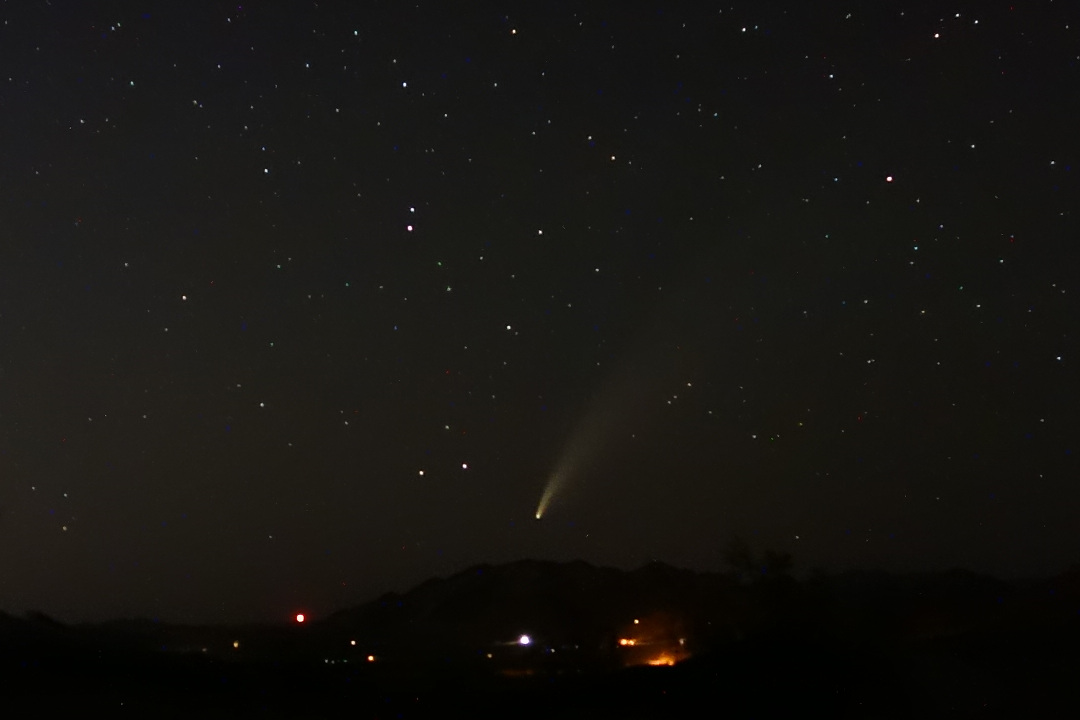
Found details on spaceweather.com:
> There is a bright comet in the morning sky. You probably can't see it with the naked eye, but even short exposures with digital cameras are picking up the starlike head and long tail of Comet Nishimura (C/2023 P1)
> Comet Nishimura is plunging toward the sun for a close encounter inside the orbit of Mercury on Sept. 17th. Increasing heat is causing it to brighten rapidly. Latest estimates of the comet's brightness place it at magnitude +4.5. In a dark sky, this would be visible to the unaided eye, but the morning sky is not dark. Cameras are required to observe the comet; a few seconds of exposure time are enough for a very nice picture.