Great conversation. The best part IMO was Patrick's statement about the importance of the Internet. Agree 100% and never heard anyone express that view so clearly.
"I have an ebullience and love for it in a way that people in our social class in the United States are aggressively socialized out of having ebullience and true love for anything. I think that the internet is the capital G, capital W, Great Work of the human race in a lot of respects, that it is magical. It is an encapsulation of the best things about our society that is also tremendously, instrumentally useful in making all the good things better and ameliorating all the problems over sufficiently long time scales.
It seems naturally to me that this is extremely important. This is extremely valuable, and it seems extremely underrated by almost everyone, including people who would consider themselves great fans of the internet but say, “Oh, I’m a great fan of the internet, but I’m a great fan of penicillin, too.
I think, in aggregate, the internet is obviously more important than penicillin by many orders of magnitude. Is it more important than medicine? I will bite that bullet. The internet is more important than medicine, the entire institution of medicine, from time immemorial to reasonable extrapolations of what we can do right now.
Is it more important than writing? You couldn’t have the internet without writing, so writing was very important to get to the development of the internet. That might be one of the most important things about writing, that writing got us to the internet. That sounds like a little bit of . . . I know people will take that full quote and say, “Oh, this crazy, nonintellectual person,” but I think that there is a reasonable case for it."
I'd take medicine over the internet. That would get us to at least a 1970s/1980s world.
Having zero medicine but the internet would be a very very different world, with people dying left and right from infections, broken bones would not be set crippling quite a few, accidents would be a lot more fatal (also because there would be no understanding of effects and causes of injuries), no wounds would ever be treated, etc etc. It would be a truly bizarre world where humans wouldn't care one bit about damage to and problems with their bodies (but would have highly optimized advertising systems).
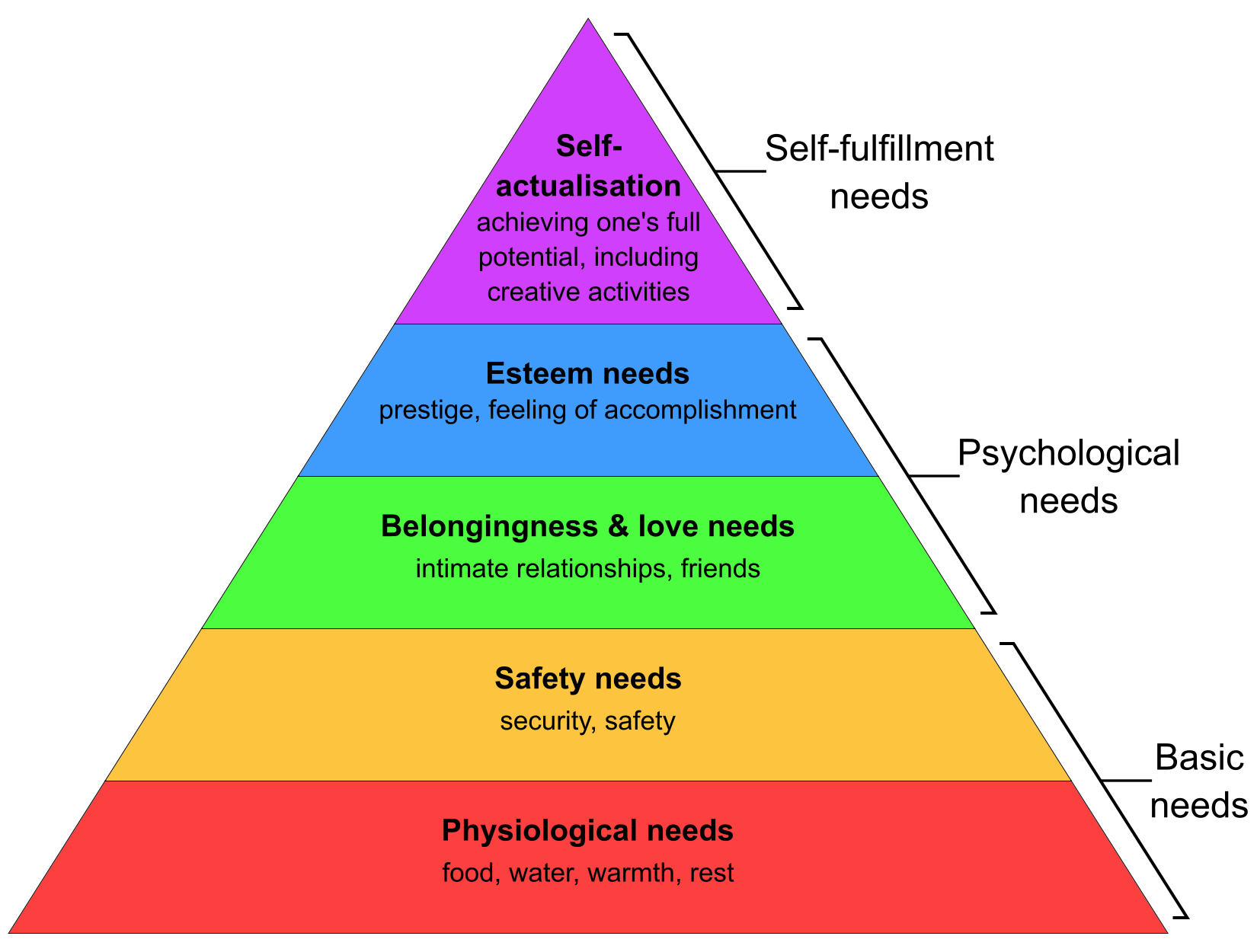
Both sits in different level of the needs hierarchy[1]. First level that is most important is food, water, shelter etc., then second level is medicine, safety etc. Internet is one of the most important invention for the top 2 levels.
You’re mixing up morality of life with impact on humanity.
Medicine is great because it helps save lives (there is “non-medicine” which also achieves some good outcomes here). The internet, the instant exchange of information, is great because it magnifies humanity’s greatest power: mass collaboration. With the Internet, medicine could emerge. At least in the form of exchange of ideas and data, and subsequently spread its positive impact faster. The world’s greatest physician scientists working together.
Also I am guessing the ads bit was hyperbolic but like, common, Google is a verb for a reason. We’ve never had access to information like this before. And this is just focusing on something abstract like “information”.
This seems to imply that most people would die in their 40s from one cause or another before the 20th century, which is patently untrue. This is entirely from infant and childhood illnesses. If you made into grade school in the 1800s you were nearly as likely to live into your 70s as you are 200 years later.
> ‘… life expectancy in the mid-Victorian period was not markedly different from what it is today. Once infant mortality is stripped out, life expectancy at 5 years was 75 for men and 73 for women.’ https://www.ncbi.nlm.nih.gov/pmc/articles/PMC2625386/
However, that is still a world with a lot medicine in there (just take simple things like sutures, inoculations, or setting broken bones). Very difficult to say what life expectancy for adults would have been with zero medicine in the world.
I am thinking quite practical: do I prefer the internet over dying from smallpox or appendicitis, for example?
The added benefit of the internet for mass collaboration isn't that much in the data... why hasn't productivity exploded upward? Why hasn't medical progress gone through the roof? Scientist collaborated long before the internet. Quite strong progress was made without it.
I am certain in some areas it has. but on the other hand in others it has damaged it- screentime is an awesome feature measuring "destroyed" productivity ;)
I think your view has a distorted importance of medicine because you have never lived a live without it. And with that I mean felt the emotions of people going through it, like when your mother dies because of childbirth when you are a kid, your siblings die, because of infections.
Like we have today in all the anti-vaccination guys esp. in better-to-do households that are responsible for measles outbreaks even though it was deemed extinct. People from areas where it was common to have all these kids' diseases, we are not afraid of are much more pro vaccinations...
I can remember a time without the internet and while I really think it is great in many ways, humanity could do fine without it...
Case in point: we got covid-19 vaccines so fast because the DNA sequence of the virus was posted for anyone to download by scientists working at ground zero. Much of the work was done before it was a global pandemic because of that sharing. Pair that with the work done on the mRNA vaccine for a previous coronavirus that didn't go far, and things weren't nearly as bad as they could have been.
This is a problem with trying to name One Most Important Thing. It's usually the synthesis of multiple innovations that makes the revolution.
Is there any evidence that the fact that anyone could look at the genome increased the speed of vaccine delivery measurably and not rather changes in processes for testing and roll-out? The genome data was only needed by a few actors for the vaccine.
Those few actors would have had to wait until it spread somewhere they have visibility in to before they could start a weeks-long sequencing process. It might have only added a month or two, but that's a lot of lives saved.
>> " Its genetic sequence was published on 11 January 2020, triggering an urgent international response to prepare for an outbreak and hasten the development of a preventive COVID-19 vaccine.[182][183][184]"
I haven't checked the citations, but I would expect an edit war if that were controversial.
Maybe a month, maybe not (and we don't have the counterfactual). The quote is not directly implying a speed-up from the publication on the internet vs publication in other forms. The sentence after your quote is pointing to the real speed-up:
"Since 2020, vaccine development has been expedited via unprecedented collaboration in the multinational pharmaceutical industry and between governments.[185]"
It is nonsensical as thought experiments go; we're comparing two things that can't be compared. But just for fun - if we existed in a world with no medicine and the internet, we'd be able to rediscover modern medicine extremely quickly. We might reasonably expect to get further than the current state of the art, in fact, because the initial wild west phase wouldn't be encumbered by overzealous safety regulation and we'd learn more before the legislatures of the world start shutting it down (especially since the baseline would be so horrific, they'd probably have tougher stomachs for some broken eggs while making omelettes).
We ran the reverse (medicine then internet) and it took a long time to get to the internet.
Why would we discover modern medicine quickly just because we have the internet? There is no reason to assume some of the concepts needed would just happen to spring up because of a cacophony of voices on the Internet (and a lot of collaborators would die while you work with them). It could even be bad for progress as all problems get broadcast, loud but wrong voices get huge amplification, etc.
The quote also is including all medicine, not just modern. Cold starting medicine then feels very hard.
Btw, early modern medicine was pretty much unencumbered by regulation - so there would be little change.
It isn't the number of voices; it is the speed and cost of setting up special interest communities. A bunch of health freaks with a penchant for experimentation would get together and start learning things. Not an overnight process but it'd be insanely quick compared to the sluggish speed of the last few millennia.
> Btw, early modern medicine was pretty much unencumbered by regulation - so there would be little change.
Not so; the early work was encumbered by rules against graverobbing. There were some famous advances made by .. someone who's name I do not recall, but he'd have been in trouble if people knew what he was up to.
Yes, there were some rules holding back anatomy to some extent at certain times, but really pretty much free for all in a lot of other areas.
Those health freaks would do the right things why? Why would other communities not seek to stop or block them from doing what they are doing (these experiments would have at times pretty dire consequences)? Why would there be zero rules for what those health freaks are doing? There is just no reason to assume this would just work out.
Why hasn't the internet brought insane advances in science if it is such a force multiplier for it?
> Those health freaks would do the right things why? Why would other communities not seek to stop or block them from doing what they are doing (these experiments would have at times pretty dire consequences)?
It's research and rediscovering a field. Of course they'd get a bunch of stuff wrong. That is how medical research works; people try things that don't work all the time.
And we're imaging a world with presumably no antibiotics. Nobody cares if people are accidentally killing themselves, death lurks behind every shrub.
> Why hasn't the internet brought insane advances in science if it is such a force multiplier for it?
... have I dropped into an alternate universe? The rate of scientific progress is unreal right now. We're progressing at a pace that is unparalleled in human history at a global scale. There is even a risk we'll obsolete the human mind this decade. Something has been force-multiplying scientific progress.
I suppose I should say technological progress rather than scientific, technically science has been slowing down since they've discovered most things. Maybe that was the point of confusion here. But the rate of knowledge dissemination is resulting in massive quality of life improvements that mean outcomes on the ground are improving in unreal ways. Look at the dissemination of things like iPhones for example.
Like in the past people didn't care about things like dissecting corpses?
What technical and scientific progress at unreal rates? The amount of information and data increased, but a lot of other things are highly incremental at best. If the progress is so great, why hasn't productivity increased a lot or life expectancy? Parallel universe indeed.
The idea that we discovered most things has quite a lot of hubris in it, given the vast sways of things we only have a poor grasp on.
Not sure the iPhone is an example of improved quality of life as the effect varies quite a lot between use cases.
science was there long before the internet, and if history teaches us one thing it is, that gaining fundamental knowledge takes time- often generations (where one generation must die for new ideas to spread)
so no, the internet may be good for lots of things, but it would by no means replace the groundwork required over centuries to come up with modern medicine...
Most Doctors look stuff up on the Internet from what I’ve seen, so I’m not sure you can remove one from the other. You can for sure have two Great Works.
All of the resources needed for day to day medicine will fit on a small thumb drive (so any phone) and can be update with just a few hundred megabytes per month (including media). It’s nice the internet makes things easier to get to, but it’s not nearly as critical as implied.
How much has it improved? Where has it improved? If the internet were not there, would that improvement not have happened? Modern medicine definitely existed well before the internet, so the internet wasn't necessary for that to exist.
Just look at how treatment during a pandemic was communicated and evolved in realtime, the whole way we do science today interacts with learning from many people in a much faster and more efficient way.
Luckily these sort of nonsense one or the other positions don’t work in the real world. Clearly it would be much easier to recreate modern medicine with the Internet available than it would be to recreate the Internet if we just had medicine.
Faster, yes, more efficient - not sure and very difficult to measure. We also got a lot more diversity and resistance to measures.
I find the view that recreating modern medicine being clearly easy with the internet dubious. Even more, we did create the internet while having medicine before, not the other way around. Without modern medicine we might not have any internet to start with as the struggle with human diseases and illness might have led to very different time attribution of efforts.
Also, the quote is for all of medicine, not just modern.
sure, but to such a fundamental amount? or was it IT- the internet is not IT, super computers and simulations, databases and so are not the internet...
I like google but google is only as good as the stuff out there, and then finding useful content (that is not popular) is hard, and getting even harder the more content is produced.
People have lived happy lives without the Internet for millennia, in fact I've lived a portion of my life without the Internet and I can remember the "good old days". Life with the Internet is very cool, but it was pretty cool also before it. I won't say that our lives were better before the Internet, but such argument can be made - imagine a world without X, Facebook, TikTok and the scourge of social media; for many people that was a better, slightly simpler world.
Medicine, on the other hand, was responsible for removing an immeasurable amount of pain and suffering from humanity, including having our loved ones (and ourselves) around for much longer. I find hard to believe people would give back antibiotics for anything we have from the post-Internet revolution.
Without medicine, I'd probably have died of a severe throat infection while hospitalized as a pre-internet teenager.
Without the internet, I'd have vastly reduced choice in entertainment.
I'll take the medicine. By many orders of magnitude.
Now if we focus on "sufficiently long time scales" perhaps the internet is going to be the human invention that enables us to get where we need to be. But that's a guess. Perhaps I'm dim but I don't see how the internet is obviously more important than penicillin by orders of magnitude.
It's great that medicine managed to develop despite the Internet not being available at the time. But the next generation of medicine will only exist because of the Internet, and it will be orders of magnitude more advanced.
In the long term, people will look back and say that although medicine did develop first, it only really got serious traction when the Internet and related technologies appeared.
> Without the internet, I'd have vastly reduced choice in entertainment.
This is facetious. Do you really believe that current medical care does not benefit from the Internet at all; that it's only used for entertainment?
Anesthesia, antibiotics, or vaccinations - to take some examples - are all not "serious traction" as far as medicine is concerned? What part of medicine will be get serious traction from the internet?
One could argue that the development of any technology, including medicine, is augmented by the internet allowing people to instantaneously pool knowledge and skills across the entire world. There are obvious benefits to that - the rates of technological development seen since the invention of telephone and fast transportation are sky-high, compared to pretty much the rest of known human history, so it stands to reason that the internet will do the same but even better. Would have we seen a COVID vaccine (or rather, multiple vaccines) in a matter of mere months, without the internet? Probably not - it took decades to get a vaccine for influenza.
Looking back, I don't think we'll look at it like "the internet allowed us to create technology X and Y", but rather "the internet turned our tech development rates, across the board, into hockey sticks steeper than we'd ever seen before".
So far we don't see that hockey stick from the internet in medicine or even most technologies.
I doubt that the Covid vaccine was developed so quickly because of the internet. The internet might have shaved a little bit time off, but it wasn't instrumental in the vaccine developement as far as I understand it. The development was a huge effort between governments, corporations, and science sitting atop decades of research. Did it make certain communications easier - for sure, but I struggle to see that as anywhere as big as changed processes in testing and roll-out.
Decades of research that was catalogued, indexed, and shared via the internet. We're talking about drastically cutting down on time people the world over would be collectively spending rediscovering the same things. Because of peer review, we can cut down on time wasted pursing things that are flawed.
HN just recently followed the peer review process of LK-99 in basically real-time across the world. The results might seem trivial in hindsight, but it took leading experts the world over a bit of time to pin down and explain what was really being obversed. It probably saved the original authors years of work trying to refine and chase LK-99.
History has shown the time and again, every advancement in communication has been a boon to human progress. Printing press, telegraph, transalantic//transcontinental telegraph cables, telephone, internet...
There's plenty of papers posted here, and a lot of the break through papers are usually made on the shoulders of giants - connecting break throughs in seemingly disconnected disciplines/sub disciplines. HN sees this most frequently in maths papers, and the story is made easily digest able in breakdowns from quanta magazine.
The internet has drastically accelerated the rate of human progress, and now we're on the cusp of removing the language barrier with automatic machine transmission.
I don't doubt the usefulness of the internet but where is the evidence of the "drastically accelerated rate of human progress"? Or rather what data is that translating into? Productivity growth it isn't. Life expectancy it isn't. Real wages it isn't necessarily. GDP growth it isn't really, either.
It'll certainly depend on your yardstick, I agree.
Scientically, technologically, we've seen more progress in under a century than we've seen in millennia. It's maybe easy to hand wave that off on advances in machine computation (computers), but computers are a globally coordinated effort. Foundaries, manufacturing techniques, CS research, etc are coordinated and advanced globally because of the internet.
M-RNA vaccines are the cummulation of a decades of advances. Genetic sequencing was a major advancement, but actually being able to make sense of it and do something with that information, and then to go encode your own M-RNA and trick the body into producing parts of the virus in order to teach it about a virus it's never actually seen is soo far removed vaccines of old, which was basically repeated exposure to a similar, weaker virus.
Could we have gotten here without the internet? Maybe? It's hard to tell, because the road to M-RNA vaccines was paved by decades of global coordination in the fields of CSE, virology, material science, chemistry, physics, etc etc.
And this ignores everything that goes into manufacturing this at scale, coordinating availability/priority, etc.
It's probably easier to look backwards and see what was lost and rediscovered. Feats of architectural engineering, Roman concrete, etc history is full of major advances being independently discovered and lost due to the inability to share, search, and archive information at scale
My problem is that it seems to largely feature on the level of anecdata, but not make it beyond that. It is more a hypothesis like: the rather moderate aggregate progress wouldn't have happened without the internet - but how to show that?
People managed huge coordination efforts before the internet (just take the US in WWII with half the GDP dedicated to war efforts). So claims about the effect of the internet from better coordination there need a lot to substantiate them.
I talked to a guy in vaccine research after the pandemic and asked him why it went was produced so fast. He said that basically we'd already done years of RNA vaccine research but it hadn't been applied yet. We had the solution already at hand, so we got a vaccine quickly. I don't think the Internet was a big factor in why we got it so quickly. (It may or may not have been a factor in why we had the RNA vaccine ready to go at that point in time.)
I mean, great point, but the internet is more than entertainment, in the way that electricity and light is more than movies.
Many people may use a significant portion of their electricity and lights on watching... whatever. But the statistical majority of use cases does not define the medium.
Maybe a less controversial way to say it is "global communication is more important than medicine," but I still like the way patio11 said it.


"I have an ebullience and love for it in a way that people in our social class in the United States are aggressively socialized out of having ebullience and true love for anything. I think that the internet is the capital G, capital W, Great Work of the human race in a lot of respects, that it is magical. It is an encapsulation of the best things about our society that is also tremendously, instrumentally useful in making all the good things better and ameliorating all the problems over sufficiently long time scales.
It seems naturally to me that this is extremely important. This is extremely valuable, and it seems extremely underrated by almost everyone, including people who would consider themselves great fans of the internet but say, “Oh, I’m a great fan of the internet, but I’m a great fan of penicillin, too.
I think, in aggregate, the internet is obviously more important than penicillin by many orders of magnitude. Is it more important than medicine? I will bite that bullet. The internet is more important than medicine, the entire institution of medicine, from time immemorial to reasonable extrapolations of what we can do right now. Is it more important than writing? You couldn’t have the internet without writing, so writing was very important to get to the development of the internet. That might be one of the most important things about writing, that writing got us to the internet. That sounds like a little bit of . . . I know people will take that full quote and say, “Oh, this crazy, nonintellectual person,” but I think that there is a reasonable case for it."