Here is an ELI5 version of what's going on in Ukraine:
Ukraine doesn't have any money, it needs to borrow it. It can ask the west, but the west gives back a list of conditions to be satisfied (human rights, economical, etc) that are incredibly hard for the governmnet to achieve given deeply rooted corruption on all levels.
There is another source for the money: Russia (which, despite some westerners' beliefs, is a very rich country). In return Russia's demands are to make sure that the deeply rooted corruption on all levels works in Russia's favour. That is much easier to achieve.
Hence the recent $15 billion loan from Putin, that officially appears to be unconditional.
Another point I'd like to make is that many people in the east (I come from one of the big industrial cities in the south-east), don't just dislike Europe and like Russia. It's that their jobs literally depend on Russia, most of the industrial exports go straight to Russia, that's why people there are terrified of any sanctions.
> Ukraine doesn't have any money, it needs to borrow it.
Most of the places where something like that's said, it's disingenious. Are people there starving? (From the news, it does not look like so.) If they are not, they have no such need to borrow.
Of course, even if they don't need it, it might actualy be a godd idea to borrow some money. But looks like the people don't think it is.
Do you suggest that if people are not starving but the country has no money to maintain the infrastructure (which in turn is what allows businesses to grow, and creates jobs) they should be made to give up their personal money before any money is borrowed from elsewhere? That's a pretty socialistic approach.
One of the conditions for joining the EU are reforms that require Ukraine to borrow $150 billion from the IMF to "re-structure" the country. Conditions on that include austerity and freezing wages. It's no surprise support for joining the EU is only in the 40-45% range.
sorry, what about policy brutality? kidnappings? tortures? murders? corruption? hiring of thugs? beating of journalists? Dmytro Bulatov was found with a part of his year cut off, cheek slashed and crucified by ukrainian police. The Cossak that was undressed? This isnt just an economic protest, dont reduce to such. Those tendencies finished a long time ago, it has now turned into something completely different.
Of course not. In fact the police brutality towards a few peaceful student protesters was what triggered the mass protests in Kiev and all over Ukraine, it wasn't about any particular agreement as many people wrongly believe. I'm just talking about the Russia vs the West politics in Ukraine.
Ok, it's well-meaning EU vs. corrupt Russia. Culturally, Ukraine seems to be much closer to Russia than to EU. So I think the end result will be similar to what happened with Arabic Spring revolutions, when the West hoped to see Western standards of democracy implanted into foreign cultures that could not possibly adhere to them (although they declared so initially). So I doubt very much that after the association with EU Ukraine will resemble even Poland or Hungary - in terms of economy or levels of corruption. I guess EU realizes that, too, and it's all about geopolitical games with Russia, after all.
No, democracy is not like making Ukranians or Egyptians love baseball, bullfighting and bratwurst. It's not some oddity from western cultures. It means rule of the people as opposed to the rule of some small group of thugs with guns (aristocracy, apparatchiks, the mafia, military dictators, religious leaders, etc). Everyone, everywhere in the world understands that by now.
What is specific to western cultures is that we don't expect the thugs to always prevail. All that talk about democracy as a foreign implant is a glaringly obvious and self serving attempt by the ruling thugs to present the status quo as an inevitability so they can keep lining their pockets without interference by the people. Let's not fall for it.
You seem to think that democracy is some God-given quality, universal to all people, and you can introduce it into any country just by invading it or inducing a regime change in some other way.
I think it is a social institution that can evolve over long time, and only in certain societies, which do not suffer of civil wars, foreign invasions, ethnic or religious conflicts, poor economy, etc. A country that does not have these democratic traditions will not be able to suddenly accept them, simply because there are different traditions of making things work.
As to the slogan "democracy is rule of the people as opposed to a small group of thugs concerned only about their pockets", I assure you that Stalin, for example, subscribed to that, too. It is a very abstract phrase, and you can hide almost anything behind it.
I don't think democracy is God-given, but I think the idea is now deeply ingrained in (almost) all cultures on earth. Not necessarily as a reality, but as a possibility. It's not foreign to Ukraine, that's for sure.
In many countries that are now solid democracies, democracy has not evolved over a long time. It came with a bang and that was possible because the idea was already widespread.
Invading a country for whatever reason is a whole different matter. That's very rarely a good idea and certainly not to enforce or introduce democracy.
But if you find "rule of the people" too abstract then then I can remind you that "culture" is no less abstract. In a globalized information and media society with massive global migration it's not even clear what "foreign culture" really means any more.
By democracy I mean principles like a multi-partite political system, free speech, commitment to securing human rights. I am not talking about freedom as such - surely the idea of freedom is "deeply ingrained" in every person, regardless of culture.
My point was that these principles cannot be just implanted in a country where traditions are very different (e.g, tradition to give some political power to religious leaders), and where the circumstances are very different from the West (e.g., poor economy).
> democracy has not evolved over a long time. It came with a bang and that was possible because the idea was already widespread.
So it was God-given?
> it's not even clear what "foreign culture" really means any more.
On the internet, probably not. But when it comes to actually running a country, factors such as family clans, nepotism, ethnic or religious factions, are still very strong in many countries, and I don't think the internet is going to change this any time soon.
Is all sudden change an act of God in your opinion? I'm talking about revolutions, not miracles. The _idea_ of democracy has evolved over a long time, but most countries did not have a long local tradition of applying it or building institutions at time it became political reality. Britain and the U.S are not typical examples of how democracy is introduced.
In many cases it was an idea that took hold in the minds of a smallish group of political activists and thinkers who observed what happened elsewhere and adapted it. In fact, one of the most pressing problems of those activists has always been how to get "the people" interested in it at all. And most of the time it wasn't democratic principles that got people interested but economic interests.
In other words, the introduction of democracy was rarely very democratic or purely homegrown or very principled or very peaceful or free of foreign influence. The old powers were often toppled under rather chaotic and opportunistic circumstances. That slow cultural process you're describing, which supposedly only works when there are no civil wars, foreign invasions, ethnic or religious conflicts or poor economy, is the exception, not the rule.
Also, the whole concept of "foreign" is flawed when it comes to ideas. Picking up "foreign" ideas and applying them somwehere else has always been part of every culture on this planet, and that has nothing to do with any gods.
Ok, so you don't mean it's the God suddenly introduced democracy in new countries, but revolutions; the revolutions started because the population was unhappy - not about the lack of democracy, but about poor economy. I agree with that. I can also add that the countries where the democratic principles developed slowly and organically (US and Britain) happen to be rich (strong economy is a condition where people can start to think about democracy and human rights, poor economy is where people think about basic security) and it was these countries that induced the democratic changes in other countries (e.g., post-WW2 Germany), using their wealth to stabilize their economies, and eventually transplanting their own democratic traditions to these new countries.
So this works fine as long as the revolution-inducing country is rich enough to sponsor the economy of the country where the revolution is taking place. In addition to economy, there are other factors, such cultural norms (e.g., family clans), that will need to be overcome, but this worked as long as the cultures are not too different (US and Germany, or Western Europe and Central Europe, for example).
So basically, we seem to agree that Western-style democracy is not something that can now be organically implanted in Ukraine, not without massive amounts of money poured into it by the West (which is problematic given the size of the country), and even then this will be difficult because of huge differences in traditions to run a country.
I am not sure about that. Yes, they are oriented towards the West, but they too were in the Russian Empire and Soviet Union for a long time, except Western-most regions that were part of Poland until WW2.
One thing that wasn't mentioned in the article was about the reasoning behind Putin's customs union. Putin is very pro-Soviet Union. He wants to make customs union to make it resemble Soviet Union with Russia as the leader country and others (such as Belarus), former Soviet Union members as satellite countries. He also sees it, as mentioned in the article, as a counterweight to EU, which he views as a threat. So his personal interest in Ukraine goes beyond "care for Russians living in Ukraine". He basically wants to rebuild Soviet Union, and Ukraine is a key component.
Putin's longing for USSR is overrated. I don't believe he gives a rat's ass about USSR.
Customs Union is a block on countries that have deeply integrated economies, common language (unofficially it is Russian) and common background. CU is just as natural and logical as, for example, European Coal and Steel Community formed after 2nd World War. Whether CU will evolve into political union, like EU is trying to do, is unknown. Probably not. So there is no reason to freak out and fantasize about menace of USSR2.
> Putin's longing for USSR is overrated. I don't believe he gives a rat's ass about USSR.
I believe he gives quite a rat's ass about USSR. Remember that Putin saw USSR fall under his own eyes. He not only blames Gorbachev for the destruction for USSR, but basically considers him a traitor for things like not approving violence against occupied states during independence uprisings. Besides the sentiments for USSR, he also is aware that his political power is going to end in some, time, so he wants to be remembered for something big. And he believes that creating something that resembles USSR is that thing. That's why he cares so much about customs union and is willing to basically bribe other countries to join it despite lacking money for Russia itself. That's what happened with Armenia - he "bribed" the country by offering big loan and lower gas prices before it joined EU economic treaty, like Georgia, Moldova did. That's why he offered money for Ukraine in exchange not even for customs union, but just not signing EU economic treaty, which was already prepared and ratified by president of Ukraine.
Putin's main concern after he quits politics is his personal safety, not rebuilding USSR. Nobody in Russia wants back into USSR, an attempt at rebuilding would be futile and suicidal.
As for "bribing" the countries to join CU - that is the whole point of CU, which implies deeper integration, lower trade barriers, lower prices for gas etc. If you don't want to be "bribed", it is simple - don't take the money (and don't blame corrupt politicians, as if there is any other kind). We may question the motives - some countries are natural fit for CU, like Belarus or, potentially, Ukraine. Some, like Armenia come cheap and are more for the show to create an image of successful regional integration. EU does the same thing - Greece is going to be the major headache for years to come, the role of countries like Bulgaria and Romania in EU is entirely unclear (does EU "bribe" them by transferring money to their budgets?). While having core European countries in a union makes perfect sense.
I hope you realize that Ukraine is never going to be an EU member, which makes the whole argument surreal.
The thing is, from economic point of view, Putin makes mistake to pay so much money just for them to participate in the union. And what Putin is known for is careful, very calculated political moves, certainly not charity. So he expects something more from it later.
Besides, saying that Ukraine will never be EU member just exposes your clear bias. Everyone knows it won't join EU for a long time, but if they elect people that work towards it (which is unlikely knowing how chaotic the opposition is) it would be a matter of time till it joins EU.
He expects to build a regional structure based on economics rather then politics in which Russia will play the main role. Portraying it as the second coming of USSR is plain wrong. It is also wrong to assume that there are plans to turn this union into political one - Russia doesn't need the headache of managing Ukrainian, Kazakh or any other nation's internal affairs. To achieve that Russia is willing to spend a few bln here and there to push them in the direction of CU. Again, EU did the same thing with Eastern Europe by accepting them on a super fast track.
I don't have bias, I am trying to see things as they are without cliches. EU is not likely to survive in its current form. One of the main issues with EU is that some countries made it there for political reasons, for which EU is beginning to pay dearly and has no appetite for Ukraine whatsoever. Putin may be making same mistake with say Armenia, but again he is just a bureaucrat like his European colleagues.
I still think Putin is not telling the whole story about his CU yet, and I think EU is in quite good shape. Only some financial problems in southern countries (Portugal, Spain and Greece) and migration problems in UK and maybe to some extent Germany. So it will most likely not only survive, but thrive further.
Even if Putin can't bring Ukraine in, he'd like to keep it out of the European Union, which he sees as an extension of a century-old Western conspiracy against Russia.
It's no secret that U.S. foreign policy is guided by The Grand Chessboard
U.S. control over Ukraine would be a checkmate in controlling Europe and the middle east.
I hate to use the old adage, but this crisis presents a real opportunity. Russia and the EU could work together to sort this out instead of remaining divided. I don't see why the US has a say in the destiny of a country that's divided between Russia and the rest of Europe.
Are Americans so ignorant to justify the publication of such an article?
(OK, I must admit, I had never heard of Mykola Lysenko before.)
* * *
EDIT: it seems this post is getting misunderstood, because I tried (and apparently failed) to shorten the following interrogation.
1. The Washington Post is an American newspaper.
2. The article explains a situation by giving a basic history lesson, and does not contain any new or exclusive information.
3. The title of the article, and the four first questions, are clearly aimed at people who ignore most about Ukraine, including its very existence.
So the target audience is: Americans who do not know anything about Ukraine. My initial assumption would be that this is a small group. However, the average weekday circulation of The Washington Post is above 400,000.
Summing up, it looks like some editors at The Washington Post believe that a lot of Americans are ignorant of facts about Ukraine, possibly including the very existence of a country called Ukraine. In my opinion, such a belief is questionable, hence my original interrogation.
* * *
To go further, I believe that another article could have been written, with all the interesting information from this one, and without the obvious in-case-you-are-not-aware-of-Ukraine part.
I also believe that an equivalent event would not be published in an equivalent newspaper in France, Spain, or The Netherlands. This is why I am wondering whether that kind of articles is specific to American newspapers.
* * *
This all started with me having a question. Despite all the downvotes, I am happy about all the answers that help me better understand American press.
To clarify a few things:
1. This was not an article from the Washington Post newspaper. It was from their online blog group. In many news outfits this is a signal that the output can be in a less formal tone/pass a different set of editorial hurdles.
2. A maxim in the American newspaper business has historically been to write to an 8th grade (12 and 13 year old) audience. They have historically felt that the American newspaper buying audience is ignorant.
3. Ukrainian politics does not receive very much coverage from the mainstream news organizations in the United States. For instance, cnn.com only has 1 story on their front page about the Ukraine and it is well below the fold. Foxnews.com has 1 story but it is headlined with highly sensational text.
So in short, yes I suspect a large part of the United States news paper reading public could use a refresher on the Ukraine protests.
Curiously, in your country how much coverage do you receive of the politics of Texas? How much about the Philippines?
> So the target audience is: Americans who do not know anything about Ukraine. My initial assumption would be that this is a small group. However, the average weekday circulation of The Washington Post is above 400,000.
Keep in mind, there are presently (per Wikipedia) some 206 sovereign states. Excluding the numerous other states that have come and gone throughout history. I would expect, for any given country, most Americans to be ignorant of its history outside of those we have closer historical or geographical ties to (I'd expect more Americans to know the history of England, for instance, than of Bolivia; or Canada versus Nigeria).
So the target audience is: Americans who do not know anything about Ukraine. My initial assumption would be that this is a small group.
Your initial assumption is incorrect.
In any case, one of the great things about online news vs. newspapers is that an article like this doesn't steal page space from another. You can write this and a much deeper dive and release them both.
The only thing most Americans know about Ukraine is that it was former USSR. I actually tried talking about the protests to about 10 different people this past weekend, and none had even heard about them.
Yes, I mostly refer to that first question. I did not get stuck there. I believe you misunderstood my post.
I do not claim Americans are ignorant — I was asking a question anyway, so not claiming anything.
I believe that, by publishing such a basic article, The Washington Post is claiming Americans are ignorant. I am trying to understand that particular phenomenon: why would a respectable newspaper, made for educated people, publish an article intended to the ignorant?
Like you admitted yourself, you also didn't know everything from the article. So your added claim:
"2. The article explains a situation by giving a basic history lesson, and does not contain any new or exclusive information."
Doesn't hold in my opinion. The article is more than "basic" for anybody not following Ukraine permanently.
Still can I agree with you if you consider the article tone a bit insulting to the reader. I find it a strange etiquette, openly writing to the reader as he's "too simple." But I believe enough readers consider it a joke, exactly on the topic "most Americans don't know anything about the World."
To be fair, I wrote "new or exclusive", not "unknown to me".
The "strange etiquette" you mention is exactly what I was referring to. Except that, to me, it did not feel like a joke, so I wanted to be sure — I am probably not enough used to some aspects of American culture.
"No one in this world, so far as I know — and I have researched the records for years, and employed agents to help me — has ever lost money by underestimating the intelligence of the great masses of the plain people. Nor has anyone ever lost public office thereby."
H. L. Mencken, "Notes on Journalism"
Personally, I think that this rule being taken seriously has done more damage for US culture than just about anything else.
Because even educated people aren't educated in every area of knowledge. Your average American newspaper reader doesn't know too much about Ukraine. That's not a good or a bad things, just a fact. Much like I don't expect an average European newspaper reader to know too much about Kentucky or Paraguay.
And in the service of serving the audience, providing some background in an approachable listicle format is quite useful. Especially considering that many readers probably know that Ukraine is in the midst of turmoil, but they may not understand the root causes.
Why so much Ukraine on HN? Protests are happening almost everyday in some european country. No Thailand protests covered here. Why the hysteria about Ukraine here?
Ukraine is geo-politically an important region, and has long history of being a part of the chess-board of empire building in Europe. It's not a value judgemnet, it's just more things are in play and the outcomes are more consequential. Thailand is a unique place, and is historically more self-contained, so the politics of Thailand don't have the ripple-effects, in terms of security implications for the region. Thailand, for example, was never conquered by a European power. So it lacks the baggage of post-colonialism, and whilst has its own intriques, they are more unique to the country iMHO.
(You were probably asking a rhetorical question, but these are worth considering for those who are not aware of them.)
Maybe there are a lot of Ukrainians on HN. Considering that Ukraine has a lot of developers and internet access there is one of the fastest and cheapest in the world.
Yes, Ukraine has one of the largest IT outsourcing economies in Europe. That may be far from the start-up world of Silicon Valley, but that somewhat affects the US IT industry.
Yeah, these medieval brutality scenes show how desperately the government wants power and this fact reveals that Ukraine is fighting not against Russia or supporting joining EU, but for their human rights. Apart from being obviously political it's also an anti-corruption revolution. The whole legislative body is corrupted to issue laws dated by Jan 16 2014. The whole judicial system is criminal to put people to jail for carrying a Maidan badge with them or wearing a helmet. There are no good words about local police and special troops who arrest, torture and kill the innocent. There are 2 main questions to ask: how did this massive criminalization happen? and is there a peaceful way out?
Thailand notwithstanding, are any of these other protests building improvised forts in the streets of a major city or taking over government buildings around the country?
Edit: 001sky has the better, less flippant reason.
Well, it might not be the same, but in Mexico there are so called self-defense groups, that try to fight against organized crime. They are armed groups of civilians that took control of entire towns and their surrounding areas, to stop the cartels from doing as they please.
They have gunfights with cartels and when they successfully drive them away, they pickup armored vehicles, guns and money, and everything else the crime groups leave behind.
The situation is so delicate that not even the army wants to try to fight these groups. They are negotiating and having meetings and all (I'm guessing the social cost of just obliterating these groups is too high; we are talking about 3 thousand armed people ready to get into action in 15 minutes, that's a lot of guns and civilians that you just can't bomb away with no repercusions. Not that the government can't, but it's too pollitically and socially costly), but the army nor the police or any other government authority have control of those areas. I believe that's a notch above improvised forts in the city's streets.
So, my point is not to compare both conflicts as if one was "above" the other, both problems are nasty and very bad things that are happening right now, however like someone said in a similar story posted days ago, this is not a political forum to the extent where it has nothing to do with technology or hacking, in any sense of the word, unless you want to consider social protest as a form of "government hacking" or "societal hacking", but then not only one country's conflict should be posted, but conflicts from all over the world.
I'm guessing part of this trend of having social and political issues popping up in technology news sites (HN, Slashdot, etc) is that, as would be expected, social unrest is highly tied to communication technologies such as Facebook, Twitter, YouTube, etc, and that overlap is what brings social unrest news to the frontpages of techonology-related sites. The most obvious example I can think of is the conflicts in Egypt and how they came to be.
But alas, I think my point still stands in that Ukraine's conflicts are in no way (that I can see) more related to techonology news, than say Mexico's conflicts, and those haven't been covered in HN, so I fail to see what is so special about Ukraine that gets to be posted several times in the past few days.
Maybe someone can enlighten me on this? I don't intend to underestimate what's happening there or to dismiss the conflicts, but I, like someone else already said, don't come to HN for political news, unless they are somehow related to technology (NSA antics, Wikileaks, etc)
At the risk of putting yet more political news in HN, here are some news in English. I'm not sure how accurate these are as I just skimmed over them.
[Edit: I don't know how accurate these are, but they are from 'reputable' sources I think, but I guess that depends on your personal opinion. It's not the HuffPo though.]
I live in Mexico so I have access to news coverage and even YouTube videos of the self-defense group's leader himself, which I will link below, but it's in Spanish. Maybe if a couple of people ask for it I can do a transcription in English.
Interviews with one of the leaders of one of the groups, in Spanish. (there are different groups in differente cities/town which don't have any connection between them. They are all independent as far as I know, not organized toghether yet).
It's heart-breaking, but one of the most impressive and wicked things he says is, if you forward to minute 6:57, he explains how, even when the cartels where in the area since a lot of years already, civilians got fed up when this happened, and I'm quoting:
"The problem blew up when they [cartel members] came to your house and told you 'I like your wife, I'll bring her back in a moment. But in the meanwhile go get your girl a bath [girl meaning your daughter, around 10 to 13 years old] because I will be taking her for several days' and then they would not return her to you until she was pregnant. THAT was the reason the situation exploted in Tepalcatepec".
Some minutes before, at 4:28 he explains why he joined the movement. He says that in the month of December only (of 2012 I believe) 14 girls between the ages of 10 and 11 were raped. And all this on top of things like, for every cow that you sell, you had to pay X amount of pesos to the cartels. For every kilo of tortilla, same thing. Basically it was a form of cartel taxes. The thing is he says that even when they had that extorsion thing going on, things were relatively "in peace", meaning that executions and such were just happening between cartel members, and not with the civilian population. And then he explains the quote above, of what made everything blow to pieces...
Now, this Mireles guy is just the leader of the groups in one of the municipalities, namely Tepalcatepec. But other groups are already active from other places as well. Also, you have to take into account that, at least Tepalcatepec, in 2005, it had around 22,000 people. So it's not a big city but it's definitely not just a collection of houses.
That's why I said that things are also quite dark and siniter down here.
Besides the language issue and the politics, I suspect there's also an age issue. From talking to friends there, the younger people want to gravitate towards Europe, as Europe is seen as more progressive and open. While the older people prefer the stability of going with Russia.
Obama's administration has been getting hammered for getting involved in these types of conflicts. Not sure he wants to stretch the US resources any further and is already hesitant to involve US military resources.See Egypt as exhibit A.
Also, it's pretty frustrating when you see countries crying for help, then when we finally send in military and financial aid, they're called "occupiers" and told to leave the country and stay out of their affairs.
I'm of the opinion these places need to figure it out themselves. The US shouldn't be in the position of being a global police force and jumping in every time something breaks out somewhere.
Sometimes I wonder when people say, "Why isn't the US helping out in (insert country here)?" Then turn around and say, "Well, we never should have been in Iraq." and forget about all the things Saddam Hussein did to his people:
Iraq has refused to allow the UN's Special Rapporteur for Human Rights to return to Iraq since his first visit in 1992. The government of Iraq has refused to allow the stationing of human rights monitors as required by the resolutions of the UN General Assembly and the UN Commission on Human Rights. The regime expelled UN personnel and NGOs who, until 1992, ensured the delivery of humanitarian relief services throughout the country.
Iraqi authorities routinely practice extrajudicial, summary or arbitrary executions throughout those parts of the country still under regime control. The total number of prisoners believed to have been executed since autumn 1997 exceeds 2,500. This includes hundreds of arbitrary executions in the last months of 1998 at Abu Ghraib and Radwaniyah prisons near Baghdad.
In the 1970s and 1980s, the Iraqi regime destroyed over 3,000 Kurdish villages. The destruction of Kurdish and Turkomen homes is still going on in Iraqi-controlled areas of northern Iraq, as evidenced the destruction by Iraqi forces of civilian homes in the citadel of Kirkuk
Iraq's 1988-89 Anfal campaign subjected the Kurdish people in northern Iraq to the most widespread attack of chemical weapons ever used against a civilian population. The Iraqi military attacked a number of towns and villages in northern Iraq with chemical weapons. In the town of Halabja alone, an estimated 5,000 civilians were killed and more than 10,000 were injured.
Or maybe we should review life under the Taliban in Afghanistan prior to the invasion?
According to a 55-page report by the United Nations, the Taliban, while trying to consolidate control over northern and western Afghanistan, committed systematic massacres against civilians
UN officials stated that there had been "15 massacres" between 1996 and 2001.[28][29] They also said, that "[t]hese have been highly systematic and they all lead back to the [Taliban] Ministry of Defense or to Mullah Omar himself."[28][29] "These are the same type of war crimes as were committed in Bosnia and should be prosecuted in international courts", one UN official was quoted as saying.[
n 1998, the United Nations accused the Taliban of denying emergency food by the UN's World Food Programme to 160,000 hungry and starving people "for political and military reasons".[152] The UN said the Taliban were starving people for their military agenda and using humanitarian assistance as a weapon of war.
On August 8, 1998 the Taliban launched an attack on Mazar-i Sharif. Of 1500 defenders only 100 survived the engagement. Once in control the Taliban began to kill people indiscriminately. At first shooting people in the street, they soon began to target Hazaras. Women were raped, and thousands of people were locked in containers and left to suffocate. This ethnic cleansing left an estimated 5,000 to 6,000 dead.
Maybe you're right, it would've been better to just stay out of both places. . .
>>>> Your long list qualifies as "asking for trouble"
SPEECHLESS.
So summary executions, starving your own people and using chemical weapons qualifies in your mind as "asking for trouble"? I'd love to see the rest of your Human Rights scale and what you think it takes to get to a level where you think interdiction is needed.
My scale is simple - do not intervene at all. US pretense that they intervened purely on humanitarian grounds is a pathetic lie obvious to the whole world. After they intervened they left a mess that is worse then before. Besides, after infamous appearance by Mr. Powell at the UN providing undeniable evidence of universal evildoing, I think US would be a bit more, ...how should I put it..., careful about spreading justice around the globe.
That's truly a staggering heading to see in an article isn't it. People write scornful things about news services like the Washington Post but to write that in black and white is a sign that it's readership occupy a totally foreign planet to most of the world.
Yes seriously. The US and EU are the reason why Russia sees the need to defends its western borders. This conflict is as much about internal politics in Ukraine as it is about geopolitical failures.
If the EU members would cling less to the US (instead of letting them build a rocket shield in Poland), Russia would possibly have fewer reasons to keep a pro-Russian buffer zone.
I think it is because there aren't two distinct nationalities in play here. Even the Russian-speaking Ukrainians do not want to rejoin Russia; they would prefer to be Ukrainian.
The situation is much closer to the situation in the United States than to those in other central and eastern European cold war countries. While there are strong regional divisions between Democrats and Republicans -- divisions that are rooted in history and culture -- members of each party have large contingents everywhere. And separatism/partition isn't seriously on the table in the USA.
I agree. This is probably the best way to relate the situation to someone in the US. No one would take you seriously here if you proposed splitting "blue" states into a separate country and proposing a split there seems equally far fetched.
Given how integrated the economy and land use is, it is not a reasonable idea in the near term. If you actually were going to divide the US on a red / blue split then it would be more appropriate at a county level[1] and would result in a bunch of city-states and one big land area[2].
1) states are not really granular enough given the existence of "battleground states" and what that means for election divisions
2) LA and SF might want to buy a desalination plant fairly quickly
The split is not red-blue. There are distinct regional cultures in America that might be called nations. Scroll down and look at the county map in the link. Read "American Nations".
Yeah, I saw the MN combined with ND and realized whoever researched it (I do believe the original map is a Russian professor) has no real clue on modern American and is looking mainly at immigration patterns.
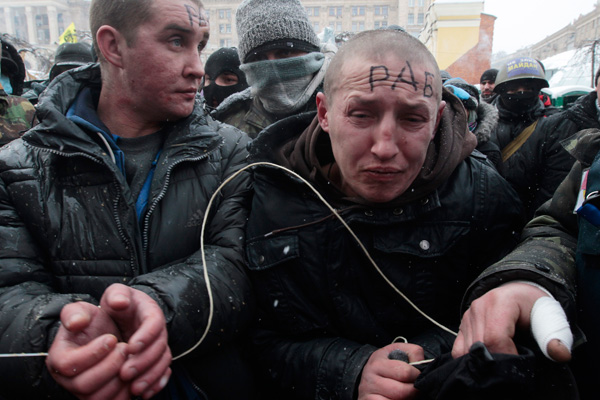
I believe that Crimea (peninsula in Black Sea) wouldn't mind to go back to Russia since it has never been historically a Ukrainian territory. East of Ukraine may not be keen on becoming Russian, but sure as hell they don't want to be ruled by Western Ukraine. Differences between East and West of Ukraine run deep and go far beyond political preferences. West sees East as scum. Period. For example, when Western protestors in Kiev catch youths from the East (they call them 'titushki', or provocateurs), protesters write the word 'SLAVE' on easterners' foreheads with permanent marker: http://icdn.lenta.ru/images/2014/01/27/13/20140127131837914/.... I don't think East and West in Ukraine have any future together.
Russians often ask this question but... (And i heard this thesis two times yesterday said by russians only btw)
- Don't forget about Crimean Tatars who live there and i really doubt they would like to either join Russia or be separated from Ukraine. Why? Lots of them were banished from the island by Russian Empire. Though still a lot of Crimean Tatars are living there now. Also they supported Maydan. http://en.wikipedia.org/wiki/Crimean_Tatars .
- WIKI says the number of ukrainians living in Crimea - 24.32%, russians - 58%, Crimean Tatars - 12 .
- But russians usually don't remember Dagestan(Russia) or the Chechen Republic(Russia) where the number of russians is less than 5%. Or Belgium with german speaking people .
- Ukrainian regions were a part of the Russian Empire for quite a long time. Why would they not join Russia?
- Crimea is an autonomy, but even now people stimulated by politicians say that they want Ukraine to be a federation. Do they know what is the difference between autonomy and federation?
And in addition. Knowing history of the country is crucial here.
If you look at the Russian Imperial Census of 1897 you will see that people living in the eastern part of modern Ukraine were 80-90% ukrainian speaking. And now if you go to the country area of eastern regions you will see lots of ukrainian speaking people.There were 3 man-made famine in Ukrainian SSR conducted by Soviet regime and lots of repressions killed more ukrainians than ukrainians died during the 2 World War. And now guess what Stalin does? He invites russians to the industrial western part of Ukraine. This region required a work force at that time.
So the question is not that simple and clear if you are looking just at big cities like Kharkiv or Donezk.
PS. The myth that Maydan is a question of ukrainians - russians to live in one state is stimulated by politician i believe. It is a question of corrupted government and people who don't want to live in a state with USSR standards.
>Lots of them were banished from the island by Russian Empire.
You either use this as a very politically loaded term for Stalinist Soviet Union (which is a problem with your post on its own right), or you are wrong.
>- But russians usually don't remember Dagestan(Russia) or the Chechen Republic(Russia) where the number of russians is less than 5%. Or Belgium with german speaking people .
Russia and Belgium, unlike Ukraine, aren't nation states. Russia is a multi-ethnic country, which is stated in its constitution.
> Ukrainian regions were a part of the Russian Empire for quite a long time. Why would they not join Russia?
Why should they?
>- Crimea is an autonomy, but even now russians stimulated by pro-Russia politicians say that they want Ukraine to be a federation. Do they know what is the difference between autonomy and federation?
So some Russians say one thing, other Russians say different things, so what? I tell you that there is a great deal of difference between unitary state with some autonomies and federation (which is obvious really, think Spain and USA).
>If you look at the Russian Imperial Census of 1897 you will see that people living in the eastern part of modern Ukraine were 80-90% ukrainian speaking. And now if you go to the country area of eastern regions you will see lots of ukrainian speaking people.
How is the census of 1897 related? You wouldn't say parts of Far East and Siberia, which were predominantly Ukrainian-speaking then should be parts of Ukraine now?
>There were 3 man-made famine in Ukrainian SSR conducted by Soviet regime and lots of repressions killed more ukrainians than ukrainians died during the 2 World War.
Oh, now 3 man-made famines specifically designed to destroy Ukrainian nation, great. What do you think of people of Lower Volga, North Caucasus and Siberia who perished of famine of 1932-1933? I guess you prefer not to notice their existence because they don't serve your political goals of the day.
>And now guess what Stalin does? He invites russians to the industrial western part of Ukraine. This region required a work force at that time.
Yeah, I guess it's also Stalin (a Georgian btw) who put all the iron ore and coal there, just to extinguish all the Ukrainians so when Ukraine becomes independent there are less Ukrainian-speaking people there? What a prophet, wasn't he? Or should he just ignore industrial potential of Eastern Ukraine whatsoever?
This is a really telling example of Russia-directed scare-mongering, I feel uneasy about it, as a Russian.
East also sees West as a land of rural people who do plumbing/maid work in Europe for food and are wicked nationalists/Nazis.
The titushki you mentioned are not shamed just because they're from Eastern Ukraine, but of what they did in Kiev for government money (beatings/vandalism to discriminate Maidan).
So I have to admit that there are some deep cultural differences, indeed. But when I try to imagine two Ukraines, there are so many questions (where to put the border - in any place it would tear apart close regions, there's no clear border, it's a huge gradual gradient from West to East) that I see no feasible answer.
Do you guys consider federalisation as an option? Ukraine seems like a sufficiently big and diverse country for that.
It sure as hell won't resolve the problem of which trade block to join though.
I think because the large majority of the wealth is in the south-eastern Russian-speaking section. From the article, it sounds like that is where all the coal and iron mines are. Not to mention the most productive farmland.
The Russian-speaking section also encompasses the major ports of Odessa and Sevastopol.
So a split down language lines would leave the Ukrainian segment landlocked and with a vastly weakened economy.
That was true about ten years ago and before. Now East has a very inefficient, power-hungry, noncompetitive economy that starts to eat more money for social subsidies than it produces (Yanukovych himself decided recently to make the "pride" of Donetsk regions, state-owned coal mines private because of their unprofitableness). Crimea has been always unprofitable even with its lucrative tourism industry. East views its post-soviet industry as asset whereas West often sees its as liability and drag to the burning need of industry modernization.
>starts to eat more money for social subsidies than it produces
>Crimea has been always unprofitable even with its lucrative tourism industry
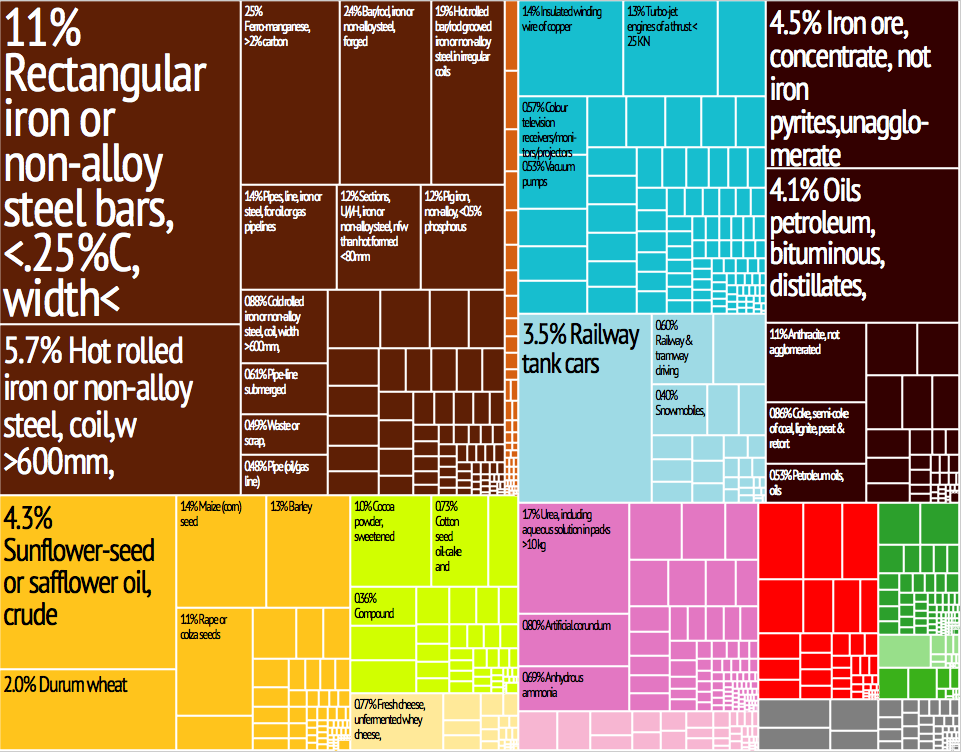
Not a marker of anything, there are only a few oblasts in Ukraine that are profitable (taxes - government spending), until very recently none of them were in the Western part of the country. This may be not the best way to judge contribution of different parts of the country into the economy. If you give a look at exports structure (http://upload.wikimedia.org/wikipedia/commons/1/13/Ukraine_E...), you can clearly see that it is dominated by products of exclusively Eastern industries.
The Slovaks were sort of reluctantly dragged into the union by the Czechs in the first place. The Slovaks were much more Catholic and traditionalist and quite comfortable with the Austro Hungarians.
I don't think they were comfortable with the Austria-Hungary at all. They were oppressed by Hungarians much more than Czechs by Austrians. Slovaks and Hungarians have pretty complicated relations even in present day.
It's a common trait of Europe in XIX century: Pushkin in Russia, Adam Mickiewicz in Poland, Byron in England, Schiller/Goethe in Germany - they're all poets-heroes of the Romanticism Age - they all virtually determined their national cultures for decades. But I agree that Shevchenko's influence was much more profound for Ukraine than Pushkin's for Russia - maybe because the culture and language of Ukraine were the only its remnants at that time whereas Russia always had its state and its history, its army, bureaucracy and its own religion.
Strangely, the article seems to omit this one detail that Kiev is the birth place of Rus (Русь) statehood. Russia, as ruled by the Rurik family begun there. Moscow only came to prominence because the Tatars/Mongols burned other great cities of the time.
This makes assertions of Russian conquest a lot less black and white. Even the languages diverged relatively recently. When you look at spelling of Russian pre-Soviets, same mix of Cyrillic and Latin letters can be seen.
This article presents the narrative from the Zapadentsi (Western Ukraine) view point, but does little to present the other side of the story.
It is an incredibly difficult and complex matter, and the opportunistic politicians and outright crooks are taking advantage of the strife of the population.
Headlines starting with numbers have been around for ages. Often they're seen as lazy or clickbait, but from time to time they can be used appropriately.
The fact that his article has made it so high on HN is interesting to me
1) is it a sad reflection on society today, and an early sign of monetisation of the WP, that a 'distractify/mashable/tweetable' title makes it up the ranks
2) is it scary that a east-west divide story makes it higher than a 'Syria torn in half' story?
3) ... Why am I afraid that intellectually vacuous titles such as ELI5 actually get upvoted?




Ukraine doesn't have any money, it needs to borrow it. It can ask the west, but the west gives back a list of conditions to be satisfied (human rights, economical, etc) that are incredibly hard for the governmnet to achieve given deeply rooted corruption on all levels.
There is another source for the money: Russia (which, despite some westerners' beliefs, is a very rich country). In return Russia's demands are to make sure that the deeply rooted corruption on all levels works in Russia's favour. That is much easier to achieve.
Hence the recent $15 billion loan from Putin, that officially appears to be unconditional.
Another point I'd like to make is that many people in the east (I come from one of the big industrial cities in the south-east), don't just dislike Europe and like Russia. It's that their jobs literally depend on Russia, most of the industrial exports go straight to Russia, that's why people there are terrified of any sanctions.