Here [1] is a map outlining Viking expansion / settlemenets.
Note England, coast of Ireland, Normandy, Southern Italy, the Baltics, Russia. Of these, you may argue that South/South-Western England and Southern Italy was Normans, who, while they had substantial viking ancestry were not all of Scandinavian origin, but the idea that they did not invade and conquer and settle is nonsense.
Certainly they did carry out attacks where the intent was just to pillage too, but they went much further.
In your own map you see they did not conquer much. The places they settled(vikings) were unpopulated and tremendously cold. They settled there because nobody else wanted to live there.
Those places were very poor, nothing compared with France or Italian, Spanish peninsulas. Places like the South of Spain Sicily or Egypt which food outcome could sustain dozens of times the native population.
Scandinavia could be rich today, but before industrial revolution was very very poor.
The former commentary talking as History written by those who "lost" is non sense. In all the green areas of your map, the Vikings eventually lost.
I know nationalism exist today in Scandinavia, like in the rest of countries. They have quality of life today and could idealize how the past was, but Vikings lived a very hard life at the time, and were not that important.
I find it amusing that you keep dragging out Spain, and now Sicily when your earlier comment started with:
> History was written by the winners, as Christians WON most of the battles.
You do realize that Spain, Sicily and Egypt was under Arab during the viking age?
And while you may disagree with including the Normans with vikings, they certainly started out with a large contingent of vikings taking substantial parts of Normandy.
I also don't see how poverty is at all relevant to the discussion.
As for idolizing the viking age, I see more of that from outside of Scandinavia, than within. For starters this idea that the defining aspect of the vikings were raids. The vast majority of Scandinavians during the viking age were farmers and fishermen. And the majority of shipping was trading. Some fringe nationalist segments use viking symbolism, but the vast majority Scandinavian nationalists couldn't care less about the viking age.
That map can't be completely accurate. It shows parts of Iceland and Greenland as settled that are uninhabitable even today. And "frequent raids" in the Arctic Ocean? No..
Look up the Medieval Warm Period. During the Viking Age, temperatures in the North Atlantic were about 1 C higher than today. Interestingly, the end of Norse settlements in Greenland corresponds pretty closely with the end of this warm period, leading into the Little Ice Age.
Its interesting to compare the accounts of the climate and terrain experienced by Leif Erickson in the Vinland Sagas versus Henry Cabot and French explorers who voyaged to the same regions during the 16th/17th centuries.
The Newfoundland base was likely inhabited for only about a decade before being abandoned, but included such features as iron smelting using bog ore near the site.
Each hop was a five to nine day sail for a Viking ship: from Scandinavia to the Faroes; from the Faroes to Iceland; from Iceland to Greenland and then; from Greenland along the coast of Labrador to northern Newfoundland. The Greenland settlements being the permanent populated base to set up the forward base in Newfoundland.
Among the abundant evidence of a much warmer climate at the time, Viking era graves in Greenland are in permafrost. There is no way they dug those in permafrost back then. Digging in cement would be easier.
It is unclear why the Vikings abandoned Newfoundland, though their own accounts suggest that they didn't get along well with the locals.
My own theory is that the only tradable goods the Vikings had that the locals would have wanted were iron items, which the Vikings absolutely wouldn't have wanted to trade (their own accounts say that was strictly forbidden). However, the locals would have been rich in furs, which were extremely valuable in European markets. If you have the element of surprise and superior weapons, along with a rich target, the temptation to raid and steal would have been overwhelming. Raiding and stealing, in turn, would have generated a reaction from the locals, who would have made a sustainable, long term settlement untenable/unprofitable for the Vikings stretched well beyond the limits of a supply line.
After the great human migration out of Africa tens of thousands of years ago, the strands that went to Europe and the strands that went to America finally briefly connected about 1000AD. However, it wasn't for another 500 years that those strands permanently intertwined.


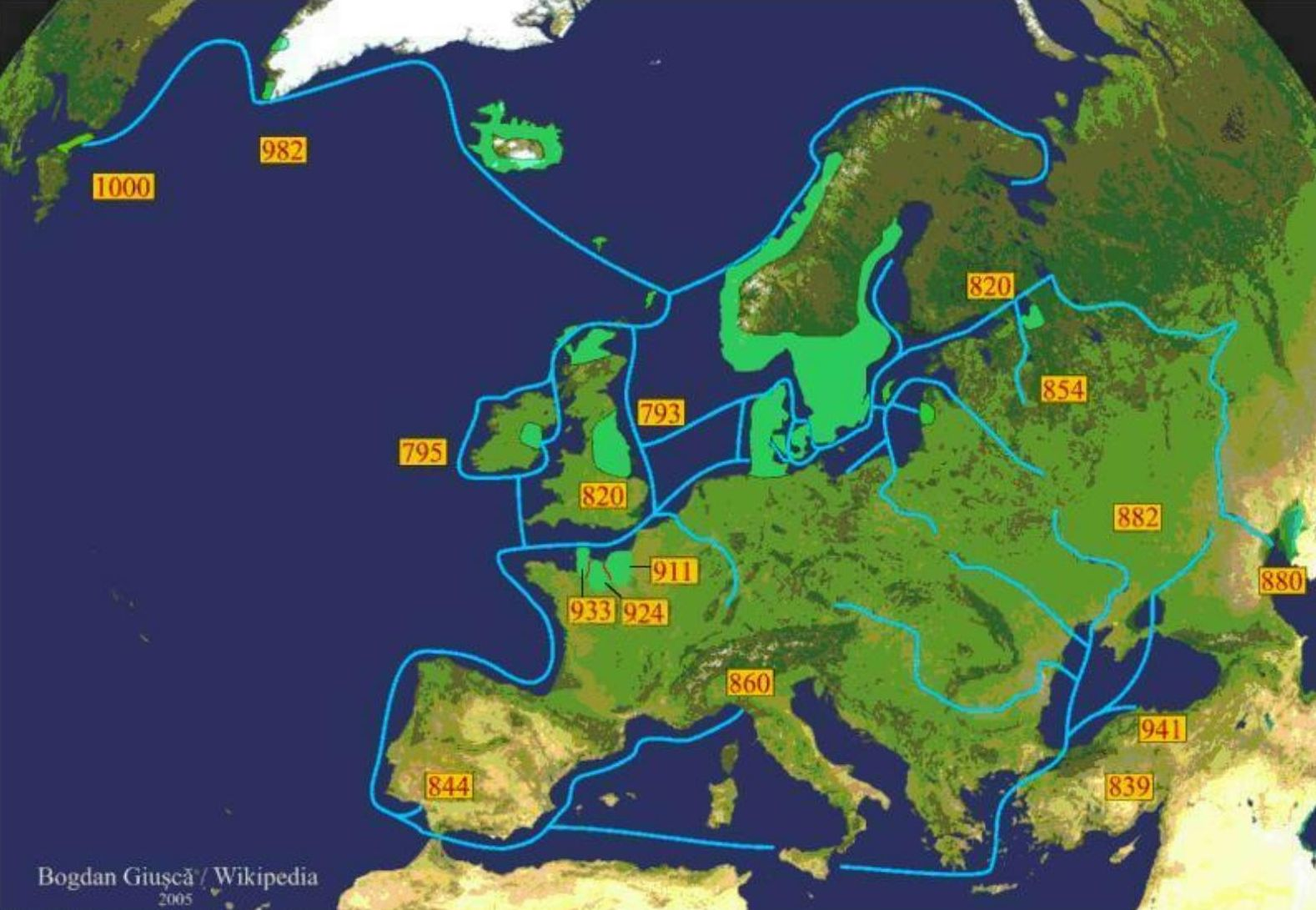
Note England, coast of Ireland, Normandy, Southern Italy, the Baltics, Russia. Of these, you may argue that South/South-Western England and Southern Italy was Normans, who, while they had substantial viking ancestry were not all of Scandinavian origin, but the idea that they did not invade and conquer and settle is nonsense.
Certainly they did carry out attacks where the intent was just to pillage too, but they went much further.
[1] http://en.wikipedia.org/wiki/Vikings#mediaviewer/File:Viking...